The short version
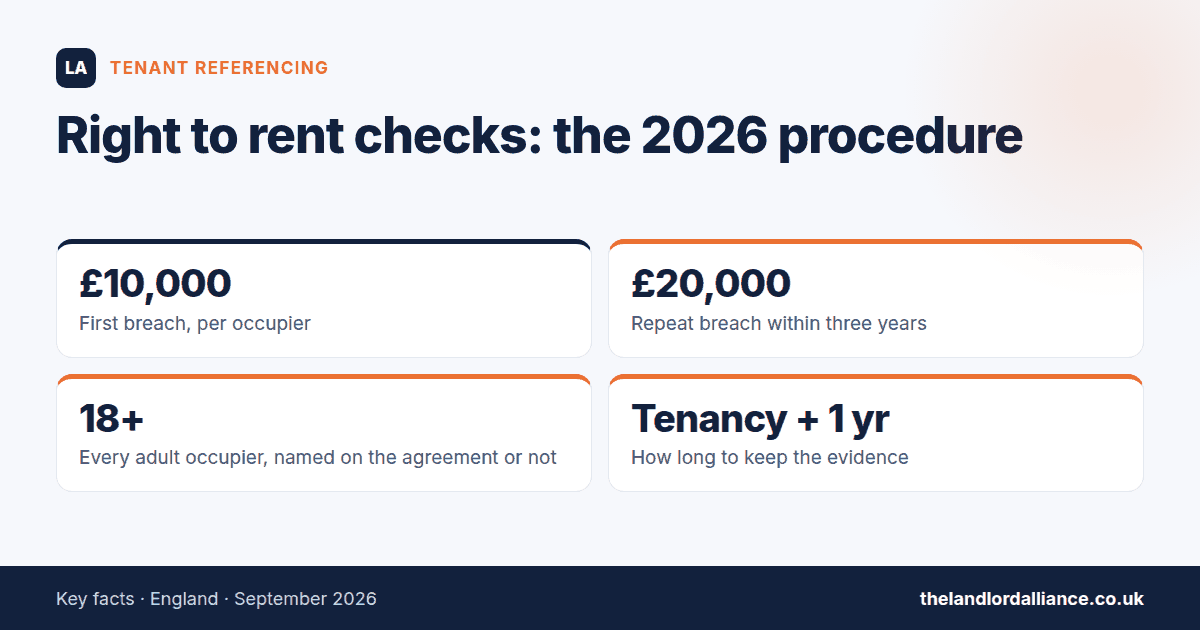
Before an adult moves in, you must check they are allowed to rent in England. Do it properly and you get a statutory excuse — a complete defence to the civil penalty. Skip it, or do it after they move in, and the penalty for a first breach is £10,000 per occupier. There are three ways to check, and which one you use depends on the tenant’s status, not on your preference. Most people with immigration permission now hold it digitally, so the share code route is the common one.
Who you must check
Every person aged 18 or over who will occupy the property as their only or main home. That includes people not named on the tenancy agreement — a partner moving in, an adult child, a friend on the sofa long-term. It does not matter whether they pay you rent.
The check must be completed before the tenancy begins. A check done a week after move-in gives you no statutory excuse for that week, and the excuse is the whole point of the exercise.
Check everyone, equally. It is unlawful to check only the applicants you assume might not be British. It is also unlawful to refuse someone with a time-limited right to rent simply because their status is time-limited. The Home Office code of practice is explicit on both, and discrimination claims are a bigger risk than the penalty for most landlords.
The three ways to check
| Method | Use it for | What you do |
|---|---|---|
| Home Office online check | Anyone with digital immigration status — most visa holders, settled and pre-settled status, eVisa holders | The tenant generates a share code. You enter it with their date of birth on the GOV.UK service and confirm the photo on screen is the person in front of you. |
| Manual document check | British and Irish citizens with a passport, and anyone whose documents are on List A or List B | See the original documents with the holder present, in person or on a video call while they hold the originals. Copy them, and record the date you checked. |
| Digital verification service provider | British and Irish citizens only, where you would rather not handle passports | A certified provider verifies the identity document digitally, often with facial recognition, and gives you the evidence. |
Getting the statutory excuse
The statutory excuse is a defence against the civil penalty, and you obtain it by carrying out a prescribed check correctly before occupation starts. Three things have to be true:
- You did the check before the tenancy began.
- You used one of the prescribed methods, and you satisfied yourself the document or online record relates to the person in front of you.
- You kept the evidence — a clear copy or the online check record, dated — for the duration of the tenancy and one year afterwards.
Missing any one of those and the excuse fails, even if the tenant did in fact have the right to rent. That is worth sitting with: the penalty is for not checking, not for housing the wrong person.
Follow-up checks
If someone has a time-limited right to rent, you must check again before their eligibility period ends. The eligibility period runs to whichever of these falls last:
- 12 months from the date of your original check
- The date their immigration permission expires
- The date the document you relied on expires
British and Irish citizens, and anyone with indefinite leave, have an unlimited right to rent. No follow-up is needed and you should not ask for one.
If a follow-up shows the right has ended. You must report it to the Home Office. Reporting is what preserves your excuse; it does not oblige you to evict, and you could not do so quickly in any event now that section 21 is gone. Report first, then take advice.
The penalties
| Lodger in your own home | Occupier under a tenancy | |
|---|---|---|
| First breach | £5,000 | £10,000 |
| Repeat breach within three years | £10,000 | £20,000 |
| Paid within 21 days | £3,500 | £7,000 |
Separately, knowingly renting to someone disqualified from renting is a criminal offence carrying up to five years’ imprisonment and an unlimited fine. That requires knowledge or reasonable cause to believe — it is not a trap for the landlord who checked in good faith.
Where the scheme does not apply
Right to rent does not apply to social housing, care homes, hospitals and hospices, hostels and refuges, accommodation provided by an employer or educational institution to its own people, holiday lets, or lettings of more than seven years. It does apply to ordinary private lettings, to lodgers, and to sub-lets.
Read next
Do I have to check British citizens?
Yes. The duty applies to every adult occupier. Checking only some people, based on how they look or sound, is unlawful discrimination.
Can I do the check over video?
For a manual document check, yes — the holder must be on the call holding the original documents while you see them, and you keep a dated copy. The online share code check does not require the person to be present in the same way, but you must still confirm the photograph is them.
What if a new adult moves in later?
Check them before they move in. The duty attaches to occupation, not to the tenancy agreement.
Does my letting agent’s check protect me?
Only if you have agreed in writing that the agent takes on the right to rent responsibility. Without that written agreement, the liability stays with you.
How long do I keep the copies?
For the duration of the tenancy and one year after it ends. Then delete them — keeping identity documents indefinitely is a data protection problem of its own.
What if the tenant refuses to provide documents?
You cannot let to them. Without a completed check you have no statutory excuse, and the penalty applies whether or not they turned out to be eligible.
Sources. Home Office code of practice for landlords and their agents: the right to rent scheme (1 October 2026 version); Immigration Act 2014, sections 20–37; Immigration Act 2016; GOV.UK guidance on checking a tenant’s right to rent. Checked 7 September 2026.
Related: Tenant referencing · All guides · Free calculators