The short version
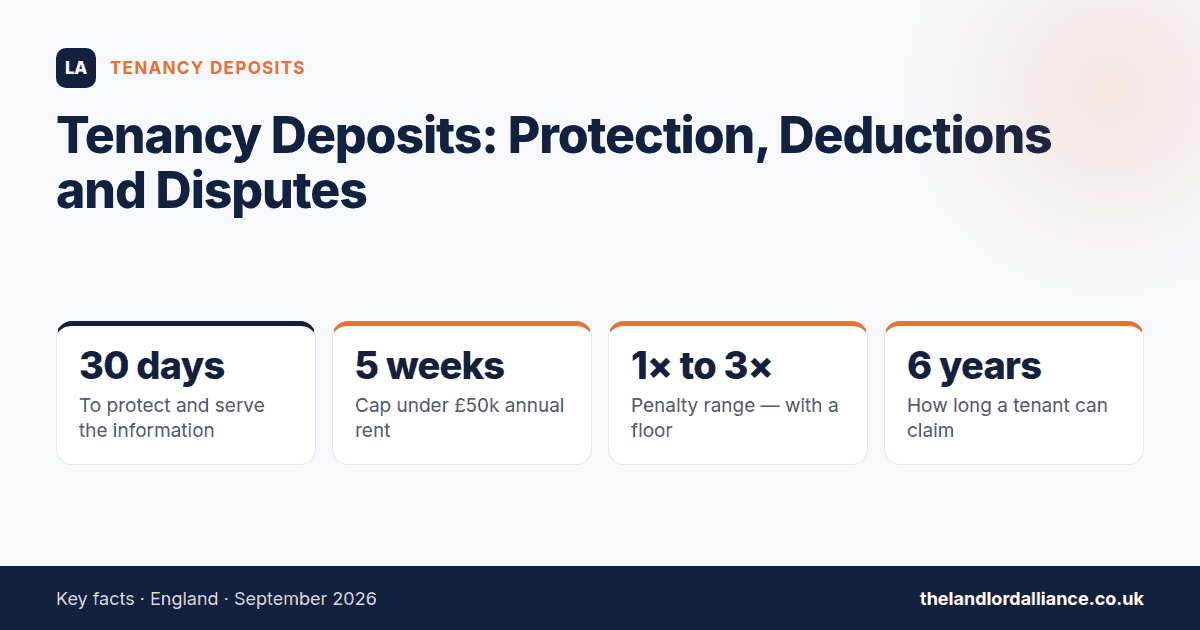
Protect the deposit in one of three authorised schemes and serve the prescribed information within 30 days. The cap is five weeks’ rent (six if annual rent is £50,000 or more). Since 1 May 2026 an unprotected deposit blocks a possession order on almost every section 8 ground — not just the abolished section 21. Protecting late fixes the possession problem but does not remove the penalty, which the court must award at between one and three times the deposit.
Deposits used to be the boring bit of compliance. They are now the single most dangerous thing on most landlords’ files, because the Renters’ Rights Act quietly turned an unprotected deposit from a section 21 problem into a possession problem — and section 21 no longer exists to be blocked.
I’d go further: if you own more than a couple of properties and read only one thing this month, make it this. The hour it takes to check every deposit is protected is worth more than anything else on this site.
The three schemes
| Scheme | Operator | Custodial | Insured |
|---|---|---|---|
| Deposit Protection Service (DPS) | Computershare Investor Services | Yes | Yes |
| mydeposits | Tenancy Deposit Solutions Ltd | Yes | Yes |
| Tenancy Deposit Scheme (TDS) | The Dispute Service Ltd | Yes | Yes |
How much you can lawfully take
Tenant Fees Act 2019, Schedule 1
Before any of the protection rules bite, the amount itself has to be lawful. Two separate caps apply, and both are calculated the same way: the annual rent divided by 52. Not 52.14, and not 365 divided by 7. The intuitive arithmetic produces a figure a fraction over the statutory one, and a fraction over is a prohibited payment.
| Payment | Cap | Provision |
|---|---|---|
| Tenancy deposit, annual rent under £50,000 | 5 weeks' rent | Sch 1 para 2(3) |
| Tenancy deposit, annual rent £50,000 or more | 6 weeks' rent | Sch 1 para 2(3) |
| Holding deposit | 1 week's rent | Sch 1 para 3(3) |
The threshold is the annual rent, not the property value. Six weeks applies from £50,000 a year — roughly £4,167 a month. And there is no pet exception: you cannot take a larger deposit, a separate pet deposit, or require pet insurance.
What actually counts as a deposit
Section 212(8) of the Housing Act 2004 defines a tenancy deposit as money intended to be held — by you or anyone else — as security for the performance of the tenant's obligations or the discharge of their liabilities under the tenancy. "Money" means cash or otherwise, so bank transfers and card payments are money and are protectable in the ordinary way.
What you cannot do is take something that is not money. Section 213(7) says no person may, in connection with an assured tenancy, require a deposit consisting of property other than money. "Property" here means moveable property under s.213(10) — so a car, a watch, jewellery or goods are caught; land is not.
The obscure trap, and it is a bad one. Two consequences follow that gov.uk does not mention. Under s.214(5) the item is recoverable by whoever gave it. And under the new s.215(6) the court may not make a possession order at all until the item is returned — and unlike the main deposit bar, this one is not disapplied for Grounds 7A and 14. A landlord holding a watch as security cannot evict for antisocial behaviour until the watch goes back.
The duty, and the deadline
What you must do
- Protect the deposit
- In an authorised scheme, within 30 days of receiving it
- Serve prescribed information
- To the tenant, within the same 30 days
- Applies to
- All assured tenancies since 1 May 2026, not just former ASTs
- Cap
- Five weeks’ rent, or six if annual rent is £50,000+
- Non-money deposits
- Prohibited outright — you cannot require a car, a watch, anything
The cap is calculated on annual rent, not monthly. One week’s rent is the annual rent divided by 52 — not the monthly rent divided by four. On £1,200 a month: £14,400 ÷ 52 = £276.92, times five = £1,384.61. Anything above that is a prohibited payment. Work it out with the deposit cap calculator.
There is no such thing as a lawful pet deposit. Money held as security is a tenancy deposit whatever you call it, so a “pet deposit” simply counts against the same five-week cap — and anything above it is prohibited. You also cannot require the tenant to buy pet damage insurance; that clause was removed from the Bill before it became law. Your only levers are the ordinary deposit, the rent, and a damages claim at the end.
What changed on 1 May 2026 — and why it is worse than it looks
Two changes, and the second is the one that catches people.
Protection now applies to all assured tenancies. The old rules were written around assured shortholds. Since ASTs no longer exist, the Act extended the regime to assured tenancies generally.
The bar moved from the notice to the order. This is the important one. The old rule stopped you serving a section 21 notice on an unprotected deposit. The new rule stops the court making a possession order — on any section 8 ground except the two antisocial behaviour ones.
| Before 1 May 2026 | Now | |
|---|---|---|
| What was blocked | Serving a section 21 notice | The court making a possession order |
| Which grounds | Section 21 only | Every section 8 ground except 7A and 14 |
| When you find out | Before you serve — cheap | At the hearing — after fees and months |
| Ground 8 arrears affected? | No | Yes |
So a tenant can be four months into arrears, you can have a textbook ground 8 case, and the court cannot make the order. It is a hard bar, not a factor the judge weighs.
The government’s own guidance omits the exception. The landlord overview on GOV.UK describes the possession bar without mentioning that grounds 7A and 14 escape it. They do — serious antisocial behaviour and nuisance grounds are expressly carved out. Worth knowing if that is the situation you are actually in.
Curing a lapse: what it fixes and what it doesn’t
This is the most commercially important distinction in the whole topic, and it is widely got wrong.
| Action | Lifts the possession bar? | Removes the penalty? |
|---|---|---|
| Protect the deposit late | Yes — the statute says “whether or not within the period” | No |
| Serve prescribed information late | Yes — the 30-day limb is deliberately omitted from the bar | No |
| Return the deposit in full | Yes | No |
| Return it with agreed deductions | Yes | No |
So if you discover a lapse: protect it immediately, because that restores your ability to get possession — and budget for a possible award anyway.
The penalty is not “up to” three times
You will read everywhere, including on GOV.UK, that a court “may order you to repay up to three times the deposit”. That understates the position and it matters.
The statute says the court must order a sum not less than the amount of the deposit and not more than three times it. The discretion is over where in that band the award lands — not over whether to award at all. On a £1,400 deposit that is a floor of £1,400 and a ceiling of £4,200, payable within 14 days.
The tenant can bring the claim after the tenancy has ended, and the limitation period is six years running from the breach — not from when the tenancy finished. On a portfolio with rolling tenancies a fresh breach can arise on each one, so “six years” is not a clean cut-off.
Full detail, including what the courts have actually awarded and where the case law currently sits: unprotected deposit penalties.
The prescribed information, item by item
SI 2007/797, article 2(1)
Protecting the deposit is the half everyone remembers. Serving the prescribed information is the half that generates the claims — and it carries the identical penalty, because s.214 refers to "section 213(3) or (6)" in the same breath. A landlord who protected perfectly on day one but never served compliant information faces exactly the same mandatory award.
It is a longer list than most landlords serve:
| Article | What must be given |
|---|---|
| 2(1)(a) | Name, address, telephone number, email and any fax number of the scheme administrator |
| 2(1)(b) | The information in the scheme administrator's own leaflet explaining ss.212–215 and Schedule 10 |
| 2(1)(c) | The procedures for paying and repaying the deposit at the end of the tenancy |
| 2(1)(d) | The procedures where either party is not contactable at the end — which includes a party whose whereabouts are known but who is not responding |
| 2(1)(e) | The procedures where the parties dispute the amount |
| 2(1)(f) | The facilities for resolving a dispute without going to court |
| 2(1)(g) | The tenancy-specific details: amount, address, your contact details, the tenant's (including contact details for use after the tenancy ends), any relevant person's, the circumstances in which you may retain part of the deposit by reference to the terms of the tenancy, and a signed certificate |
That certificate has to confirm two things: that the information is accurate to the best of your knowledge and belief, and that you gave the tenant the opportunity to sign a document containing it. Where an agent complied with the initial requirements, several of these references can be read as the agent rather than you.
Renewals, replacements and the tenancies still on the old rules
Two provisions decide whether a continuing tenancy needs the whole exercise repeating.
Replacement tenancies — s.215B
Where the deposit was properly protected and the prescribed information properly given for an original tenancy, and the same deposit continues to be held in the same scheme for a replacement tenancy between the same parties for the same premises, the s.213 requirements are treated as complied with for the new tenancy. This is what neutralises the old Superstrike problem going forward.
Legacy assured tenancies
Schedule 6 paragraph 11 of the Renters' Rights Act disapplies the whole of the section 26 rewrite for a tenancy that, immediately before 1 May 2026, was an assured tenancy that was not an assured shorthold. Those stay on the old regime permanently. Rare, but if you hold one, none of the new section 215 applies to it.
Change any one of those four elements — a different deposit, a different scheme, a new tenant joining, a different property — and s.215B does not apply. Treat it as a fresh deposit: protect it and serve the prescribed information again within thirty days. Tenant swaps in a house share are the usual trip-hazard, and since 1 May 2026 every tenancy is periodic, so they happen outside a fixed term by definition.
The compliance timeline
| When | What has to happen |
|---|---|
| Before you take it | Check the amount against the cap. Five or six weeks' rent, annual rent divided by 52 |
| Day 0 | You receive the deposit. The clock starts on the date of receipt, not the tenancy start date — unless a holding deposit was applied to it, in which case it starts on the date of the agreement |
| By day 30 | Comply with the scheme's initial requirements — s.213(3) |
| By day 30 | Serve the prescribed information, in the prescribed form, on every tenant and every relevant person — s.213(5) and (6) |
| Keep | Proof of both, and of what the property looked like at check-in. That evidence decides any later deduction |
| On renewal | Check s.215B applies. Same deposit, same scheme, same parties, same premises — or start again |
| At the end | Repay, or claim with evidence. Disputed sums go to the scheme; agreed sums are released |
Where the law is still moving
One question sitting over all of this is unresolved. Lowe v The Governors of Sutton's Hospital in Charterhouse is before the Supreme Court, with a hearing listed for 3 November 2026, on two points about defective prescribed information: whether the requirement is satisfied where the landlord refers to a clause in a tenancy agreement that was not attached and whose numbering was wrong, and whether the confirmation requirement is met where only a covering letter is signed and the certificate itself is not.
The Court of Appeal decided both in the landlord's favour in 2025, applying the "reasonable recipient" principle — an obvious error is one a reasonable recipient would see through. The Court of Appeal built on that again in Hamer v Levy in May 2026, where information with a wrong address, a wrong digit in a phone number and no signed certificate was still held sufficient.
That is the position landlords currently rely on, and it may not survive. If the Supreme Court reverses, every landlord whose prescribed information contains an error or an unsigned certificate is re-exposed. The sensible response is not to wait for the judgment — it is to check your paperwork now, while a defect is still cheap to fix.
The deposits hub
Questions
Do I need to re-protect deposits taken before 1 May 2026?
Existing protection carries over — the tenancy converted, the deposit stayed where it was. What changed is the consequence of never having protected it properly in the first place.
Can I take a bigger deposit for a tenant with a pet?
No. The cap is on the deposit however you label it. Pet deposits and required pet insurance are both unlawful.
What if I took a deposit above the cap?
The excess is a prohibited payment and must be returned. Do that before you go anywhere near a possession claim.
My tenant is refusing to agree deductions. What now?
Use the scheme’s free adjudication — but note both parties must consent, and the decision is legally binding. See deductions and disputes.
I protected it 40 days late three years ago. Am I exposed?
Potentially, yes — the six-year clock runs from the breach. Protecting late restored your possession position but not the penalty exposure.
Can I take something other than money as a deposit?
No. Requiring a non-money deposit is prohibited, and the court cannot make a possession order until the item is returned.
Every deposit, checked in one place
Which scheme, protected when, prescribed information served on what date — held against each tenancy, so the answer takes seconds instead of an afternoon in the filing cabinet. £10 a month, cancel anytime.
See what’s includedDeposits and arrears pull against each other. Applying the deposit to rent arrears reduces the arrears figure — and Ground 8 tests that figure again at the hearing, so it can defeat your own mandatory ground. See the rent arrears process for the sequencing, and the threshold checker for the numbers.
England only. Position as at 31 August 2026. General information from a landlord, not legal advice. Deposit penalties are awarded by the courts and the sums are significant — take advice if you have a live lapse.
Sources: Housing Act 2004 Part 6 Chapter 4, ss.213–215 as amended by Renters’ Rights Act 2025 s.26; Tenant Fees Act 2019 Schedules 1 and 2; SI 2026/421; the three schemes’ Joint Guide to Deposits, Disputes and Damages.