The short version
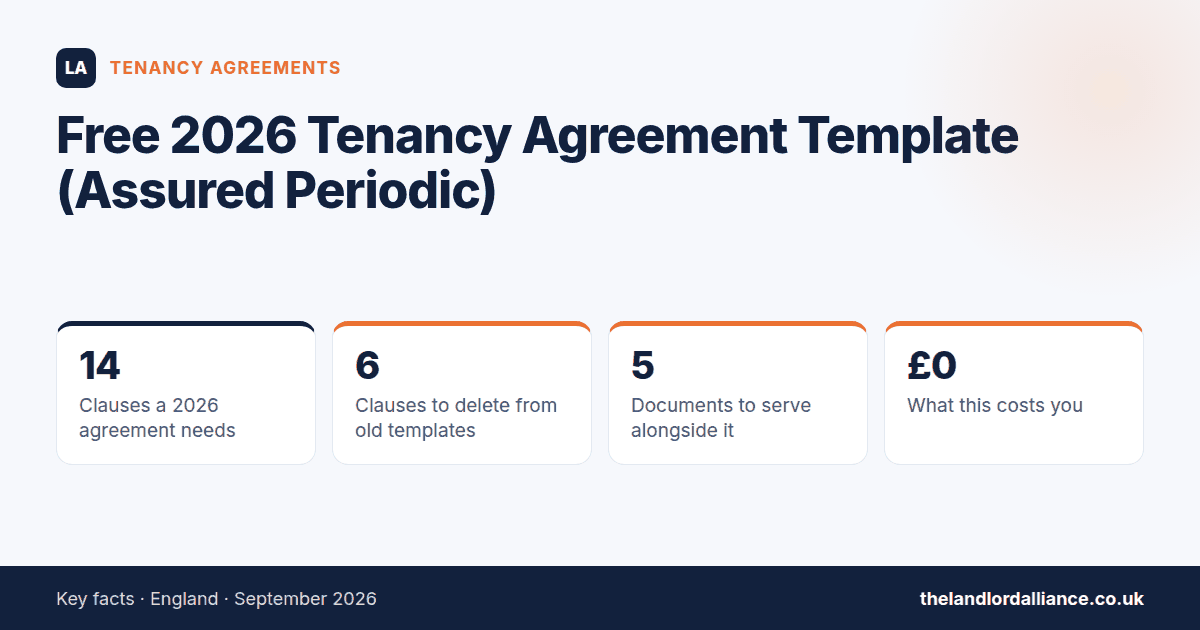
A compliant 2026 tenancy agreement is an assured periodic tenancy agreement — no fixed term, no break clause, no rent review clause, no blanket pet ban. The full clause list is set out below, free and ungated, so you can check your own agreement against it or build one. Most templates still circulating are pre-May 2026 ASTs, and several of their standard clauses are now either legally inert or an active liability.
Most “free tenancy agreement template” pages want your email address before they show you anything, and half of them hand over a document that still says Assured Shorthold Tenancy across the top. So here is the whole thing on the page, no form, no gate. Check yours against it or draft from it.
Part 1 — What the agreement must contain
For any tenancy granted on or after 1 May 2026 you must give the tenant a written statement of terms. For most landlords the agreement and the statement are the same document, which is the simplest way to handle it.
| # | Clause | What it must say |
|---|---|---|
| 1 | Parties | Full name of the landlord and every tenant. All joint tenants named individually |
| 2 | Property | Full address, and what is included — parking, garden, outbuildings, any excluded rooms |
| 3 | Type of tenancy | An assured tenancy that is periodic. State the period, normally monthly |
| 4 | Start date | The date the tenancy begins. No end date — there isn’t one |
| 5 | Rent | Amount, the period it covers, the day it is due, and how it is paid |
| 6 | Rent increases | That rent may be increased by section 13 notice, not more than once every 52 weeks |
| 7 | Deposit | Amount, which scheme protects it, and when prescribed information was given |
| 8 | Landlord’s obligations | Repairs under s.11 Landlord and Tenant Act 1985, safety certificates, quiet enjoyment |
| 9 | Tenant’s obligations | Pay rent, use as a private residence, no damage, report disrepair, allow access on notice |
| 10 | Access | At least 24 hours’ written notice, reasonable hours, except genuine emergency |
| 11 | Ending — tenant | At least two months’ notice, unless a shorter period is agreed in writing |
| 12 | Ending — landlord | Only on a section 8 ground, with the notice period for that ground |
| 13 | Pets | Tenant may request; consent not unreasonably refused; response within 28 days |
| 14 | Address for service | An address in England and Wales where notices can be served on you |
Part 2 — What to delete
These appear in almost every pre-2026 template. The first group does nothing; the second group is worse than nothing.
Inert — remove for tidiness
- Fixed term of any length
- Break clause
- Rent review or annual uplift clause
- Quarterly or six-monthly rent periods
- Any reference to section 21
- Renewal or extension provisions
Liability — remove urgently
- Blanket “no pets”
- “No DSS” or “no benefits”
- “No children” or “professionals only”
- Six or twelve months’ rent in advance
- Pet deposit or pet rent
- A requirement to take pet insurance
On pet insurance specifically: the provision allowing landlords to require it was removed from the Bill before it became law. It is not in the Act. A great many templates and briefings still include it because they were drafted against the 2024 draft. You cannot require pet insurance, and you cannot take a pet deposit. More on pets.
Part 3 — Serve these alongside it
The agreement on its own is not enough. Get these served at the outset and keep the record of service — several of them affect your ability to obtain possession later.
| Document | When | If you don’t |
|---|---|---|
| Gas safety certificate | Before occupation, then annually | Criminal offence. Affects possession |
| EICR | Before occupation, then every five years | Civil penalty up to £30,000 |
| EPC | Before occupation | Civil penalty |
| Deposit prescribed information | Within 30 days of receiving the deposit | Bars possession, including section 8 |
| How to Rent guide | At the start of the tenancy | Affects possession |
Part 4 — Getting it signed
Nothing exotic required. Electronic signature is fine and is what most landlords now use. What matters is that you can later evidence what was signed, by whom, and when.
Do
- Every joint tenant signs
- Date it
- Give each tenant a copy immediately
- Keep the signed original in the property file
- Record the date each certificate was served
Also worth doing
- A dated photographic inventory before move-in
- Meter readings, photographed
- A signed schedule of condition
- Note the contact address for each tenant
The inventory has quietly become more important. With pet deposits gone and pet rent prohibited, the ordinary deposit and the evidence supporting a deduction are the only mechanism you have left for damage. A vague inventory was survivable when you could charge extra up front. It isn’t now.
Questions
Do I have to use a written agreement?
You must give a written statement of terms for a new tenancy. A verbal tenancy is still a valid tenancy, but you’d be starting in breach of an obligation.
Can I add my own clauses?
Yes, provided they don’t conflict with the Act or the unfair terms rules. A clause that tries to remove a statutory right — a longer notice period for the tenant, a penalty for leaving — has no effect.
Can I still say the tenancy is for twelve months?
You can write it. It does nothing. The tenancy is periodic and the tenant can give two months’ notice from day one.
What about a guarantor?
Still available and still worth having. Note that a guarantor is not liable for rent falling due after the tenant’s death — that changed under the Act.
Does this work for an HMO?
The tenancy structure is the same, but HMOs carry additional licensing and safety requirements this page doesn’t cover.
Is this template legal advice?
No. It is a checklist from a landlord who has been through the transition. For anything unusual — a company let, a mixed-use property, an existing dispute — take advice.
Want it as a document rather than a checklist?
Members get the full 2026 agreement in Word and PDF, plus the notices, prescribed forms and compliance checklists — all kept current as the law changes. £10 a month, cancel anytime.
See what’s includedEngland only. Position as at 20 August 2026. General information from a landlord, not legal advice. This checklist is a starting point, not a substitute for advice on your specific circumstances.
Related: tenancy agreements in 2026 · periodic tenancies · what happened to ASTs · the Renters’ Rights Act