The short version
To check a right to rent share code you need two things: the code and the tenant’s date of birth. You enter both at the GOV.UK checking service, which is free and has no limit on how many checks you run. It returns a page telling you whether the person has an unlimited or a time-limited right to rent, with their photograph. Satisfy yourself the photograph is the person renting from you, then save the result with the date of the check. Do it before the tenancy starts — and where the tenant’s permission to stay has an end date, within the 28 days before it starts.
Most guidance on right to rent explains the scheme. Very little of it covers what actually happens once you are sitting there with a code in front of you, which is the moment most landlords are in when they go looking. This page is that part: the check itself, what the result screen means, and what you have to keep afterwards. For the wider picture — who you must check, the three permitted methods and where the scheme does not apply — see right to rent checks.
What you need before you start
Two things, and a surprising number of things you do not need.
| You need | You do not need |
|---|---|
| The share code, beginning with R | An account, a login or a subscription |
| The tenant’s date of birth | Copies of their passport or biometric card |
| The tenant present, in person or on a live video call, so you can match the photograph | A fee — the GOV.UK service is free and unlimited |
A right to work code will not work. Right to work codes usually begin with W and right to rent codes with R. Each service only returns the information relevant to its own check, so a W code entered into the right to rent service simply fails. If a tenant sends you one, ask for a right to rent code specifically — see right to rent share codes for how they generate it.
How to check a share code
- Open the GOV.UK service to check a tenant’s right to rent using their share code.
- Enter the share code and the tenant’s date of birth. Nothing else is asked for.
- Read the result. It will state whether the right to rent is unlimited or time-limited, and if time-limited, the date it ends.
- Look at the photograph and satisfy yourself it is the person who will be living in the property. Do this with them present or on a live video call — not from a photo they emailed you. This step is part of the check, not an optional extra.
- Save or print the result page, including the date you carried out the check.
If the tenant can prove their right to rent with an acceptable original document instead, you cannot insist they use the online service. The reverse is also true in one specific case: you can no longer accept a biometric residence permit or card as a document. If a tenant holds one, the card is now only a way for them to generate a share code, and the code is what you check.
What the result tells you
| What the result says | What it means | What you do |
|---|---|---|
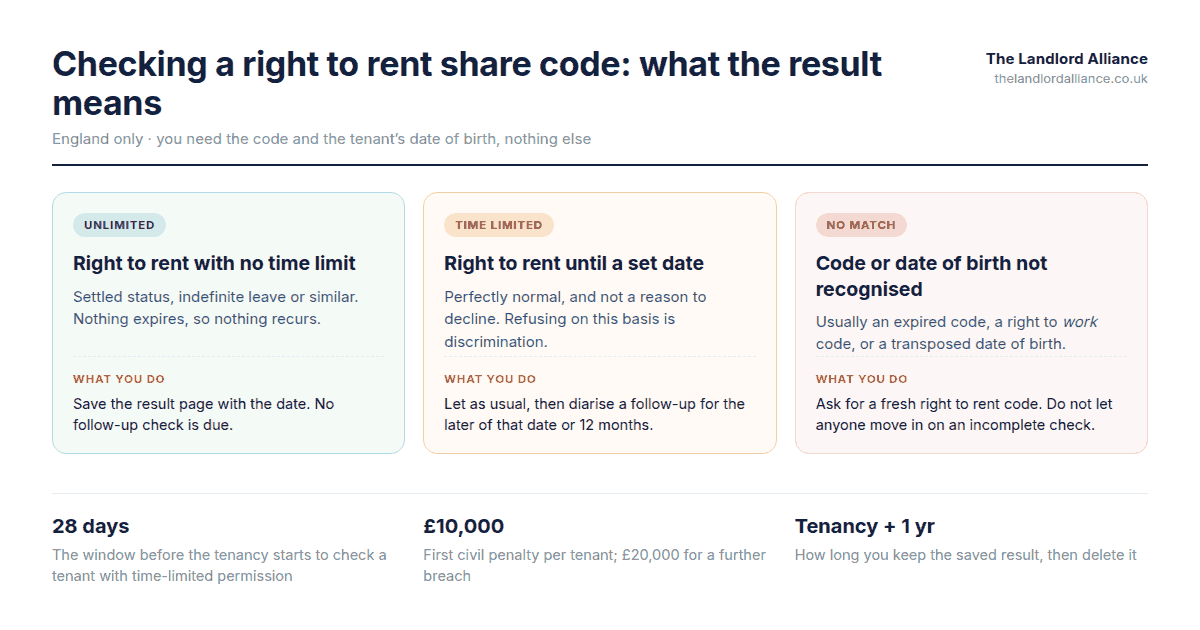
| Right to rent with no time limit | Settled status, indefinite leave or similar. Nothing expires. | Save the result with the date. No follow-up check is due. |
| Right to rent until a stated date | Their permission to stay in the UK has an end date. | Let as normal and diarise a follow-up. This is not a reason to decline. |
| Code not recognised | Expired code, or a right to work code. | Ask for a fresh right to rent code. It takes them a few minutes. |
| Details do not match | The date of birth is wrong or transposed. | Re-enter carefully. Day and month order is the usual culprit. |
| Photograph does not match | Could be an old photo, could be something else. | Do not proceed on a maybe. Ask for the passport as well, and stop if it does not resolve. |
| No right to rent | They are not permitted to rent in England. | Do not let to them. If they are already your tenant, report it to the Home Office. |
Time-limited status is not a reason to say no. Refusing someone because their right to rent has an end date is discrimination, and the Home Office code of practice for landlords says so directly. It is also against the law to check only the people you assume are not British citizens: check every adult occupier, or you are discriminating.
What to save, and for how long
Save the result page as a PDF or a clear screenshot that includes the date of the check, and keep it for the length of the tenancy and one year after it ends. Then delete it. Identity records held beyond the period you need them are a data protection liability rather than an asset.
The saved result is the entire evidence base for your statutory excuse. If you are ever sent an information request by the Home Office, this is what you send. Keep it somewhere you will still be able to find it in three years, alongside the rest of your tenant referencing file for that tenancy.
When the check does not give you a statutory excuse
You are covered when
- You checked every adult occupier, whether or not they are named on the agreement
- You completed the check before the tenancy began
- You matched the photograph with the person present or on live video
- You kept the dated result
- Your agent did the check and you have that arrangement in writing
You are not covered when
- The check happened after move-in — there is no excuse for the period before it
- You only checked the people you assumed were not British
- You accepted a screenshot of someone else’s check rather than running your own
- You missed a follow-up on time-limited status
- You found out the right had ended and did not report it
Booking the follow-up check
Where the result was time-limited, do the follow-up just before the later of two dates: the end of the tenant’s permission to stay, or twelve months after your previous check. Where the result had no time limit, no follow-up is due at all.
The tenant generates a fresh share code at that point and you repeat the same steps. If the follow-up shows the right to rent has ended, you must tell the Home Office — reporting is what preserves your position, and failing to report can mean a fine or up to five years in prison. It does not oblige you to start possession proceedings, and that would not be quick in any case: section 21 no longer exists, so you would need a ground under section 8.
What it costs to get wrong
| Accommodation | First penalty | Further penalties |
|---|---|---|
| Lodger in a private household | £5,000 | £10,000 |
| Tenant in rented accommodation | £10,000 | £20,000 |
Separately from the civil penalty, renting to someone you knew or had reasonable cause to believe had no right to rent is a criminal offence carrying up to five years in prison.
The follow-up date is the one people miss
The Landlord Alliance app records the right to rent check against each individual tenant, stores the result, and reminds you before a time-limited follow-up falls due — so a twelve-month deadline set today is not relying on you remembering it next autumn. £10 a month, first month free.
See what is includedRead next
Is checking a right to rent share code free?
Yes. The GOV.UK right to rent checking service is free and there is no limit on how many checks you run. Paid identity service providers are only relevant for British and Irish citizens, who cannot use a share code at all.
What do I need to check a share code?
The code and the tenant’s date of birth. Nothing else. You also need to be able to see the tenant, in person or on a live video call, to match the photograph the service returns.
Can I check a share code before the tenant moves in?
You must. A check completed after move-in gives you no statutory excuse for the period before it. Where the tenant’s permission to stay is time-limited, the check has to fall within the 28 days before the tenancy starts.
How do I know if the share code is a right to rent code?
Right to rent codes usually begin with R and right to work codes with W. A right to work code entered into the right to rent service will fail, which is the most common reason a code appears not to be recognised.
Do I still need a share code if the tenant has an eVisa?
Yes. The eVisa is the digital status itself; the share code is how the tenant lets you view the part of it that covers renting. Holding an eVisa does not remove the need to generate a code for each check.
Can my letting agent check the share code instead of me?
Yes, and most do. Put the arrangement in writing: without it, the liability for a defective check stays with you. If a tenant sublets without your knowledge, they are the one responsible for checking their sub-tenants.
How long do I keep the result of a share code check?
For the length of the tenancy and one year after it ends, then delete it. Keep the date of the check with it, because the date is part of what proves the check was done in time.
Sources. GOV.UK: check a tenant’s right to rent in England using their share code, checking your tenant’s right to rent and penalties for illegal renting; Home Office: right to rent immigration checks, landlords code of practice and the right to rent document checks user guide. Checked 13 September 2026. Share code prefix conventions are Home Office operational practice rather than statute — if a code behaves unexpectedly, ask for a fresh one.
England only. Position as at 13 September 2026. General information from a landlord, not legal advice.
Related: Tenant referencing · All guides · Free calculators