The short version
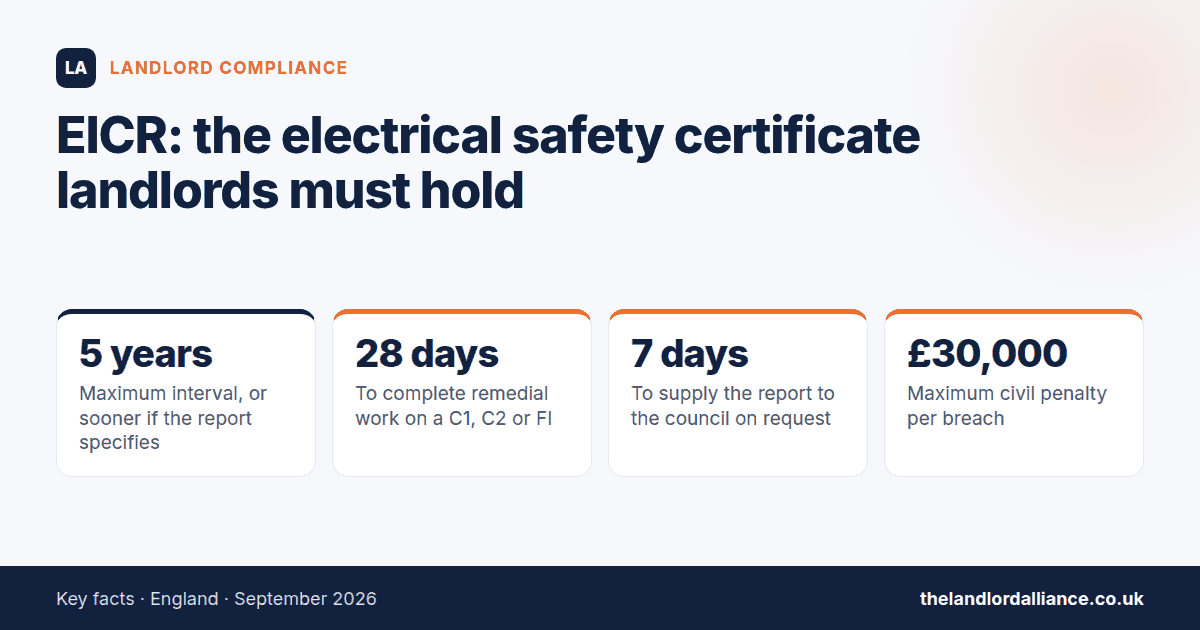
Every rented property in England needs an Electrical Installation Condition Report at least every five years. The report is graded: any C1, C2 or FI makes it unsatisfactory, and you have 28 days to put the faults right — or sooner if the report says so. Give the report to existing tenants within 28 days, to new tenants before they move in, and to the council within 7 days if it asks. The maximum penalty is £30,000, and unlike a prosecution it can be imposed by the council without going near a court.
What the codes mean
This is the part that causes the most confusion, and the part that decides whether you have a 28-day problem or nothing to do at all.
| Code | Meaning | What you must do |
|---|---|---|
| C1 | Danger present. Risk of injury now. | Immediate action. The electrician should make it safe before leaving. Remedial work within 28 days at the latest. |
| C2 | Potentially dangerous. | Urgent remedial action — within 28 days, or sooner if the report says so. |
| FI | Further investigation required. | Investigate within 28 days. FI on its own makes the report unsatisfactory. |
| C3 | Improvement recommended. | Nothing mandatory. A report with only C3 items is satisfactory. You are not obliged to act, and a contractor telling you otherwise is upselling. |
The most common mis-sell in the sector. An electrician quotes for a full rewire on the back of a list of C3 observations. C3 means “this could be better”, not “this is unsafe”. Ask which items are C1, C2 or FI, get the quote limited to those, and then decide separately whether the C3 work is worth doing.
The deadlines
| What | When |
|---|---|
| Inspection | At least every 5 years, or at the shorter interval the report specifies |
| Report to existing tenants | Within 28 days of the inspection |
| Report to a new tenant | Before they occupy |
| Report to a prospective tenant | Within 28 days of a request |
| Report to the local authority | Within 7 days of a request |
| Remedial work | Within 28 days, or sooner if specified |
| Written confirmation the work is done | To the tenant and the council within 28 days of completion |
Who can do it
The regulations require a “qualified and competent person”. They do not name a scheme, which means the burden of establishing competence sits with you. In practice, look for registration with a recognised body such as NICEIC, NAPIT, ELECSA or STROMA, ask what qualifications the individual attending holds — not just the company — and confirm they carry professional indemnity insurance.
Get the report in the standard EICR format with the schedule of test results attached. A one-page “certificate” with no test schedule is not an EICR and will not satisfy a council that asks for it.
When the report comes back unsatisfactory
- Read the observations before agreeing to anything. Separate the C1, C2 and FI items from the C3s. Only the first three carry a legal deadline.
- Get the remedial work done within 28 days, or within the shorter period the report specifies. The clock starts from the inspection date.
- Obtain written confirmation from the electrician that the work is complete and the faults are remedied.
- Send that confirmation, with the original report, to the tenant and to the local authority within 28 days of the work being finished.
If the work cannot be done in time — a part on order, an access problem — document the reason and the steps taken. As with gas, what protects you is evidence of reasonable steps rather than a perfect date.
Enforcement
Local authorities enforce this, and they do so by financial penalty rather than prosecution. Up to £30,000 per breach, and breaches can be counted separately, so a portfolio with a systemic gap is exposed several times over.
A council can also serve a remedial notice and, if you do not act, arrange the work itself with the tenant’s consent and recover the cost from you. That is a worse outcome than doing it yourself: you lose control of the contractor and the price.
Read next
Is an EICR the same as a PAT test?
No. An EICR covers the fixed installation — wiring, consumer unit, sockets. PAT testing covers plug-in appliances and is not a legal requirement for landlords, though it is sensible for appliances you supply.
Does a new build need one?
Yes. The five-year cycle applies whatever the age of the property. The Electrical Installation Certificate issued for new work starts the clock but is not a substitute for an EICR when the five years are up.
My report says three years, not five. Which applies?
The shorter one. Five years is a maximum, and where the inspector specifies a shorter interval that becomes your legal deadline.
Do C3 items have to be fixed?
No. C3 means improvement recommended. A report with only C3 items is satisfactory and no work is legally required.
Do HMOs need one more often?
The regulations say five years, but many licence conditions require annual electrical checks. Check the conditions attached to your own licence — they override the general position.
What if a tenant refuses access?
The same approach as gas: written offers of appointments, more than one date, an explanation of why it matters, and a documented escalation. Councils accept evidence of reasonable steps; they do not accept silence.
Sources. Electrical Safety Standards in the Private Rented Sector (England) Regulations 2020; GOV.UK guide for landlords on electrical safety standards in the private rented sector; IET Wiring Regulations classification codes. Checked 7 September 2026.
Related: Compliance checklist · All guides · Free calculators