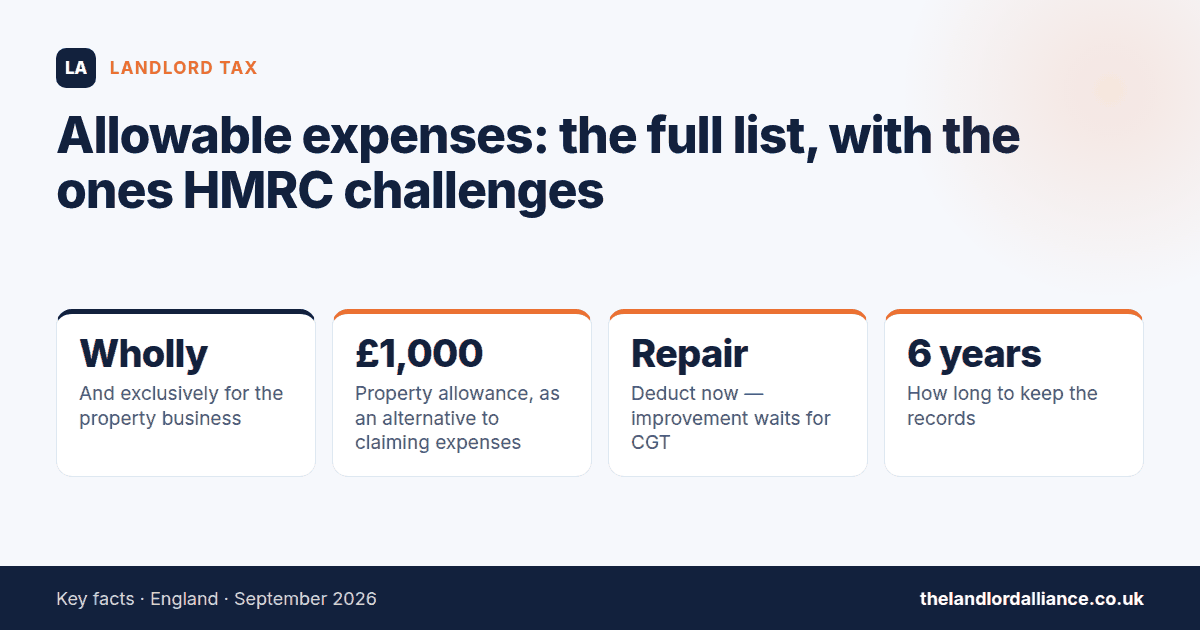
Information, not tax advice. The general rule is that an expense must be incurred wholly and exclusively for the property business. Where a cost is partly personal, only the identifiable business proportion is claimable.
The short version
Since Section 24 removed mortgage interest from the expenses list, every remaining deduction is worth more than it used to be, because it is now the only thing reducing your taxable profit. The single line that decides most disputes is repair versus improvement: restoring something to its previous condition is a repair and comes off this year’s rent; making it better than it was is an improvement and waits until you sell, when it reduces the capital gain instead. Neither is lost — but one relieves at your income tax rate now and the other at your capital gains rate later.
The full list
| Category | Claimable | Notes |
|---|---|---|
| Letting agent fees | Yes, in full | Management, tenant find, renewal fees |
| Repairs and maintenance | Yes | Restoring, not upgrading — see below |
| Landlord insurance | Yes | Buildings, contents, liability, rent guarantee |
| Ground rent and service charges | Yes | On leasehold property you let |
| Council tax and utilities | Yes, if you pay them | Common in HMOs and during voids |
| Safety certificates | Yes | Gas, EICR, EPC, fire risk assessments |
| Accountancy fees | Yes | For the rental accounts. Not for personal tax planning. |
| Legal and professional fees | Usually | Tenancy agreements, possession proceedings, debt recovery. Not purchase or sale costs. |
| Advertising and referencing | Yes | You must pay these — charging the tenant has been banned since 2019 |
| Licensing fees | Yes | HMO, additional and selective licence fees |
| Replacement of domestic items | Yes, like for like | Beds, sofas, carpets, white goods — replacements only, not the first purchase |
| Travel to the property | Yes, business proportion | Mileage at HMRC rates, or actual costs. Keep a log. |
| Phone, broadband, software | Business proportion | Apportion honestly and record the basis |
| Use of home as office | Yes, modest amount | A simplified flat rate is usually easier to defend than an apportionment |
| Subscriptions | Yes | Landlord associations, trade publications, relevant software |
| Ground maintenance | Yes | Gardening and cleaning between tenancies |
| Bad debts | Yes, if genuinely irrecoverable | Not simply rent that is late |
What you cannot claim
- Mortgage capital repayments. Only ever the interest, and now only as a credit.
- Improvements. A new extension, a new conservatory, the first fitting of something that was not there.
- Your own time and labour. You cannot invoice yourself.
- Costs of buying or selling. Legal fees, survey, stamp duty and estate agent fees are capital costs — they reduce the gain when you sell.
- Fines and penalties. Including licensing penalties and parking tickets.
- The cost of the property itself, or of the land.
- Personal expenses with only incidental business use.
Repair or improvement: the line that matters
| Work done | Treatment | Why |
|---|---|---|
| Replacing a rotten single-glazed window with double glazing | Repair | Double glazing is the modern equivalent. Using current materials does not make it an improvement. |
| Adding a window where there was not one | Improvement | Something new exists that did not before |
| Replacing a worn kitchen with a similar standard kitchen | Repair | Like-for-like renewal of an existing asset |
| Replacing a basic kitchen with a high-specification one | Partly improvement | The uplift in standard is capital; apportion honestly |
| Repointing, re-roofing, damp proofing an existing problem | Repair | Restoring the building to its former state |
| Converting a loft into a bedroom | Improvement | New accommodation created |
| Redecorating between tenancies | Repair | Routine maintenance |
| Work needed to make a newly bought property lettable | Usually improvement | Repairs required because of the condition you accepted at purchase are generally capital |
Nothing is wasted. An improvement is not a lost deduction — it is added to the base cost and reduces your capital gain when you sell. Which is why keeping the invoice for that extension for fifteen years genuinely matters.
The five HMRC challenges most
- Whole-property refurbishments dressed as repairs. A single large invoice covering a full renovation invites the question. Ask the contractor to itemise repair and improvement work separately at the time, not afterwards.
- Travel. Regular trips to a property near a holiday home, or mileage that implies more visits than a property could plausibly need. Keep a dated log with the purpose of each visit.
- Use of home and phone. Round-number apportionments with no working. A modest, evidenced claim survives; a large unexplained one does not.
- Pre-letting expenditure. Costs incurred before the property was first let, claimed as running costs. Expenses in the seven years before the business starts can qualify, but only if they would have been deductible had the business already been trading.
- Replacement of domestic items relief. Claiming the first purchase rather than a replacement, or claiming an upgrade in full. The relief covers a like-for-like replacement; if the new item is better, only the equivalent cost qualifies.
Records
Keep invoices, receipts, bank statements and your mileage log for at least six years after the tax year they relate to, and keep the capital ones indefinitely because you will need them at sale. If Making Tax Digital applies to you, the records must be digital and categorised as you go — which in practice ends the shoebox-in-January approach whether you liked it or not.
Read next
Can I claim a new kitchen?
If it replaces a worn kitchen at a similar standard, yes, as a repair. If it is a significant upgrade, the uplift is capital and waits until you sell.
Can I claim for my own labour?
No. You can claim materials, but not the value of your time.
Can I claim expenses during a void?
Yes, provided the property is genuinely available to let and you are actively trying to let it. Costs during a period you occupied it yourself are not claimable.
What is the property allowance?
A £1,000 allowance you can claim instead of actual expenses. Below £1,000 of gross rental income you need not declare it at all. For anyone with a mortgage, actual expenses are almost always worth more.
Can I claim expenses from before I let the property?
Potentially, for the seven years before the business began, but only where the cost would have been allowable if you had already been letting. Work to make the property lettable is usually capital instead.
Do I need receipts for everything?
Yes in practice. A claim you cannot evidence is a claim HMRC can remove, and the burden is on you.
Sources. HMRC Property Income Manual, particularly PIM2000 onwards on deductions and the guidance on replacement of domestic items relief; Income Tax (Trading and Other Income) Act 2005; HMRC guidance on pre-trading expenditure. Checked 8 September 2026.
Related: Landlord tax · All guides · Free calculators