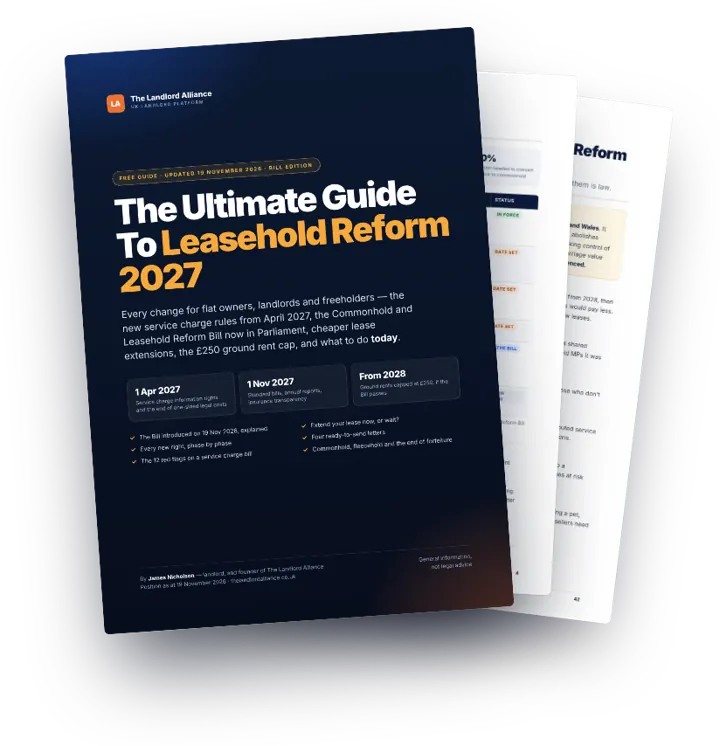
The Ultimate Guide To Leasehold Reform 2027
On 19 November 2026 the Commonhold and Leasehold Reform Bill was introduced in Parliament: the beginning of the end for leasehold. Eight days earlier the government set the dates for the new service charge rules. This free guide explains both, in plain English: what changes in April and November 2027, what the Bill would do from 2028, whether to extend your lease now or wait, and how to challenge a bill today.
- The Bill’s nine changes, from the £250 ground rent cap to commonhold
- Extend your lease now, or wait for 990-year extensions?
- Every new service charge right, phase by phase
- The 12 red flags on a bill, and four letters you can send this week
- What it all means for a buy-to-let flat’s returns
Written by James Nicholson, landlord and founder of The Landlord Alliance
Get the free guide
We’ll email you the PDF straight away.
Leasehold reform 2027: the dates that matter
Two announcements in eight days. On 11 November 2026 the government set start dates for the service charge reforms in the Leasehold and Freehold Reform Act 2024 (GOV.UK, 11 November 2026). On 19 November it introduced the Commonhold and Leasehold Reform Bill, which the Housing Minister called the beginning of the end for the leasehold system (GOV.UK, 18 November 2026).
A right to ask what you pay for and why, including previous years. Landlords can no longer pass on their legal costs without a court or tribunal’s approval.
Standard demand forms, accounts and annual reports from private landlords. Insurance details disclosed, commissions stopped, admin fees published.
Councils and housing associations move to the same standard demands, accounts and annual reports.
Ground rents on most existing leases capped at £250 a year, falling to zero over 40 years, if the Bill becomes law.
What the Commonhold and Leasehold Reform Bill would do
The Bill applies to England and Wales. It is not law yet: it has to pass both Houses of Parliament, and each part starts only when ministers switch it on. Chapter 16 of the guide takes each change in turn and says what it means for you.
A £250 ground rent cap
On most existing residential leases from 2028, falling to nothing over 40 years. The government says up to one million leaseholders would pay less.
Commonhold by default
Most new flats would be commonhold, with no landlord. No start date has been set for the ban on new leasehold flats.
Conversion at 50%
An existing block could convert to commonhold with half the flat owners in favour, down from all of them.
Forfeiture abolished
A landlord could no longer take a home over a relatively small unpaid bill. A court-led system would enforce lease terms instead.
Fleecehold protections
Up to 1.75 million freehold homes on privately managed estates would lose the threat of enforcement over unpaid estate charges.
Caps on fees
Powers to cap permission and admin fees, such as for keeping a pet, and to limit what sellers pay for information from their landlord.
A right to gigabit broadband
A stronger right to ask for gigabit broadband in your building, with set times for the landlord to respond.
Taking control
An easier, cheaper way for leaseholders to take control of their building and remove a third-party landlord.
Cheaper lease extensions
Fixes to the 2024 Act so that 990-year extensions, with no marriage value, can finally be switched on.
Got a short lease? Cheaper extensions are coming, but nobody can give you a date. Chapter 17 of the guide walks through whether to extend now or wait.
Six parts, 18 chapters, no jargon
Written for the people who pay for leasehold: flat owners, landlords with buy-to-let flats, and investors who own a small freehold. Every fact is traced to a primary source, and every rule is labelled as in force, date set, or only in the Bill.
What just happened
- November 2026, in plain English
- How service charges became a crisis
The new service charge rules
- 1 April 2027: the right to know
- 1 November 2027: the paperwork revolution
- 2028, and what is already in force
Your toolkit: use it now
- The ten rights you already have
- Reading a bill and the 12 red flags
- How to challenge, and four letters
The landlord’s angle
- What service charges do to your returns
- The 24-point leasehold flat checklist
- If you own the freehold
A thousand years in the making
- From the medieval manor to the mansion block
- A century of reform, 1884 to the Bill of 2026
The Bill, and what to do
- Commonhold, explained
- The Bill’s nine changes
- Extend your lease now, or wait?
- Your action plan to 2028
If you own a flat, this is your money
There are about 5.1 million leasehold homes in England and Wales (GOV.UK), and 1.91 million leasehold homes in England are let by private landlords (MHCLG, 2024–25). Service charges and ground rent are often the biggest costs on a flat after the mortgage, and the lease is the one asset that shrinks every year.
Flat owners
Understand the bill, challenge what is wrong without risking the landlord’s legal costs, and know what the reforms give you and when.
Landlords with flats
See what the ground rent cap and service charge rules mean for your returns, what to check before you buy, and whether to extend a short lease now.
Small freeholders
Converted a house and sold the flats? Own a share of freehold? From 2027 the new rules apply to you as the landlord.
Four of the 12 red flags on a service charge bill
The other eight, how to challenge each one, and the letters to send are in the guide.
Leasehold reform FAQ
What is the Commonhold and Leasehold Reform Bill?
A Bill introduced in Parliament on 19 November 2026, covering England and Wales. It would cap ground rents on most existing leases at £250 a year from 2028, make commonhold the default for most new flats, let existing blocks convert with 50% support, abolish forfeiture, protect homes on fleecehold estates, cap permission fees, and fix the 2024 Act so cheaper lease extensions can start. It is not law yet.
When does leasehold reform start?
In stages. The new service charge rules have dates: 1 April 2027 for information rights and legal costs, 1 November 2027 for standard bills, accounts and reports from private landlords, and 1 November 2028 for councils and housing associations. The Bill has no start dates yet, though the government says the ground rent cap would apply from 2028.
Will my ground rent be capped at £250?
If the Bill passes as introduced, ground rent on most existing residential leases would be capped at £250 a year from 2028, then fall to nothing over 40 years. The government says up to one million leaseholders would pay less. Until then the terms of your lease still apply, so keep paying.
Should I extend my lease now or wait?
It depends on how many years are left. The Bill clears the way for 990-year extensions with no marriage value, but nobody can say when they will start, and with 80 years or less left, marriage value is added to the price today. The guide walks through the decision. Get a valuation before you decide to wait.
Does this apply in Wales or Scotland?
The service charge dates in the guide are for England; Wales is bringing in the same rules on its own timetable. The Bill applies to England and Wales. Scotland has a different system.
I downloaded The Service Charge Shake-Up. Is this different?
Yes. This is the new edition, rewritten after the Bill was introduced. Everything from the first edition is still in it, with the Bill, the lease extension question and the latest government figures added.
Is the guide really free?
Yes. Enter your first name and email and we’ll send you the PDF. The guide mentions The Landlord Alliance and our training courses, and you can unsubscribe from our emails at any time.
Get The Ultimate Guide To Leasehold Reform 2027
Know your rights before 1 April 2027, spot what is wrong with your bill, and decide what the Bill means for every flat you own.
Service charge dates: EnglandThe Bill: England and WalesUpdated 19 November 2026General information, not legal advice
Sources: GOV.UK, 18 November 2026, the Bill on the Parliament website, GOV.UK, 11 November 2026 and the Leasehold and Freehold Reform Act 2024