
Two stories broke this week that every UK landlord should read together. One is about what happens if you try to leave the market. The other is about what’s coming if you stay. Neither is a reason to panic — but both should change how you make decisions this year.
Story one: selling just got riskier than most landlords realise
Since 1 May, if you want possession of a tenanted property in order to sell it, you serve a Ground 1A notice — the Renters’ Rights Act route that replaced Section 21 for this purpose. Here’s the part that hasn’t sunk in yet: once you’ve used Ground 1A, you’re banned from re-letting that property for 12 months — even if the sale falls through.
And sales fall through more often than you’d think. New analysis from Hamptons found that 51% of homes listed for sale by landlords in 2025 failed to sell. For flats, it was 60%.
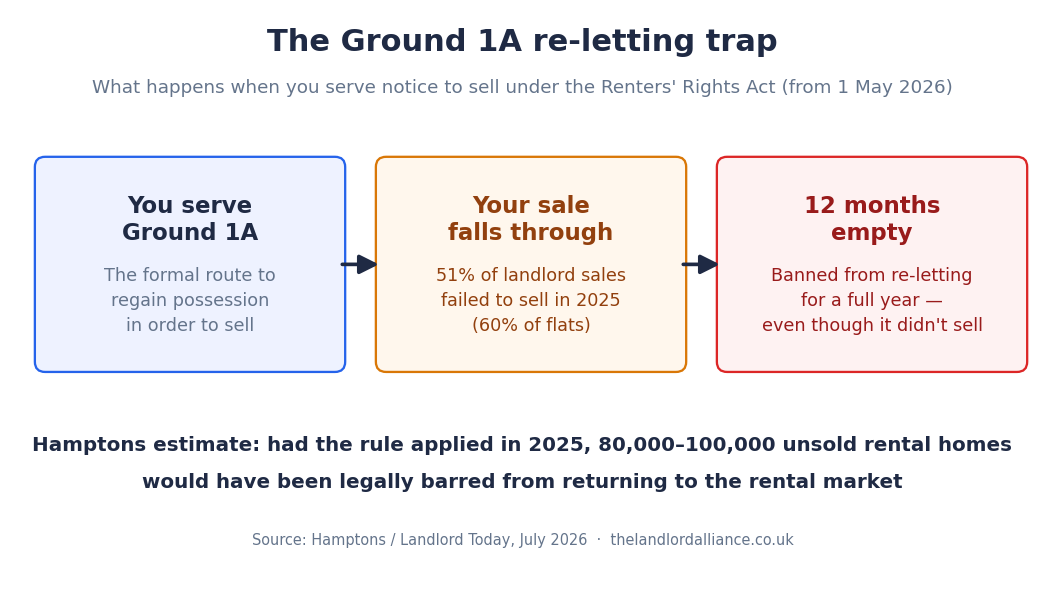
Run those numbers forward and Hamptons estimates that if the rule had applied last year, 80,000–100,000 unsold rental homes would have been legally stuck — unsold, unlettable, and earning nothing for a full year. That’s the “limbo” making the headlines.
What this actually means for your decision-making
Selling is no longer a decision you can half-make. Under the old rules, if a sale dragged or the price disappointed, you could quietly re-let and try again next spring. That safety net is gone. Serving Ground 1A is now a one-way door: you need to be confident the property will actually sell, at a price you’ll actually accept, before you serve notice.
Before you decide, do three things:
- Price it like a seller, not an owner. Half of landlord sales failed at the asking prices landlords chose. If you wouldn’t accept a realistic price — the one your agent winces at — don’t serve notice at all.
- Stress-test the empty year. Can you carry the mortgage, insurance and council tax on that property for 12 months with zero rent if the sale collapses? If the answer is no, the Ground 1A route is a gamble you can’t afford to lose.
- Consider selling with the tenant in place. A tenanted sale to another landlord avoids Ground 1A entirely — no notice, no ban, no void. You may take a small price haircut, but compare that with a year of nothing.
If you own flats, read this twice
The risk isn’t spread evenly. Flats made up 51% of rental homes listed for sale last year, they fail to sell more often (60%), they take almost a month longer to go under offer (85 days vs 59 for houses), and nearly a quarter of all flats on the market in June were ex-rentals — so you’re competing with other exiting landlords to sell the same kind of stock.
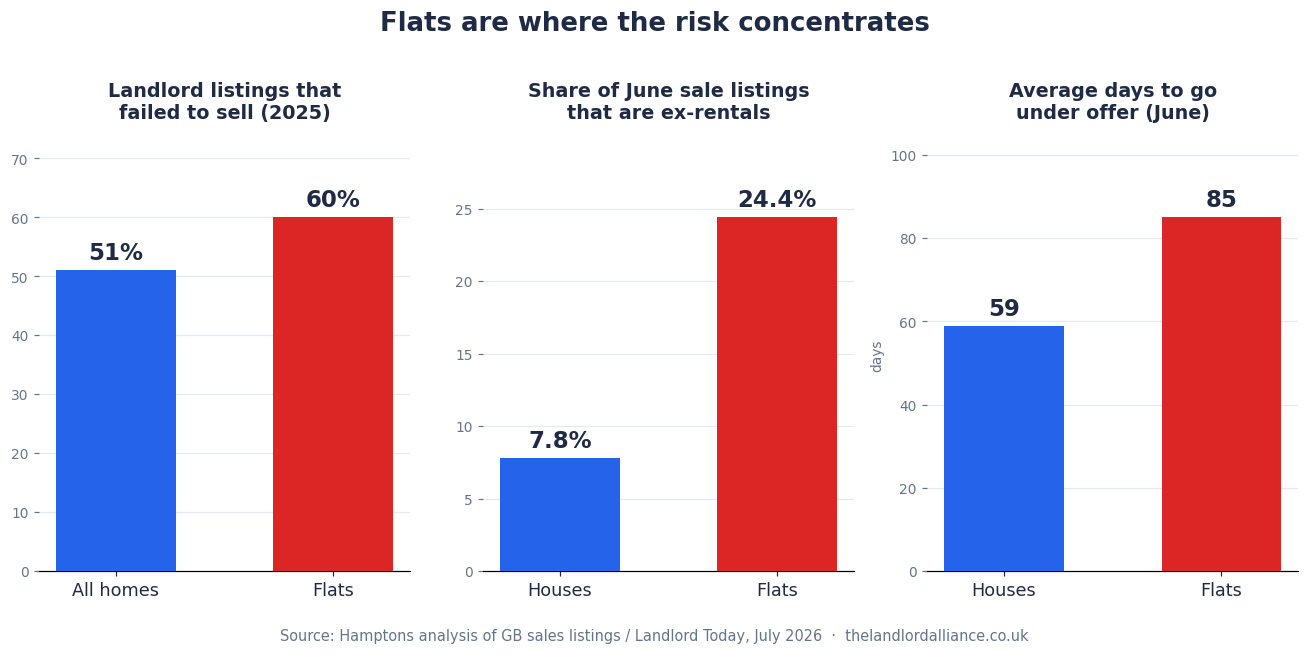
Interestingly, the same Hamptons data shows the exodus may be past its peak: ex-rentals were 9.2% of June’s sale listings, down from 11.3% a year earlier, and for the first time since 2019 landlords bought a bigger share of homes than they sold. Hamptons’ own read is that the big wave of exits was driven by the earlier tax changes and mortgage rates — not the Act itself — and that a slower sales market is now making landlords more cautious about serving notice. Sensibly so.
Story two: the campaigners’ wish-list for the next Prime Minister
Meanwhile, with a change of Prime Minister expected within days, Generation Rent has published what it wants next — calling the Renters’ Rights Act “only a first step”. Their five demands:
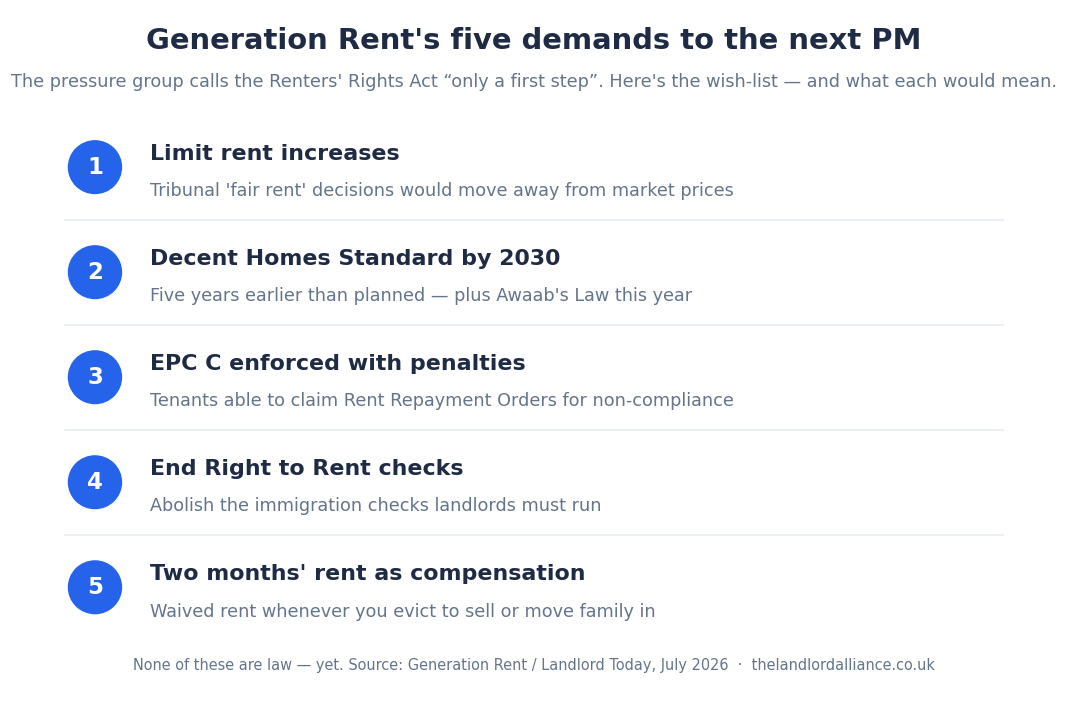
To be clear: none of this is law, and wish-lists are not legislation. But it tells you the direction of pressure. Two of the five are really about acceleration of things already coming — the Decent Homes Standard and EPC C by 2030 — and one (Awaab’s Law timescales for damp and mould) is likely to arrive in some form regardless of who’s in Number 10.
The takeaway: the landlords who get hurt are the unprepared ones
Look at both stories side by side and a pattern appears. The re-letting ban punishes landlords who drift into decisions — who serve notice “to see what happens”. The campaign demands, if any become law, will punish landlords whose paperwork and property condition aren’t already in order. In both cases the cost lands on the unprepared, not on landlords generally.
So the boring advice is the right advice:
- Know your numbers before you act. Yield, realistic sale price, void cost, mortgage exposure — per property, not as a gut feel.
- Get compliance ahead of the curve, not behind it. If your EICRs, gas safety and EPCs are green today, an accelerated Decent Homes Standard or EPC C deadline is a to-do list, not a crisis.
- Don’t make a one-way decision on a two-way market. If you’re 50/50 on selling, the new rules mean waiting costs you little — but serving notice and failing to sell costs you a year.
Inside the Alliance, the portfolio dashboard will tell you each property’s yield and equity position in seconds, the compliance tracker shows you exactly which certificates would fail an inspection tomorrow, and the community is exactly the place to ask “would you sell this flat or hold it?” before you do anything irreversible. That’s what it’s for.
James, Founder — The Landlord Alliance
The detail behind this. Ground 1A is the mandatory ground a landlord uses to sell, and it replaced section 21 on 1 May 2026. Our guide to selling under Ground 1A works through the four months' notice, the twelve-month condition that attaches to the date you specify rather than the date you serve, and what the re-letting ban actually costs if the sale falls through.
Sources: Hamptons analysis via Landlord Today, 13 July 2026; Generation Rent via Landlord Today, 13 July 2026. This article is general information, not legal or financial advice — take professional advice before serving notice or selling.