The short version
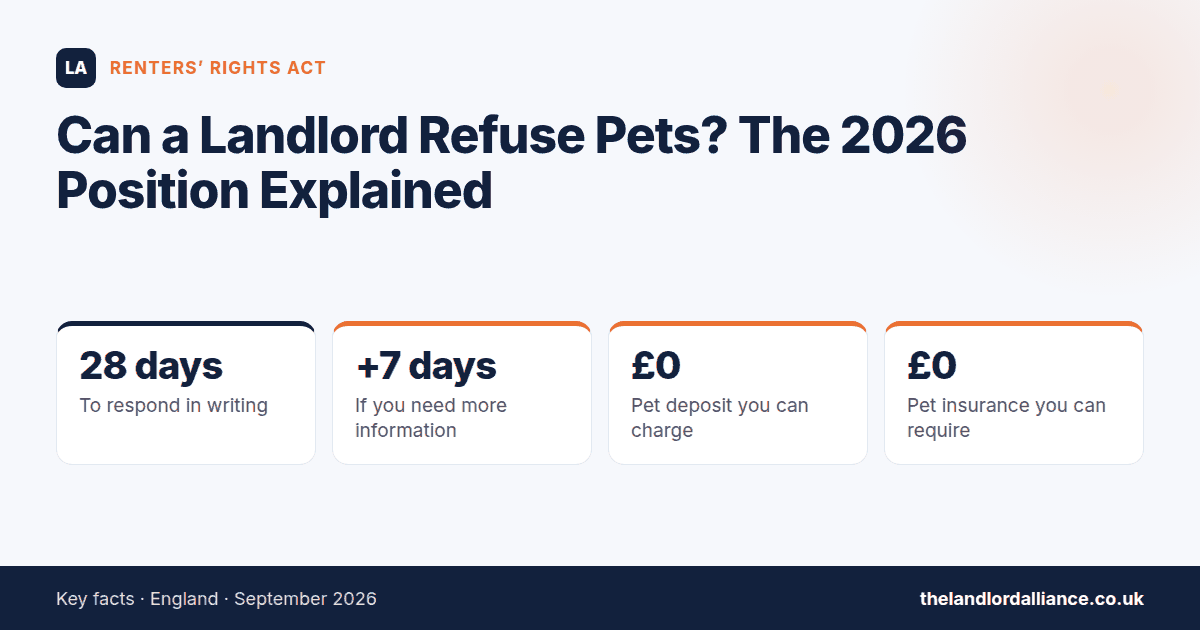
Since 1 May 2026 a tenant can request to keep a pet, and you cannot unreasonably refuse. You have 28 days to reply in writing. A blanket “no pets” clause no longer works. And the part most landlords still have wrong: you cannot require pet insurance and you cannot take a pet deposit — that provision was removed from the Bill before it became law. You can still deduct for actual pet damage from the ordinary deposit at the end of the tenancy.
Of everything in the Act, this is the change generating the most misinformation. Landlord forums, agent newsletters and a surprising number of law firm briefings still say you can require the tenant to take out pet damage insurance. You can’t. That clause existed in the Renters’ Rights Bill as introduced, was removed during its passage through Parliament, and never made it into the Act. If your source says otherwise, your source is describing a draft from 2024.
How a pet request works
| Stage | What happens | Timing |
|---|---|---|
| 1. Request | Tenant asks in writing, describing the pet | Any time during the tenancy |
| 2. Your reply | Consent, or refuse with reasons — in writing | Within 28 days |
| 3. More info | If you ask the tenant for further details, the clock extends | Later of the remaining 28 days, or 7 days after they reply |
| 4. Superior landlord | If you must ask a freeholder or head lessor, the clock extends the same way | 7 days after you get their answer |
| 5. Agreement | You and the tenant can agree a longer period | By agreement |
The request has to be in writing and has to describe the pet — type, size, and what space it needs. A tenant saying “can I get a dog?” in passing is not a formal request that starts the clock. A tenant emailing “I’d like to keep a two-year-old neutered cocker spaniel, kept indoors, walked twice daily” is.
Reply in writing, always. The duty is to respond in writing within the period. A verbal yes creates exactly the argument you don’t want in eighteen months when there’s damage and no record of what was agreed.
What counts as reasonable refusal
The Act gives one express example: refusal is reasonable where keeping the pet would put you in breach of an agreement with a superior landlord. Beyond that, “reasonable” is judged on the facts, and government guidance fills in the practical picture.
| Likely reasonable | Likely unreasonable |
|---|---|
| A head lease or freeholder agreement prohibits pets | You don’t like pets |
| The property is genuinely too small for the animal | A previous tenant’s pet caused damage |
| Another tenant in a shared property has a serious allergy | You’re worried it will be harder to let later |
| The animal is illegal to keep | Your agreement contains a blanket no-pets clause |
| The specific animal is unsuited to the specific property | Refusing an assistance animal |
The distinction running through that table is worth internalising, because it will decide most disputes: a reasonable refusal is specific. It’s about this flat and this dog. A general policy about pets, however sincerely held, is the thing the legislation removed.
Assistance animals sit in their own category. Refusing one is very unlikely to be reasonable and may also engage disability discrimination law, which carries consequences well beyond this Act.
If you’re refusing, write it properly
State the specific reason, refer to the specific property and animal, and where a superior landlord is the cause, attach or quote the clause. A refusal that says “unfortunately we do not permit pets at this property” is the weakest possible position — it reads as a blanket policy, which is exactly what it can’t be.
The money: what you can and can’t do
Pet costs, settled
- Pet deposit
- Not permitted. The Tenant Fees Act cap is unchanged and pets are not an exception
- Pet insurance
- Cannot be required. Removed from the Bill before enactment
- Pet rent
- Not a permitted payment. Do not add a pet surcharge to the rent
- Higher rent generally
- Only via a section 13 notice, on market evidence — not as a pet charge
- Damage at the end
- Deductible from the ordinary deposit, evidenced as normal
- Professional cleaning
- Only if there is actual need beyond fair wear and tear
I’d flag the “pet rent” line specifically. Charging an extra £25 a month because there’s a dog is not a permitted payment, and dressing it up as a rent increase doesn’t fix it — a section 13 increase has to be justifiable as market rent for the property, not as a surcharge for the animal.
What you’re left with is the ordinary deposit and ordinary evidence. Which means the inventory matters more than it used to: photograph carpets, skirting, doors and garden before the pet arrives, and again at the end. That’s the mechanism the Act leaves you, so use it properly.
If you have been charging pet rent or holding a pet deposit since May, get that reviewed. Prohibited payments have to be returned, and holding one can affect your position on possession as well as exposing you to a penalty.
What I actually do
My own view, for whatever it’s worth as one landlord: consenting is usually the better commercial decision. Pet-owning tenants have fewer places to go, tend to stay longer, and a longer tenancy is worth considerably more than the marginal risk to a carpet. The Act has removed the tools I might once have used to price that risk, but it hasn’t changed the underlying economics, which were never as unfavourable as landlords assumed.
What I do insist on is a proper record: the request in writing, my consent in writing naming the specific animal, and a dated photographic inventory before it moves in. Consent to “a cat” is not consent to three cats and a python two years later.
Questions
My tenancy agreement says no pets. Does that still apply?
No. A blanket prohibition is overridden by the implied term the Act inserts into every private assured tenancy.
What if I don’t reply within 28 days?
You are in breach of the implied term. Don’t test what follows — diarise the deadline the day the request arrives.
Can I consent to one pet but not another?
Yes. Consent is specific to the animal described. A tenant wanting a second pet needs to make a fresh request.
My freeholder’s lease bans pets. What do I do?
That is the clearest reasonable refusal there is. Ask the freeholder, keep their answer, and quote the lease clause in your written refusal.
Can I ask for a reference for the pet?
You can ask for information about the animal, and that extends your response window. Be genuine about it — asking questions purely to delay is not a strong position.
What about pets in an HMO?
Another sharer’s serious allergy is a legitimate specific reason. The analysis is the same: specific to this property and these occupants.
Pet requests, logged and timed
Record the request, track the 28-day clock, and store your written response and the inventory photos against the tenancy. £10 a month, cancel anytime.
See what’s includedEngland only. Position as at 20 August 2026. General information from a landlord, not legal advice.
Sources: Renters’ Rights Act 2025 s.11 and s.27; Tenant Fees Act 2019; GOV.UK guidance for landlords on pet requests.
Related: the full Renters’ Rights Act guide · tenancy agreements in 2026 · section 8 grounds