The Complete Handbook To Serviced Accommodation 2027
Short-stay lets in England, as they work now. The holiday-let tax break has gone, Airbnb’s fee has gone up and a national register starts in 2027. This free serviced accommodation guide shows exactly when SA beats a long let and when it doesn’t, with every number worked to the pound.
- One flat worked three ways: long let, self-managed SA and managed SA
- The occupancy you need to beat a tenant, and what every booking really costs
- Rent-to-rent SA, a deal that works next to one that doesn’t, and the 2.5× test
- Planning, London’s 90 nights, leases, the Renters’ Rights Act line and fire safety
- The register, council tax or business rates, tax after the holiday-let regime and VAT
Written by James Nicholson, landlord and founder of The Landlord Alliance
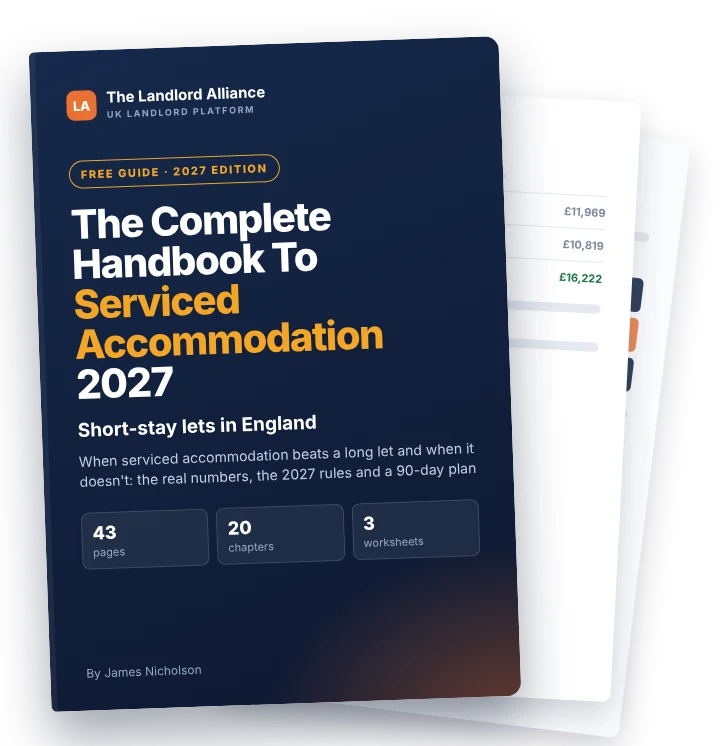
Get the free guide
We’ll email you the PDF straight away.
Does serviced accommodation beat a long let?
A two-bed city-centre flat that would let to a tenant for £1,150 a month. As serviced accommodation it averages £120 a night at 60% occupancy, close to the UK average. Every cost counted: platform fees, cleaning, laundry, supplies, energy, broadband, council tax, insurance, software and replacements.
The guide shows the full grid of occupancy against price, the year month by month, the same flat after tax at the 2027 rates, and a rent-to-rent contractor house that does work.
20 chapters, three worksheets, every source
Written for landlords and investors in England, whether you own the property, rent it to let it out, or manage it for an owner. Every rule and figure is traced to its source, and what’s only proposed is marked as such.
Is SA for you?
- What serviced accommodation is
- Who stays, and what they want
- Pros, cons and a self-check
The numbers
- ADR, occupancy and RevPAR
- One flat, three ways
- Rent-to-rent and the 2.5× test
The rules in 2027
- Planning and London’s 90 nights
- Leases, lenders, the Renters’ Rights Act
- Fire safety, the register, rates, tax, VAT
Set it up and run it
- Choosing the place and property
- Furnishing, listings and pricing
- Running it day to day
Tools
- Your first 90 days
- Deal check and compliance checklist
- Set-up budget and scorecard
Reference
- Straight answers to 16 questions
- Glossary
- Every source, checked 20 Nov 2026
A guest who lives there may be a tenant
Genuine holiday lets are outside the Renters’ Rights Act. But since 1 May 2026, letting a home to someone as their main home creates an assured periodic tenancy, whatever the booking calls it. A long “stay” by someone with nowhere else to live can leave you with a tenant who can only be asked to leave on a legal ground, through the courts. The guide shows the signs on each side of the line, and six habits that keep you on the right one. If you want the strategy step by step on video, see our serviced accommodation course.
Get three yeses in writing before you start: the lease or the owner, the mortgage lender and the insurer. A missing one can end the business.
Serviced accommodation FAQ
What is serviced accommodation?
Serviced accommodation is a furnished home let by the night or the week, with bills, wifi, linen and cleaning included. In England it is usually a whole flat or house let to holidaymakers, contractors, business visitors and people between homes, through platforms such as Airbnb and Booking.com or directly.
Is serviced accommodation more profitable than buy-to-let?
Only if it is busy enough at a good enough price. In the guide’s worked example, a two-bed flat at 60% occupancy and £120 a night earns less than letting it to a tenant once fees, cleaning, bills and council tax are counted. At about 63.5% it matches the long let, and above that it pulls ahead quickly.
Do I need planning permission for serviced accommodation?
There is no special planning use class for short lets in England. Letting a home now and then is not a change of use, but busy, whole-year letting can be, decided by the council case by case. In Greater London, short letting for more than 90 nights a year needs planning permission.
Do I need to register my short-term let?
Not yet. Government guidance updated on 2 October 2026 says the national register of short-term lets in England is expected to start in March 2027. The details, including any fee, have not been published.
How is holiday-let income taxed now?
The furnished holiday lettings regime was abolished from 6 April 2025, so short-let profits are taxed like any rental, with mortgage interest relief limited to the basic rate. From 6 April 2027 property income is taxed at 24%, 44% and 49%.
Is the guide legal, tax or financial advice?
No. It is general information for England, written by a landlord and checked against official sources on 20 November 2026. Rules, fees and rates change, so speak to a solicitor, an accountant or a broker before you commit.
Is the guide really free?
Yes. Enter your first name and email and we’ll send you the PDF. The guide mentions The Landlord Alliance and our training courses, and you can unsubscribe from our emails at any time.
Get The Complete Handbook To Serviced Accommodation 2027
The real numbers, the 2027 rules and how to run it, plus three worksheets and a plan for your first 90 days.
EnglandUpdated 20 November 2026General information, not legal, tax or financial advice
Sources include GOV.UK’s rules for self-catering holiday homes, the Housing Act 1988 as amended by the Renters’ Rights Act 2025, the Home Office fire safety guide for paying-guest accommodation, HMRC’s manuals and VisitBritain. The full list is at the back of the guide.