This is information, not tax advice. Dates and thresholds below are taken from HMRC guidance and checked on 7 September 2026. If you think you are in scope and have not started, the right next step is an accountant, not more reading.
The short version
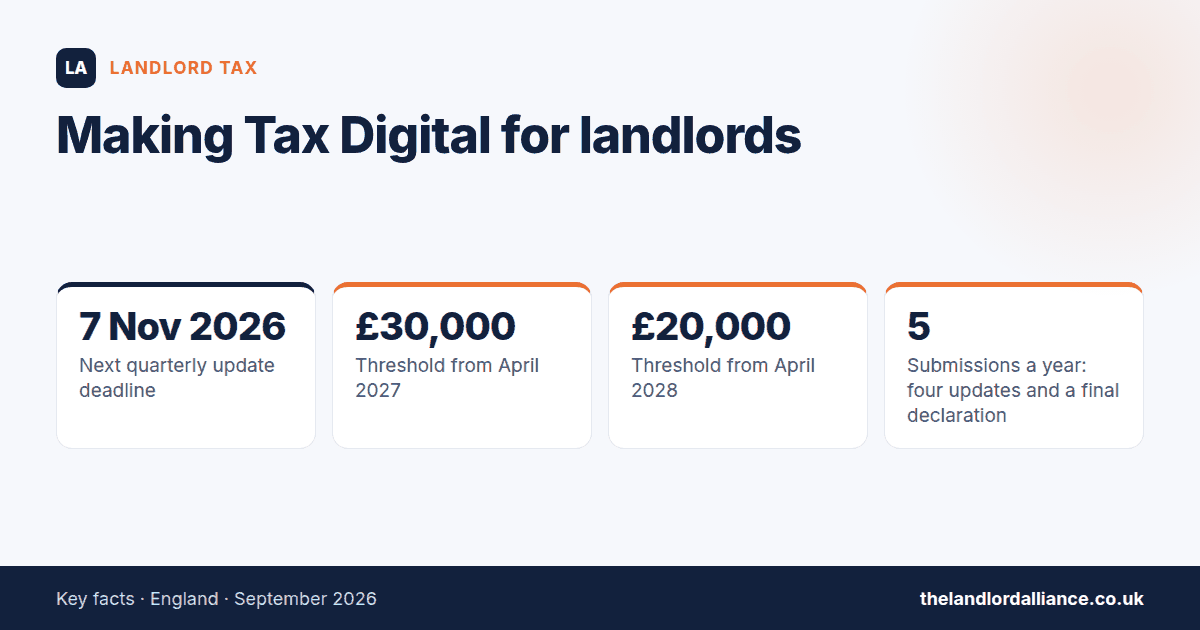
If your qualifying income was over £50,000, Making Tax Digital for Income Tax applied to you from 6 April 2026 and your first quarterly update was due on 7 August 2026. The next one is due 7 November 2026. Qualifying income means gross rent plus any self-employment turnover, measured before expenses, taken from your tax return two years earlier — so entry in April 2026 was decided by your 2024/25 return. The threshold drops to £30,000 in April 2027 and £20,000 in April 2028, which is when most landlords get caught.
Are you in scope, and when?
| Qualifying income over | You start | Decided by your return for |
|---|---|---|
| £50,000 | 6 April 2026 | 2024/25 |
| £30,000 | 6 April 2027 | 2025/26 |
| £20,000 | 6 April 2028 | 2026/27 |
Qualifying income is turnover, not profit. It is gross rent received plus gross self-employment income, before a single expense or any mortgage interest is taken off. A landlord with £56,000 of rent and £9,000 of profit is over the £50,000 line. This is the single most common misunderstanding, and it is the one that leaves people finding out late.
Two examples
In scope from April 2026. Three properties producing £54,000 of rent between them, no other trade. Qualifying income £54,000. In scope, whatever the mortgage costs are.
In scope from April 2028. One flat at £1,100 a month, so £13,200 of rent, plus £9,000 of freelance turnover. Qualifying income £22,200. Under both earlier thresholds, over the £20,000 one, so this landlord starts in April 2028 — based on their 2026/27 return, which is the year running right now.
What you actually have to do
- Keep digital records. Every item of rental income and expense recorded digitally, with the date, the amount and the category. A spreadsheet counts, provided it can be linked to software that files.
- Send four quarterly updates. Cumulative totals of income and expenses by category, filed through compatible software. No tax is calculated or paid at this point.
- Make a final declaration. After the year end, confirm the figures, add anything not covered by the quarterly updates (other income, reliefs, allowances) and finalise. Due by 31 January as before, and the tax is due then too.
The quarterly calendar
| Quarter covers | Filing deadline |
|---|---|
| 6 April – 5 July | 7 August |
| 6 April – 5 October | 7 November |
| 6 April – 5 January | 7 February |
| 6 April – 5 April | 7 May |
| Final declaration and payment | 31 January following |
You can elect to use calendar quarters instead — 1 April to 30 June and so on — which most software offers as a setting. The filing deadlines stay on the 7th. Make the election before your first update of the year and keep it consistent.
What a quarterly update is not. It is not a tax bill, it is not a return, and it does not have to be perfect. Estimates and accruals can be tidied up at the final declaration. Nothing is due to be paid on 7 November. The payment dates — 31 January and 31 July — have not changed at all.
Penalties
Late submission moved to a points system. One point per missed deadline, whether it is a quarterly update or a final declaration, and at four points you get a £200 penalty, then another £200 for each further late submission. Points clear after twelve months of filing everything on time, once anything outstanding is submitted.
Late payment penalties are separate and harsher than they were: 3% of the unpaid tax once it is 15 days late, another 3% at 30 days, then a 10% annual rate accruing daily after that, plus interest at base rate plus four points.
Do not lean on the first-year easement. HMRC has indicated a softer approach to late submission points for quarterly updates in the first year of mandation. The obligation to file is unchanged, the easement is not a permanent feature, and it does nothing at all for late payment penalties. Treat it as a safety net you never test.
Exemptions and awkward cases
| Situation | Where you stand |
|---|---|
| Digitally excluded | You can apply to HMRC for exemption on grounds of age, disability, location or religion. You still file a Self Assessment return. |
| Under the threshold | No obligation, and a spreadsheet remains legal. You can join voluntarily. |
| Jointly owned property | In scope, but there is an easement: if you only receive your share of the figures after expenses, that net amount is what counts, and you are not required to report expenses quarterly for the jointly let property. |
| Non-UK resident landlords | The rules apply to your UK self-employment and property income. |
| Property held in a limited company | Out of scope. MTD for Income Tax applies to individuals. Companies file corporation tax returns as before. |
| Furnished holiday lets | Property income, so it counts towards qualifying income — note the FHL regime itself was abolished from April 2025. |
Choosing software
Only software that has been through HMRC’s recognition process can file. HMRC withdrew its published list of products in July 2025 and replaced it with an interactive finder tool, so the only reliable check is to search that tool for the product you are considering.
Among the landlord-specific products, Hammock, Landlord Vision, Landlord Studio, PaTMa and Lendlord all appeared in the finder when we checked on 7 September 2026. General accounting packages such as Xero, QuickBooks, FreeAgent and Sage also file, and bridging tools will submit from a spreadsheet you already keep — usually the cheapest and least disruptive option if your records are tidy.
Being honest about our own product. The Landlord Alliance is not on HMRC’s recognised list and does not submit anything to HMRC. If filing is what you need solved, one of the products above is your answer, not us. Our full comparison, including prices, is in landlord software compared.
What to do this week
- If you are already in scope and have filed nothing: speak to an accountant now. Two deadlines have passed and the third is 7 November. This is a fixable problem that gets more expensive with every quarter.
- If you are in scope and filing: check your categories match what your final declaration will need, and check joint ownership is set up correctly. Both are easier to fix now than in January.
- If April 2027 or 2028 is your year: your entry is decided by a return you have not filed yet. Start recording digitally from the beginning of a tax year rather than mid-way — the migration is the hard part, not the filing.
- If you are near a threshold: work out your gross rent, not your profit, and check it against the line. Then check it again including any freelance income.
Read next
Do I pay tax quarterly under MTD?
No. The payment dates are unchanged: 31 January and 31 July. Quarterly updates report figures, they do not create a bill.
Can I keep using my spreadsheet?
Yes, if it holds the required digital records and you link it to bridging software that submits to HMRC. What you cannot do is type figures from paper into a portal.
What counts towards the threshold if I have two properties and a job?
Employment income does not count. Gross rent from both properties does, as does any self-employment turnover. Add the gross figures and compare to the threshold.
My accountant does everything — does this change anything?
Yes. Someone still has to keep the digital records through the year, and four filings a year is more work than one. Agree who does what, and what it costs, before the year gets away from you.
What if my income drops below the threshold?
Once you are in, you generally stay in unless your qualifying income falls below the threshold for three consecutive years. Do not assume a single quiet year takes you out.
Is there a penalty for a wrong figure in a quarterly update?
The updates are not expected to be final. Errors are corrected in the next cumulative update or at the final declaration. The penalties are for filing late, not for estimating.
Sources. gov.uk: Making Tax Digital for Income Tax for sole traders and landlords, step by step; check if you are eligible for Making Tax Digital for Income Tax; HMRC find-software tool (Beta). Penalty detail cross-checked against published professional-body guidance. Checked 7 September 2026.
Related: Landlord tax · Free calculators · All guides