Read this first. The Landlord Alliance is one of the products compared on this page. We built it, so we have an obvious interest in what you conclude. Every price below is quoted from the vendor’s own published pricing page as it stood on 7 September 2026, every gap in our knowledge is marked as a gap rather than filled in, and the paragraph describing what our own product cannot do is longer than the one describing what it can.
The short version
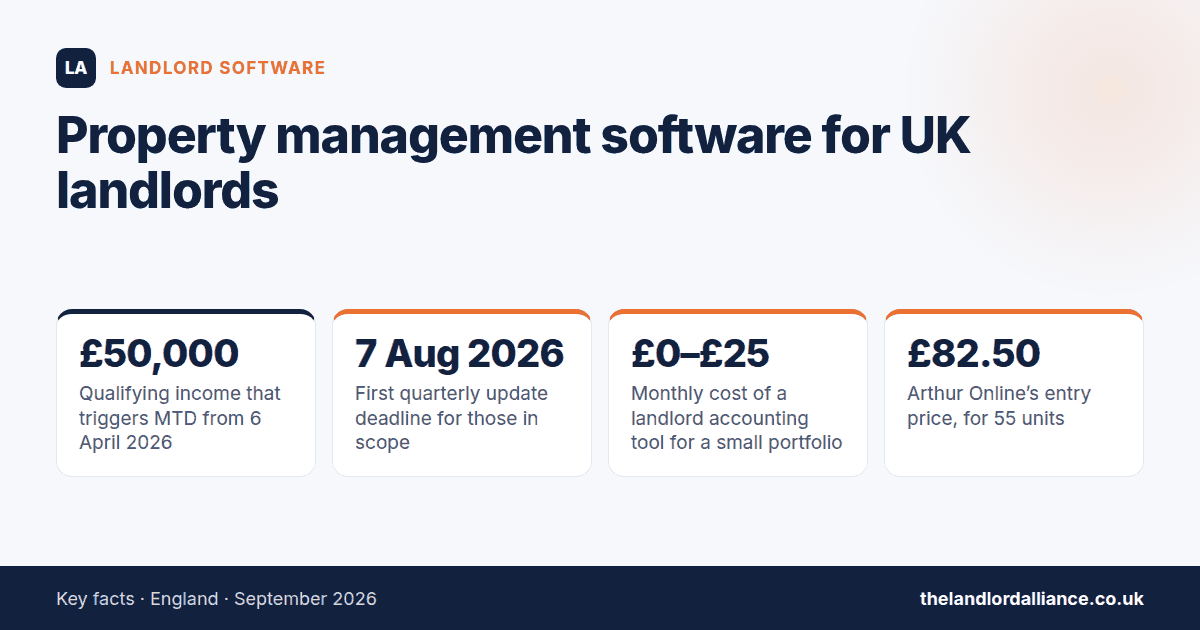
Three genuinely different kinds of product are sold under the name “property management software”, and buying the wrong category is the expensive mistake, not paying £5 a month too much. Self-managing landlords with fewer than about 30 properties want landlord accounting software; the agency-grade platforms that dominate the search results are priced from roughly £80 a month and are built for someone managing units on behalf of other owners. Making Tax Digital is now the sorting mechanism: from 6 April 2026 landlords with qualifying income over £50,000 must keep digital records and file quarterly, and only software on HMRC’s recognised list can do it.
If you have one to five properties and you file your own tax return, the honest answer is that a £0–£15 per month tool will do everything you need. Read the next section before you look at a single pricing page.
“Property management software” means three different things
This is the single most useful thing on the page. The phrase is used by three product categories that share almost no buyers, and the comparison articles that rank for it mix them together, which is why a landlord with four flats regularly ends up on a demo call for a platform priced for a lettings agency with 300 units.
| Category | What it actually does | Built for | Typical price | Examples |
|---|---|---|---|---|
| Landlord accounting and tax | Records rent and expenses, reconciles a bank feed, produces the figures for your tax return and, increasingly, submits them to HMRC | Self-managing landlords, roughly 1–30 properties | £0–£25/month | Hammock, Landlord Studio, Landlord Vision, PaTMa |
| Portfolio and asset management | Tracks value, equity, LTV, yield and cash flow across the portfolio; models refinancing and new purchases; holds compliance dates and documents | Landlords who think of the portfolio as an investment, not just a set of tenancies | £0–£30/month | The Landlord Alliance, Lendlord, Alphaletz |
| Agency and block management | Manages units on behalf of other owners: client accounting, owner statements, contractor workflows, multi-branch permissions | Letting agents, block managers, build-to-rent operators | £80–£500+/month | Arthur Online, Reapit, Fixflo |
The test. Do you hold money that belongs to someone else? If yes, you need client accounting and you are in the third category. If no, you are almost certainly in the first two, and you can ignore roughly nine-tenths of what is written about property management software.
Start here: which one you actually need
Rather than ranking products, here is the decision as it usually presents itself.
| Your situation | What to buy | Why |
|---|---|---|
| 1–2 properties, income under £20,000, tidy records | Nothing yet, or a free tier | MTD will not reach you until at least April 2028 on the announced timetable. A spreadsheet remains legal. PaTMa and Lendlord both have genuinely free options if you want structure without cost. |
| Income over £50,000, self-assessment filed by you | A recognised MTD product, chosen now | You are in scope from 6 April 2026 and your first quarterly update was due 7 August 2026. Hammock, Landlord Studio, Landlord Vision, PaTMa and Lendlord all appear on HMRC’s recognised list. |
| Income over £50,000, accountant files for you | Ask the accountant first | Many practices have standardised on one product and will discount or absorb it. Buying a different one creates work for both of you. |
| Records already tidy in a spreadsheet you like | Bridging software | Several recognised products do nothing but take a compliant spreadsheet and file from it. It is usually the cheapest route and the least disruptive. |
| Growing portfolio, thinking about refinancing and yield | Portfolio management, plus tax software or an accountant | Accounting tools tell you what happened. Portfolio tools tell you what the portfolio is worth and what it can support. These are different jobs and few products do both well. |
| Managing units for other landlords | Agency software | Client money handling, owner statements and audit trails are not features you can improvise. This is the one case where £80–£150 a month is the right answer. |
Qualifying income is gross rent, not profit. The £50,000 test is applied to turnover from self-employment and property before expenses, and before mortgage interest. A landlord with £58,000 of rent and £12,000 of profit is in scope. This catches people out more than any other part of the rules.
What it costs
Every figure here is taken from the vendor’s own pricing page on 7 September 2026. Software pricing changes often and promotional rates come and go, so treat this as a shape rather than a quote, and check before you pay.
| Product | From | What that covers | Files MTD to HMRC | Free option |
|---|---|---|---|---|
| Hammock | £8 + VAT/month | 1–3 properties; £15 for 4–10, £25 for 11–20, £31.50 for 21+. 20% off annually. | Yes — quarterly updates and final declaration on every plan | No |
| Landlord Studio | £12/month | Pro plan, 3 units included, then £1.20 per extra unit; five bank feeds | Yes, included on Pro. The free plan files at £5 per submission. | Yes — MTD Go, up to 3 units |
| Landlord Vision | From £11.97/month | Flat-rate plans; free trial available | Yes | Trial only |
| PaTMa Property Manager | £15/month | Pro plan, 5 units included, then £1.50 per unit to 100 | Yes — both tiers described as MTD ready | Yes — 1 rental unit |
| Lendlord | £0 | Portfolio tracking, financing analysis | Yes | Yes — free for landlords until further notice |
| The Landlord Alliance | £10/month or £99/year | 1–19 properties; £29/month or £290/year above that. No contract. | No — not on HMRC’s recognised list | No |
| Arthur Online | £82.50/month | 55 units included, then £1.50 per unit; annual billing | No | No |
The price is not the cost. At these numbers the difference between the cheapest and the dearest small-landlord tool is around £200 a year. The cost that matters is the twenty hours you spend migrating to the wrong one, discovering in month four that it cannot do the thing you bought it for, and migrating again.
Eight things to check before you pay
- Does it appear in HMRC’s software finder? If MTD applies to you, this is not a feature comparison, it is a gate. A product that cannot file is not a candidate, whatever else it does well.
- Does the price cover your unit count, or your property count? A four-bed HMO let by the room is one property and can be four units. Per-unit pricing changes the arithmetic sharply for HMO landlords.
- How many bank accounts can you connect? Landlord Studio’s Pro plan allows five, Pro Plus twenty. If you run an account per company or per property, check this before anything else.
- Can you get your data out? Ask for the export format in writing before you import a decade of transactions. “You can export to CSV” and “you can export a reconciled ledger with opening balances” are different promises.
- Who fixes it when HMRC changes the API? Quarterly filing is a live integration with a government service. Small vendors have handled this well and large ones have handled it badly, so look at how the product behaved through the 2025–26 testing phase rather than at company size.
- Does it handle jointly owned property? Spouses splitting rental income 50/50 need the split reflected in what is filed. Not every tool does this cleanly.
- What happens to your documents if you cancel? Certificates, tenancy agreements and deposit paperwork are legal records you may need years later. Check the retention and export terms, not the marketing page.
- Is there a contract? Annual billing and an annual contract are not the same thing. Arthur bills annually by default; several of the smaller tools let you leave monthly. Ask which you are agreeing to.
Where switching goes wrong
Almost all the pain in this category is migration pain, and almost none of it is discussed in the comparison articles.
Mid-year switching. Moving between products part-way through a tax year means your figures live in two places and the reconciliation falls to you. If you can, switch at the start of a tax year. If you cannot, keep the old system readable until the return is filed rather than cancelling on day one.
Opening balances. Importing transactions is easy; importing the position you were in when the transactions start is not. Arrears carried forward, deposits held, and part-paid invoices are the three that usually break. Expect to enter these by hand and check them against the bank.
Bank feed history. Open banking connections typically pull between 90 days and 12 months of history, not the full record. If you are adopting mid-year, you will need to import the earlier months from statements.
Deposits. A deposit is not income and should not appear as rent received. Some tools handle protected deposits as a distinct liability, others expect you to categorise around it. If yours does the latter, be deliberate about it — the consequences of losing track of a deposit are set out in our guide to unprotected deposit penalties.
Software does not make you compliant. It records what you did. Gas safety, EICRs, right to rent, deposit protection and the notice requirements under the Renters’ Rights Act are obligations that exist whether or not a dashboard is showing them. A tracker is useful precisely because it is a prompt, not a substitute.
Where The Landlord Alliance fits
What it is
A portfolio and compliance platform: value, equity, LTV, yield and cash flow on every property; a red/amber/green compliance tracker; rent, arrears, tenancies and maintenance; a document library; templates that fill themselves in; an AI adviser; and a landlord community. £10 a month or £99 a year for 1–19 properties, £29 or £290 above that. No contract or minimum term.
What it is not
It is not accounting software and it does not submit anything to HMRC. It is not on HMRC’s recognised software list, so it cannot be the product you use to meet Making Tax Digital. It has no free tier, while PaTMa, Lendlord and Landlord Studio all do. It is not agency software: there is no client accounting and no owner statements, so if you manage property for other landlords it is the wrong tool. If your single problem is quarterly filing, buy Hammock, Landlord Vision, Landlord Studio or PaTMa instead — and if you are in scope for April 2026, buy one of them regardless of what else you use.
Read next
What is the best property management software for UK landlords?
There is no single answer because the products are not competing for the same buyer. For a self-managing landlord in scope for MTD, the shortlist is Hammock, Landlord Vision, Landlord Studio and PaTMa. For a landlord managing units on behalf of other owners, it is Arthur Online or a comparable agency platform. Anyone who names one winner for both has not understood the question.
Do I legally have to use property management software?
No. Once MTD for Income Tax applies to you, you must keep digital records and file quarterly using compatible software, but that is a narrower requirement than “property management software” — a bridging tool over a spreadsheet satisfies it. Outside MTD, a spreadsheet remains perfectly legal.
Can I use Xero or QuickBooks instead?
Yes, and many landlords with company structures do. General accounting packages handle MTD and are strong on bookkeeping, but they know nothing about tenancies, deposits, compliance dates or per-property yield. The landlord-specific tools trade some accounting depth for that knowledge.
How much should I expect to pay?
For one to ten properties, £8–£15 a month covers everything most self-managing landlords need, including MTD filing. Above roughly 30 units the per-unit charges start to matter and it is worth modelling the actual number. Above 50 units managed for other people, the agency platforms begin at around £82.50 a month.
Is free landlord software good enough?
For one or two properties, often yes. Watch the caps and the exceptions: PaTMa’s free plan covers a single unit, and Landlord Studio’s free plan charges £5 for each MTD submission, which changes the arithmetic once you are filing four times a year plus a final declaration. We look at each free tier in detail in our guide to free landlord software.
When do I need to have chosen something?
If your qualifying income was over £50,000, you are in scope from 6 April 2026 and your first quarterly update was due 7 August 2026. If you have not started, that is a conversation to have with an accountant this week rather than a software comparison to browse.
How we checked. Prices were read from each vendor’s own published pricing page on 7 September 2026, and MTD recognition from HMRC’s find-software tool, which is in Beta. Software pricing changes frequently — check before you buy. The Landlord Alliance is a product described on this page; treat our assessment of ourselves accordingly.
Sources: gov.uk Making Tax Digital for Income Tax for sole traders and landlords, step by step; HMRC find-software tool; published pricing pages for Hammock, Landlord Studio, Landlord Vision, PaTMa, Lendlord and Arthur Online; Capterra UK listing data.
Related: All landlord guides · Free calculators · Our pricing