The short version
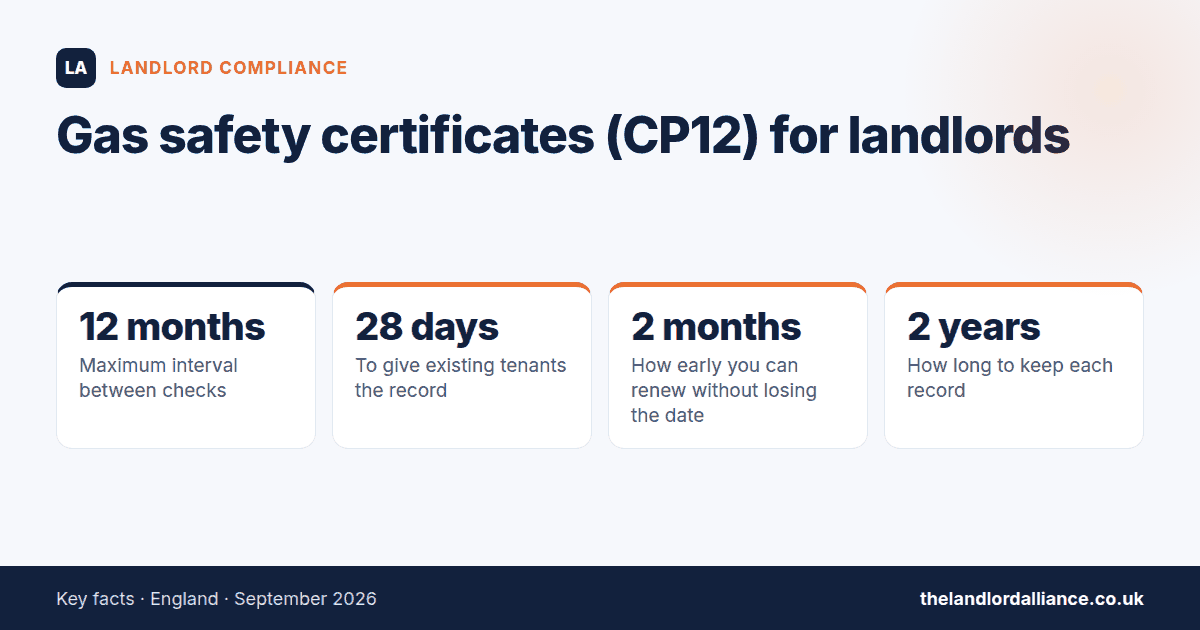
Every gas appliance, flue and pipework you own in a let property must be checked every 12 months by a Gas Safe registered engineer. Give the record to existing tenants within 28 days, and to new tenants before they move in. Keep it for two years. The one piece of flexibility most landlords do not know about: you can have the check done up to two months early and keep the original expiry date, so there is no good reason to let one run out.
What the check actually covers
The engineer checks every gas appliance and flue that you as landlord own or are responsible for: the boiler, the gas fire, the gas hob if you supplied it, and the pipework serving them. They confirm each appliance burns correctly, that ventilation is adequate, that flues carry the products of combustion safely away, and that the installation is not at risk.
Appliances the tenant owns are not part of your check — but the flue and the pipework serving them still are, because they are part of the installation. In practice, if the tenant has brought their own gas cooker, the engineer will still want to look at the connection.
“CP12” is a legacy name. CP12 was a CORGI form number and CORGI has not run the register since 2009. The correct name is the Landlord Gas Safety Record. Everyone still says CP12, including engineers, and nothing turns on it — but if a document calls itself something else entirely, check it was issued by a Gas Safe registered engineer.
The deadlines
| What | When |
|---|---|
| The safety check | Every 12 months, by a Gas Safe registered engineer |
| Copy to existing tenants | Within 28 days of the check |
| Copy to a new tenant | Before they occupy the property — not within 28 days |
| Keep the record | Two years |
| Early renewal window | Up to two months before expiry, keeping the original anniversary date |
Verifying the engineer
Only a Gas Safe registered engineer can carry out the check, and registration is specific to the type of work. Ask to see the Gas Safe ID card, check the licence number on the Gas Safe Register website, and check the back of the card for the categories of work they are qualified for. A card that covers commercial catering does not cover a domestic boiler.
This takes ninety seconds and it is the only part of the process you can genuinely get wrong through no fault of your own — a record from an unregistered person is worth nothing, and the liability is yours.
When the tenant will not let them in
You have no right to force entry, and attempting it would be harassment. What protects you is evidence of reasonable steps.
- Write, and keep the copy. A text or email with a date and a proposed appointment is fine, and is better evidence than a phone call.
- Offer more than one date, including outside working hours.
- Explain why in the letter. Many refusals are not refusals — they are people who did not realise it was a legal requirement and a safety matter.
- Escalate in writing, referring to the access clause in the tenancy agreement.
- As a last resort, apply to the court for an injunction permitting access. This is rare, and the paper trail is what makes it work.
Do not simply let it lapse. There is no defence of “the tenant would not let me in” written into the regulations — what the HSE looks at is whether you took all reasonable steps. A folder of dated attempts is that evidence. Silence for four months is not.
What non-compliance costs
Gas safety breaches are enforced by the Health and Safety Executive, not the council, and they are prosecuted rather than penalised by notice. A breach carries an unlimited fine and, where the failure is serious or has caused harm, imprisonment. Unlike most landlord obligations, this one can attract a criminal record.
There is a second consequence that is easy to overlook: an insurer is entitled to decline a claim arising from an appliance you had not had checked. A lapsed certificate can turn a fire into an uninsured loss.
Read next
Do I need one if the property has no gas?
No. If there is no gas supply and no gas appliance, there is nothing to check. If the supply is capped but present, get the engineer to confirm that in writing.
Does it cover the tenant’s own gas cooker?
Not the appliance itself, but the installation pipework and the flue serving it remain your responsibility. Most engineers will check the connection as a matter of course.
What if the check is late?
Get it done immediately. If the gap exceeds twelve months you have breached the regulations, and the fix is to restore compliance and document why it happened rather than to wait for the original anniversary.
Can I email the record to the tenant?
Yes, if the tenant has agreed to receive documents electronically. Keep proof that you sent it and when.
Do lodgers count?
Yes. The duty applies to residential lettings generally, including a lodger in your own home.
Is a boiler service the same thing?
No. A service is maintenance and is not a legal requirement; the annual safety check is. Most engineers will do both in one visit, and it is worth paying for — but do not assume a service certificate satisfies the regulations.
Sources. Gas Safety (Installation and Use) Regulations 1998, regulation 36; Health and Safety Executive landlord guidance; Gas Safe Register. Checked 7 September 2026.
Related: Compliance checklist · All guides · Free calculators