The short version
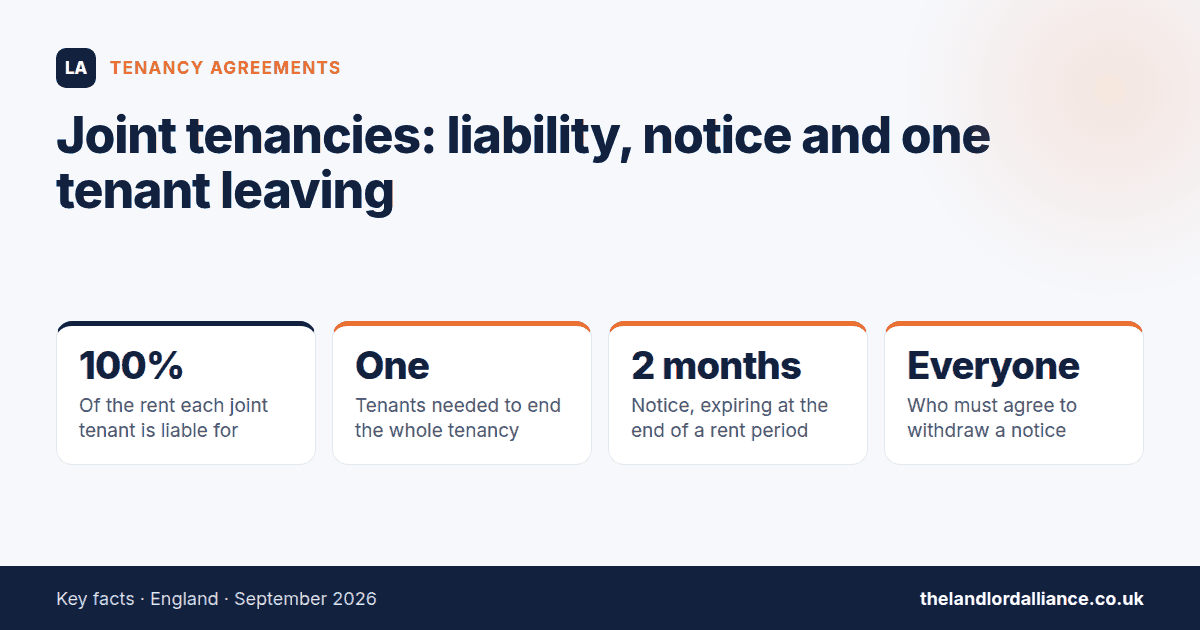
Two things about joint tenancies matter more than everything else combined. First, liability is joint and several: each tenant is liable for all of the rent, not their share of it, so if one stops paying you can pursue any of them for the whole amount. Second, and this is the one that catches people out since May 2026 — a notice to quit from one joint tenant ends the tenancy for everyone. The others have no right to stay. And once that notice is served it cannot be withdrawn unless every joint tenant and the landlord agree.
Joint and several liability, in practice
A joint tenancy is one tenancy held by two or more people together, not several tenancies running side by side. That has a specific consequence: each tenant is liable for the whole of the rent and the whole of any damage, not for a proportionate share.
| Situation | What people assume | What is actually true |
|---|---|---|
| Rent is £1,200 between three tenants; one stops paying | £400 is outstanding and it is that tenant’s problem | £400 is outstanding and all three are liable for it. You can pursue whichever one is good for the money. |
| One tenant damages a room | The deposit is split and only their share is at risk | The deposit is one deposit for one tenancy. Deductions come out of the whole. |
| Arrears reach three months | Ground 8 applies only to the defaulting tenant | Ground 8 is about the tenancy. Possession is sought against all of them. |
| One tenant moves out and stops paying | They are off the hook once they have gone | They remain a tenant, and liable, until the tenancy ends properly. Leaving the property is not leaving the tenancy. |
One tenant gives notice: the whole tenancy ends
This is the biggest practical change since May 2026, and it works in a way that surprises tenants and landlords equally.
Under section 20 of the Renters’ Rights Act a tenant ends the tenancy by giving at least two months’ notice, expiring at the end of a rent period. Where the tenancy is joint, a notice given by any one of the joint tenants brings the whole tenancy to an end — for all of them — even if the others want to stay.
The withdrawal trap. A notice to quit cannot simply be taken back. To withdraw it, or to agree a shorter period than two months, every joint tenant and the landlord must agree. So a housemate who serves notice in the middle of an argument and regrets it a week later has created a situation that only unanimous agreement can undo. If even one of the others is unreachable, or the landlord declines, the tenancy ends on the notice date.
What happens next is a commercial decision, not a legal obligation. The remaining tenants have no automatic right to continue. You may grant a new tenancy to whoever you want to keep — with fresh referencing, a fresh deposit, a fresh written statement of terms and a fresh right to rent check — or you may let the tenancy end and re-let the property. You are not obliged to offer anything.
Replacing one tenant mid-tenancy
The tidy scenario: one housemate leaves, a replacement moves in, everyone else stays. There is no statutory mechanism for swapping a name on a joint tenancy, so this is done by ending the old tenancy and granting a new one — a surrender and regrant.
- Reference the incoming tenant and complete a right to rent check before they move in. The check attaches to occupation, not to the paperwork.
- Agree the surrender in writing with all the outgoing and continuing tenants, with a clear date.
- Deal with the deposit properly. The old tenancy’s deposit is returned or transferred and the new tenancy’s deposit protected within 30 days, with fresh prescribed information to every tenant. This is where most landlords slip.
- Issue a new written statement of terms naming everyone.
- Check the guarantors. A guarantee given for the old tenancy does not automatically extend to the new one.
Let the tenants settle the money between themselves. Who repays whose share of the deposit is their arrangement, not yours, and getting drawn into it is how landlords end up in the middle of an argument they had no part in.
Deposits with joint tenants
There is one deposit for one tenancy, however many people contributed to it. Protect it once, within 30 days, and serve the prescribed information on every tenant — not just the one who transferred the money. Serving only the lead tenant is a common and expensive mistake, since the penalty for getting deposit protection wrong runs to three times the deposit.
At the end, the deposit is dealt with as a whole. If the tenants disagree about how the return should be split between them, that is a dispute between them; your job is to account for the deposit correctly and evidence any deductions. See deductions and disputes for what adjudicators actually accept.
Guarantors on a joint tenancy
The single most common drafting failure in this area is ambiguity about scope. Say explicitly what the guarantee covers:
- Whose obligations? Just the tenant they are related to, or all the tenants jointly? Parents usually assume the former; the document often says the latter.
- What obligations? Rent only, or rent plus damage and costs?
- For how long? Every tenancy is periodic now, so a guarantee limited to “the fixed term” covers nothing. It needs to run for the duration of the tenancy.
- Signed when? Before the tenancy starts. A guarantee signed afterwards may fail for want of consideration.
A guarantor who signs believing they are covering one third of the rent, and is then pursued for all of it, is a guarantor who will contest the guarantee. Clear drafting protects you as much as them.
Council tax
Joint tenants of a whole property are jointly and severally liable for council tax, in the same way as for rent. The exception is where the property is a house in multiple occupation for council tax purposes — typically where tenants have separate agreements for individual rooms — in which case the liability falls on the landlord. That distinction turns on how you let, not on what the agreement is called.
Read next
Can one tenant end a joint tenancy for everyone?
Yes. A notice to quit from any one joint tenant ends the tenancy for all of them, even if the others want to stay. This is the position under section 20 of the Renters’ Rights Act.
Can that notice be withdrawn?
Only if every joint tenant and the landlord agree. One holdout, or a landlord who declines, and the tenancy ends on the notice date.
Do the remaining tenants have a right to stay?
No. The landlord may grant them a new tenancy but is not obliged to. Anyone continuing to occupy needs a fresh agreement, deposit, prescribed information and right to rent check.
If one tenant stops paying, can I pursue the others?
Yes. Joint and several liability means each tenant is liable for the whole rent, so you may pursue any of them for the full arrears.
Do I need one deposit or one per tenant?
One deposit for one tenancy, protected once, with prescribed information served on every tenant individually.
Is a joint tenancy better than separate room agreements?
For a group who know each other, usually yes — joint and several liability is a real protection and there is one set of paperwork. Separate room agreements suit a property let room by room, but they can bring the property into HMO territory for licensing and shift council tax liability to you.
Sources. Renters’ Rights Act 2025 (c. 26), section 20 on tenant notices to quit and the joint tenancy provisions; Commencement No. 2 Regulations SI 2026/421; Housing Act 2004 Part 6 on deposit protection; Local Government Finance Act 1992 on council tax liability. Checked 8 September 2026.
Related: The Renters’ Rights Act · All guides · Free calculators