The short version
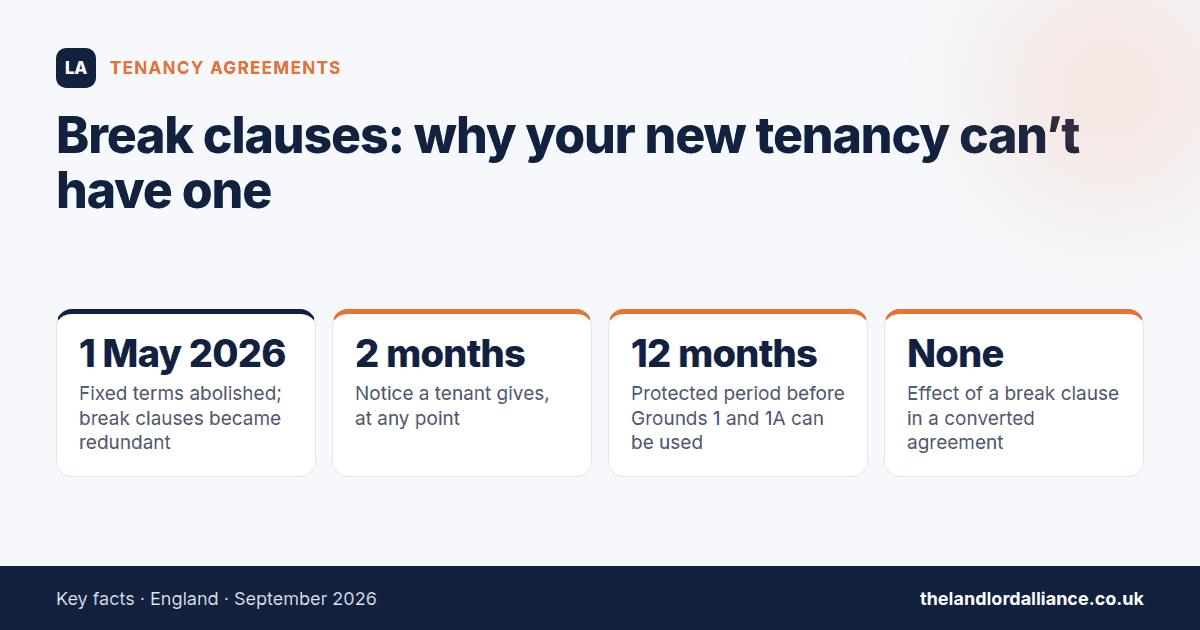
If you are looking for a break clause for a tenancy granted on or after 1 May 2026, you will not find one, because there is nothing left to break. The Renters’ Rights Act abolished fixed terms. Every assured tenancy is periodic from the first day, the tenant can leave on two months’ notice at any point, and a landlord needs a ground under section 8 — so a clause that lets either side exit early is describing a problem that no longer exists. If your existing agreement still contains one, it converted with the rest of the tenancy on 1 May 2026 and the clause now has no legal effect.
What a break clause was for
Under the old system a tenancy usually had a fixed term — six or twelve months — during which neither side could simply walk away. A break clause was the negotiated escape hatch: typically exercisable after month six, on two months’ notice, by one or both parties.
It existed because the fixed term was a cage. Remove the cage and the clause has nothing to do. That is exactly what happened.
What replaced it
| Before 1 May 2026 | Now | |
|---|---|---|
| Tenant wants to leave | Bound for the fixed term unless a break clause applied or the landlord agreed a surrender | Two months’ notice, at any point, ending at the end of a rent period |
| Landlord wants possession | Section 21 after the fixed term, or a break clause, or a section 8 ground | A section 8 ground only. No no-fault route. |
| Earliest the landlord can act to sell or move in | Effectively the end of the fixed term | Grounds 1 and 1A cannot be used in the first 12 months of the tenancy |
| Fixed term in the agreement | Binding | No effect. All tenancies are periodic from day one. |
This is the change landlords most often underestimate. A break clause gave you a date you could plan around. You no longer have one. A tenant who signs in January can serve notice in February and be gone by the end of April, and there is nothing in any agreement you can write that changes that. Budget voids accordingly — our buy-to-let numbers assume 10% of rent for maintenance and voids for exactly this reason.
If your agreement still has one in it
Plenty of live agreements still contain a fixed term and a break clause, because landlords were not required to reissue anything when the Act commenced. Three things follow.
- The clause has no effect. The tenancy converted to a periodic assured tenancy by operation of law on 1 May 2026. A term purporting to bind the tenant for twelve months, or to limit when they can give notice, cannot be enforced.
- The rest of the agreement survives. One void term does not void the contract. The repairing obligations, the rules on pets and subletting, the access arrangements all stand.
- You should still have served the information sheet. Existing tenants had to be given the government’s Renters’ Rights Act information sheet by 31 May 2026 — a separate duty from the agreement itself, carrying a penalty of up to £7,000 per breach. If you missed it, read what to do now.
For new tenancies, do not simply delete the break clause and leave the fixed term. Both have to go, and what you need instead is a compliant written statement of terms.
The nearest thing to a landlord break: the 12-month protected period
Grounds 1 (you or a close family member moving in) and 1A (selling) cannot be used during the first twelve months of a tenancy. After that they become available, on four months’ notice.
So the practical earliest point at which a landlord can regain possession to sell, absent any fault by the tenant, is around sixteen months from the start of the tenancy — twelve months protected, then four months’ notice, and longer again if the tenant does not leave on the notice date and the claim goes to court. If you are buying a property you expect to sell within two years, that timeline belongs in the decision. Ground 1A also carries a twelve-month ban on re-letting afterwards.
If you genuinely need flexibility
There is no drafting solution, and any agent or template offering one is selling you a clause that will not survive contact with a court. What does work:
- Surrender by agreement. If both sides want to end the tenancy early, they can agree to it. Put it in writing, record the date possession is given back, and deal with the deposit and final rent in the same document.
- A serviced or holiday let, if that is genuinely what it is. Short-term lets outside the assured tenancy regime are a different product with different rules, not a workaround for an ordinary letting. Calling something a holiday let when a family lives there year-round does not make it one.
- Buy for the hold, not the flip. The regime rewards landlords who intend to let for years and penalises those who need the property back on a schedule. That is a deliberate policy choice, and planning around it is easier than fighting it.
Read next
Can I put a break clause in a new tenancy agreement?
You can write one, but it will have no legal effect. Fixed terms were abolished on 1 May 2026, so there is no term to break. A tenant can leave on two months’ notice regardless of what the agreement says.
My tenancy started in 2025 and has a six-month break clause. Does it still apply?
No. The tenancy converted to a periodic assured tenancy on 1 May 2026 and the fixed term and break clause ceased to have effect from that date. The tenant now gives two months’ notice; you need a section 8 ground.
How much notice does a tenant have to give?
At least two months, and the notice must expire at the end of a rent period. A shorter period is possible only if the landlord agrees.
Can I hold the tenant to twelve months if they agreed to it?
No. The tenant cannot contract out of the statutory position, and an agreement that tries to do so is unenforceable on that point.
When can I get the property back to sell it?
Not in the first twelve months. After that, Ground 1A requires four months’ notice, and you cannot re-let the property for twelve months after using it.
Does any of this apply to a lodger?
No. A lodger in your own home is an excluded occupier under a licence, not an assured tenancy, and the Renters’ Rights Act rules do not apply.
Sources. Renters’ Rights Act 2025 (c. 26), including section 20 on tenant notices to quit; Commencement No. 2 Regulations SI 2026/421; GOV.UK guide to the Renters’ Rights Act, including the 12-month protected period for Grounds 1 and 1A; Housing Act 1988 Schedule 2 as amended. Checked 8 September 2026.
Related: The Renters’ Rights Act · All guides · Free calculators