This is the one page on this site where you genuinely should not act without an accountant. Incorporation decisions turn on your whole financial position, and the transfer costs are large and irreversible. What follows is the shape of the decision, not advice on your version of it.
The short version
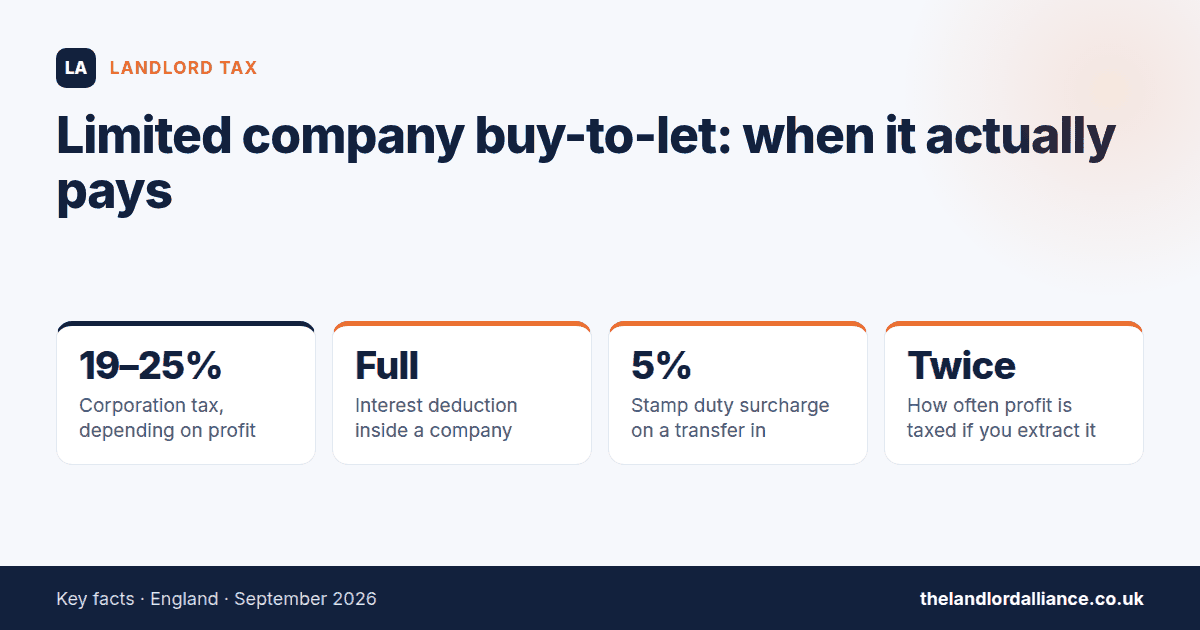
Companies still deduct mortgage interest in full, and they sit outside the new property income rates arriving in April 2027. That makes a company decisively better for a higher-rate taxpayer buying from here and retaining the profit. It makes it much less obviously better if you intend to draw everything out as dividends, and it is often a bad idea for property you already own personally, because moving it in is a disposal — capital gains tax and stamp duty, payable now, against savings that arrive slowly.
The core arithmetic
Same property both ways: £18,000 rent, £3,000 running costs, £6,000 mortgage interest, owner a higher-rate taxpayer.
| Owned personally | In a company, profit retained | In a company, profit drawn | |
|---|---|---|---|
| Rent | £18,000 | £18,000 | £18,000 |
| Running costs | −£3,000 | −£3,000 | −£3,000 |
| Mortgage interest | Not deductible | −£6,000 | −£6,000 |
| Taxable profit | £15,000 | £9,000 | £9,000 |
| Tax at 40% / corporation tax at 19% | −£6,000 | −£1,710 | −£1,710 |
| Section 24 credit | +£1,200 | — | — |
| Dividend tax on extraction | — | — | −£2,606 |
| Left over | £4,200 in your hand | £7,290 in the company | £4,684 in your hand |
That table is the whole argument. If you are reinvesting, the company keeps 73% more of the same rent working for you. If you need the money to live on, the advantage shrinks to something that a slightly worse mortgage rate could wipe out entirely.
What it costs to run
| Cost | Reality |
|---|---|
| Corporation tax | 19% on profits to £50,000, 25% above £250,000, with marginal relief between — producing an effective 26.5% on the slice in the middle. |
| Mortgage rates and fees | Limited company products typically price above personal buy-to-let, with a smaller lender pool and higher arrangement fees. This is the cost people most often leave out. |
| Personal guarantees | Almost every lender will require one. The limited liability is not as complete as the structure suggests. |
| Accountancy and filing | Annual accounts, a corporation tax return and a confirmation statement, every year, per company. |
| Extraction | Dividends are taxed again in your hands. Dividend rates rose two percentage points in April 2026. |
Moving existing property in: the part that usually decides it
Transferring a property you own personally into your own company is a disposal at market value, even though no money changes hands and you own both sides.
- Capital gains tax on the gain, at 18% within your basic rate band and 24% above it, payable within 60 days of completion.
- Stamp duty paid by the company on the market value, including the 5% additional property surcharge.
- Early repayment charges on the existing mortgage, plus fees and legals on the new one.
Run this number before anything else. On a property worth £300,000 with a £100,000 gain, the capital gains tax could be around £24,000 and the stamp duty around £20,000 — roughly £44,000 to save a Section 24 cost that might be £1,200 a year. That is a thirty-year payback. The arithmetic only changes if a relief applies.
The reliefs, and why they are not a shortcut
Two reliefs are commonly raised, and both are narrower than the marketing suggests.
Incorporation relief can defer the capital gains tax where an actual business is transferred as a going concern in exchange for shares. The critical word is business: HMRC and the tribunals look for substantial, regular activity, not passive ownership of a few lets. A landlord with two properties and an agent will not qualify.
Partnership stamp duty relief can reduce the SDLT where an existing genuine partnership incorporates. It requires a real partnership that existed and operated as one before the transfer, evidenced properly. Retrospectively declaring a partnership to access the relief is exactly the arrangement HMRC challenges.
Both are legitimate where the facts genuinely fit. Neither is a scheme you can bolt on, and both need specialist advice before you commit, not after.
Who it suits
| Situation | Verdict |
|---|---|
| Higher-rate taxpayer, buying new property, building a portfolio, reinvesting profit | Usually yes. This is the case the structure is built for. |
| Higher-rate taxpayer, one or two properties, needs the income now | Marginal. The extraction tax and running costs eat most of the gain. |
| Basic-rate taxpayer | Usually no. Section 24 costs you little, so the main benefit does not apply. |
| Existing personally-held portfolio, no relief available | Usually no. The transfer cost is the answer, and it is normally decisive. |
| Planning to pass property to children | Worth advice. Shares can be gifted incrementally in a way a property cannot, which is a genuine advantage — but this is inheritance planning, not tax arbitrage. |
Read next
Is a limited company better for buy-to-let?
For a higher-rate taxpayer buying new property and reinvesting the profit, usually yes. For a basic-rate taxpayer, or someone who needs to draw the income, usually not by enough to matter.
Can I move my existing properties into a company tax-free?
Rarely. It is a disposal at market value, so capital gains tax and stamp duty normally apply. Incorporation relief can defer the gain but only where a genuine property business is transferred.
Do companies pay the 5% stamp duty surcharge?
Yes, on residential purchases, including transfers from the owner.
Are company mortgage rates worse?
Generally yes, with higher fees and fewer lenders. Model the finance premium against the tax saving — on one property it can cancel it out.
Do the April 2027 property income rates apply to companies?
No. Those rates apply to individuals. Companies pay corporation tax, which widens the gap further from 2027.
Can I take money out without paying dividend tax?
You can repay a director’s loan tax-free if you genuinely lent the company money — for example the deposit. Beyond that, extraction is taxed.
Sources. Corporation Tax Act 2010 on rates and marginal relief; Taxation of Chargeable Gains Act 1992, section 162 (incorporation relief); Finance Act 2003, Schedule 15 paragraph 18 (partnership SDLT); HMRC Property Income Manual; House of Commons Library briefing CBP-10450 on the Budget 2025 dividend and property income rates. Rates checked 8 September 2026.
Related: Landlord tax · All guides · Free calculators