This is information, not investment advice. We are landlords, not financial advisers, and nothing here is a recommendation to buy or not buy. The numbers below are worked openly so you can put your own in.
The short version
Buy-to-let has not stopped working, but it has stopped working passively, and it has stopped working the same way for everyone. Three things changed the arithmetic: a 5% stamp duty surcharge on the whole purchase price, Section 24 taxing revenue rather than profit, and a tenancy regime where the tenant can leave on two months’ notice and you cannot ask them to. The result is a widening gap between basic-rate and higher-rate taxpayers on identical deals. On the worked example below, a basic-rate taxpayer nets £2,864 a year and a higher-rate taxpayer nets £648 — same flat, same mortgage, same rent.
The three things that changed
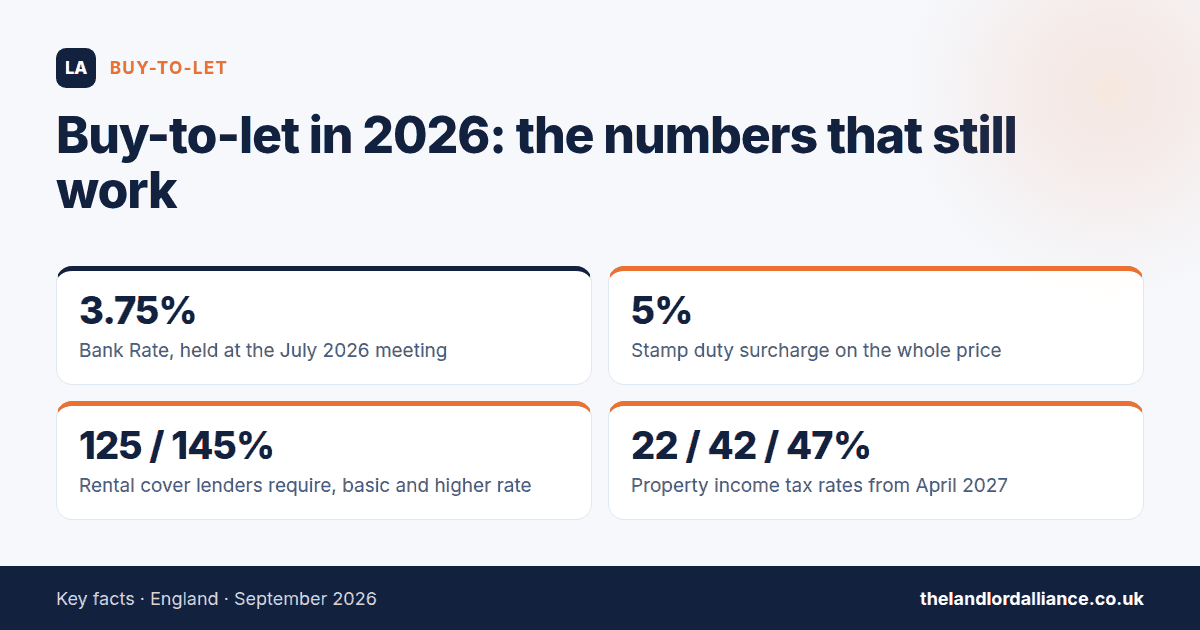
Tax moved from profit to revenue. Since April 2020, mortgage interest is not an expense. You are taxed on rent minus running costs, and then given a credit worth 20% of the interest. For a higher-rate taxpayer that is a real cost, and it also inflates your apparent income — which can drag you into a higher band, taper your personal allowance or cost you child benefit without a penny more actually reaching you. From April 2027 property income gets its own rates, two points higher, at 22, 42 and 47%.
Entry costs rose sharply. The additional property surcharge is 5%, and it applies to the whole purchase price, not the slice above a threshold. On a £200,000 flat that is £11,500 of stamp duty where an owner-occupier would pay £1,500. That is not a rounding error — it is roughly two years of net rent on a typical deal.
Tenancies became open-ended. Since 1 May 2026 there are no fixed terms and no section 21. The tenant can leave on two months’ notice at any point; you need a ground under section 8. If you sell using Ground 1A, you cannot re-let for twelve months. Void risk is now asymmetric, and it belongs in your numbers.
A worked deal, start to finish
A £200,000 two-bed flat, bought with a 25% deposit, let at £1,100 a month, self-managed, on an interest-only mortgage at 5%.
What it costs to get in
| Item | Amount | Note |
|---|---|---|
| Deposit (25%) | £50,000 | £150,000 borrowed |
| Stamp duty | £11,500 | 5% on the first £125,000, then 7% on the next £75,000 |
| Legals, searches, survey | £2,000 | Budget more for a leasehold flat |
| Total cash in | £63,500 | Before any works |
What it returns in a year
| Line | Basic-rate taxpayer | Higher-rate taxpayer |
|---|---|---|
| Rent (£1,100 × 12) | £13,200 | £13,200 |
| Mortgage interest at 5% | −£7,500 | −£7,500 |
| Insurance, certificates, accountancy | −£800 | −£800 |
| Maintenance and voids at 10% of rent | −£1,320 | −£1,320 |
| Taxable profit (interest added back) | £11,080 | £11,080 |
| Income tax | −£2,216 | −£4,432 |
| Less Section 24 credit (20% of interest) | +£1,500 | +£1,500 |
| Cash in your pocket | £2,864 | £648 |
| Return on the £63,500 you put in | 4.5% | 1.0% |
Run the same deal at April 2027 rates. With property income taxed at 42% instead of 40%, the higher-rate column drops from £648 to £426 a year — assuming the Section 24 credit stays at 20%, which is not yet settled. On a £63,500 stake that is a 0.7% return, before a single boiler breaks.
Why the deal above is fragile, and what makes it robust
The higher-rate column has £54 a month of headroom. One replacement boiler wipes out two years. That is not an argument against buy-to-let; it is an argument against that deal at that gearing for that taxpayer. Three levers change it materially:
- Less debt. Interest is the largest single line. At 40% loan-to-value rather than 75%, the higher-rate column moves from £648 to comfortably four figures, and the Section 24 penalty shrinks with it.
- A limited company. Companies still deduct interest in full and are outside the April 2027 property income rates. For a higher-rate taxpayer buying from here, that is often decisive — but moving existing property into a company is a sale, with capital gains tax and stamp duty to match. Model the transfer cost before anything else.
- Yield, not capital growth. A 6.6% gross yield in a £200,000 market behaves very differently from 6.6% in a £450,000 one, because the fixed costs — certificates, insurance, letting, void weeks — do not scale with price. The North and Midlands maths is not the South East maths.
The stress test: the loan you want versus the loan you get
Lenders do not size a buy-to-let loan on the actual rate. They apply an interest coverage ratio to a stressed rate: rent must cover the stressed interest by 125% for a basic-rate borrower and 145% for a higher-rate one. The stress rate is typically a floor of around 5.5%, or the product rate plus about 2%, whichever is higher — with an important exception: fixed terms of five years or more are usually assessed at closer to the pay rate.
On £1,100 a month of rent, a higher-rate borrower stressed at 5.5% with 145% cover supports roughly £165,000 of debt; the same rent at 125% cover supports about £192,000. Two borrowers, same property, materially different deals. This is why a five-year fix is often not a view on rates at all — it is how the borrowing gets to the size you need.
Watch the fee, not the headline. The lowest advertised buy-to-let rates in September 2026 sit near 3.1% on a two-year fix and 4.2% on a five-year — both carrying arrangement fees running to several thousand pounds, often charged as a percentage of the loan. On a £150,000 loan a £7,000 fee is roughly 2.3 percentage points a year over two years. Compare the total cost over the fixed term, never the rate on its own.
What the Renters’ Rights Act changed for an investor
| Then | Now | What it means for the numbers |
|---|---|---|
| Twelve-month fixed term | Periodic from day one | No guaranteed income period. Budget voids on the assumption a tenant can leave in month three. |
| Section 21, two months | Section 8 grounds only | Exit from a bad tenancy is slower and more expensive. Referencing matters more than it did. |
| Six months’ rent up front from a weak applicant | One month’s rent maximum | The old workaround is gone. A referenced guarantor is the remaining tool. |
| Sell whenever | Ground 1A, then no re-letting for 12 months | Selling with vacant possession takes planning, and a failed sale is expensive. |
| Rent review clause in the agreement | Section 13, once a year, two months’ notice | Rent rises are slower and challengeable. Buy on today’s rent, not on a hoped-for one. |
Where it still works
Stripped of the noise, buy-to-let in 2026 works reliably in three situations: a basic-rate taxpayer with modest gearing in a decent-yield market; a higher-rate taxpayer buying through a company with a long-term hold; and anyone adding value — conversion, extension, refurbishment — rather than relying on the market to do the work. What no longer works is the assumption that a 75% loan-to-value purchase in a low-yield area will look after itself while prices rise.
The tell is simple. If a deal only makes sense on capital growth, it is a bet on the market, not an investment in a rental business. Both are legitimate. They should not be confused, and only one of them survives a bad five years.
Read next
Is buy-to-let still worth it in 2026?
For a basic-rate taxpayer with moderate gearing in a decent-yield area, yes. For a higher-rate taxpayer buying at 75% loan-to-value in a low-yield market, the worked example above returns about 1% on cash — which is a lot of work and risk for the money. The honest answer depends entirely on your tax position and your gearing, not on the market as a whole.
How much deposit do I need?
Usually 25% as a minimum, and the stress test often decides the real answer rather than the headline loan-to-value. Work backwards from the rent: at 145% cover and a 5.5% stress rate, your rent has to support the loan before the lender cares what deposit you have.
Should I buy in a limited company?
If you are a higher-rate taxpayer buying new property to hold long term, often yes. If you already own property personally, the transfer is a disposal and the tax and stamp duty on it frequently exceed years of savings. Model the switch before assuming it.
What is a good rental yield?
Gross yield is the wrong measure — it ignores tax, interest and voids. Look at return on the cash you actually put in. On the example above, a 6.6% gross yield produced a 4.5% and a 1.0% return depending only on the owner’s tax band.
Do I pay the 5% stamp duty surcharge on my first buy-to-let?
If you own no other property, no. The surcharge applies when the purchase means you own more than one residential property. Owning your own home and buying a rental triggers it.
Can I still get the tenant out if I want to sell?
Yes, using Ground 1A, but it is slower than section 21 was and you cannot re-let the property for twelve months afterwards. Plan the sale around the notice period rather than the other way round.
Sources. Bank of England Bank Rate, maintained at 3.75% at the July 2026 MPC meeting; GOV.UK stamp duty land tax residential rates and the higher rates for additional dwellings; HMRC guidance on property income and finance costs; House of Commons Library briefing CBP-10450 on the Budget 2025 property income rates; PRA underwriting standards for buy-to-let mortgage contracts; published best-buy buy-to-let rates as at 6 September 2026. Checked 7 September 2026. Rates and fees move daily — check before you commit.
Related: All landlord guides · Free calculators · Landlord tax