The short version
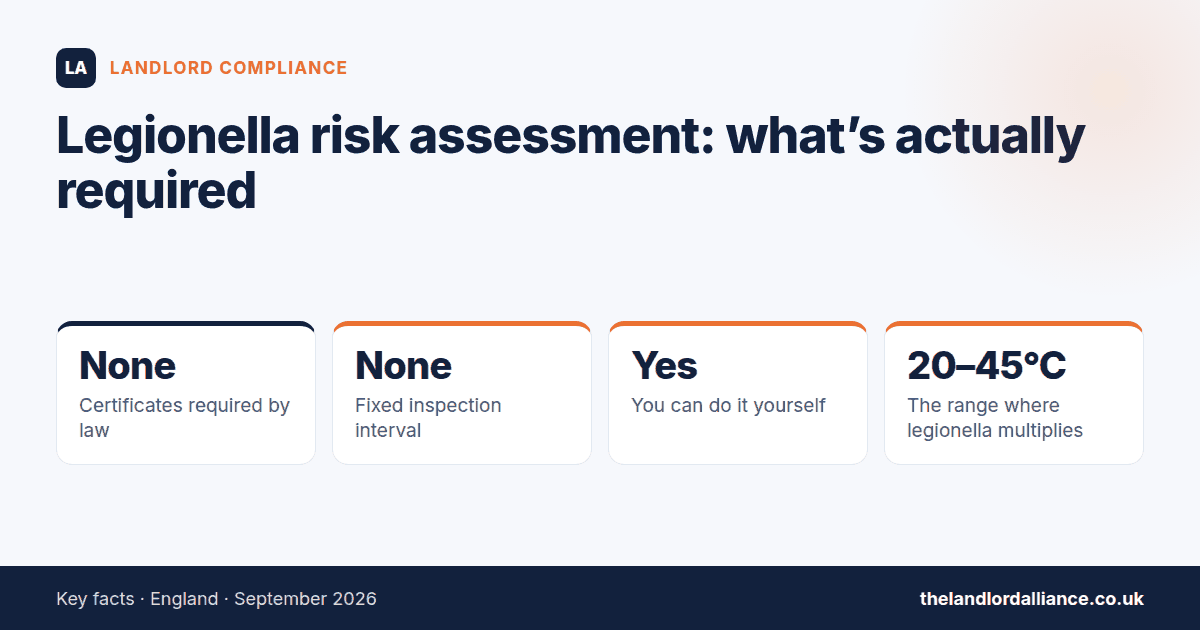
This is the most oversold obligation in residential letting. There is no legionella certificate, no annual requirement, and no need for a specialist contractor for a typical domestic property. What the law requires is that you have assessed the risk and taken any reasonable steps it identifies. For a normal house or flat with a combi boiler and no stored water, that assessment is a short written record you can produce yourself in half an hour, reviewed if something changes. Companies selling annual legionella certificates to ordinary landlords are selling a document with no legal status.
What the law actually says
The duty comes from general health and safety law — the Health and Safety at Work etc. Act 1974 and the Control of Substances Hazardous to Health Regulations — as applied to landlords by the Health and Safety Executive’s approved code of practice on legionella, usually referred to as L8.
The HSE’s own position on domestic lettings is unambiguous: landlords have a duty to assess and control the risk, the risk in most domestic systems is low, and a simple assessment carried out by a competent person is sufficient. It does not require testing, sampling, certification or a contractor.
If someone is selling you an annual legionella certificate for a two-bed flat, they are selling you nothing. No such certificate exists in law, no council or court asks for one, and no insurer requires it. What you need is a dated written assessment. Spending money on this instead of on ventilation or an EICR remedial is a poor allocation of a maintenance budget.
Where the risk actually is
Legionella bacteria multiply between roughly 20°C and 45°C, in water that sits still, and infection happens by inhaling contaminated droplets — a shower spray, not a glass of water.
| Feature | Risk | What to do |
|---|---|---|
| Combi boiler, no stored water | Very low | Record it. Water is heated on demand and not stored. |
| Hot water cylinder | Low, manageable | Ensure it stores at 60°C and distributes at 50°C or above at the taps |
| Cold water storage tank | Moderate | Check it is lidded, insulated, free of debris, and that cold water stays below 20°C |
| Showers | The main exposure route | Clean and descale the head and hose periodically |
| Infrequently used outlets | Moderate | An outside tap, a spare bathroom, a garden hose — flush them |
| Void periods | The real one | Flush all outlets before a new tenant moves in, especially after a long empty period |
| Thermostatic mixing valves | Moderate | Water sits at blended, ideal-growth temperatures. Check and service them. |
Doing the assessment
- Describe the system. Combi or cylinder, any cold water tank, number of bathrooms, any outlets used rarely, any thermostatic mixing valves.
- Check temperatures. Hot water reaching about 50°C at the tap within a minute or so; cold below 20°C.
- Look for dead legs — lengths of redundant pipework left behind after a bathroom was moved or a washing machine removed. Cap or remove them where practical.
- Check any stored water is covered, insulated and clean.
- Record what you found and what you did, with the date and your name. A single page is sufficient.
- Review it when something changes — a new boiler, a new bathroom, a long void, a change of tenant — rather than on an arbitrary annual cycle.
What to tell the tenant
Include a short note in the tenant information you provide at the start of the tenancy:
- Do not adjust the boiler or cylinder thermostat below the setting provided.
- Flush unused outlets, including showers, if the property has been empty for a week or more.
- Clean and descale the shower head periodically.
- Report any problem with hot water temperature.
That note, plus your assessment, is a complete and defensible position for a normal domestic let.
When to bring in a professional
Genuinely higher-risk systems justify expert input: large or complex properties, communal water systems in blocks of flats, cooling towers or evaporative condensers, spa baths or hot tubs, sizeable HMOs with extensive pipework, or any property where you find you cannot answer the basic questions above. In a block of flats the communal system is the freeholder’s responsibility, and asking them for evidence of their assessment is the right step.
Read next
Do I need a legionella certificate?
No. No such certificate exists in law. You need a risk assessment, which is a written record rather than a certificate.
How often must the assessment be done?
There is no fixed interval. Review it when the system or the circumstances change — a new boiler, a long void, a new tenancy.
Can I do it myself?
Yes, for a typical domestic property. The HSE expects a competent person, and a landlord who understands their own water system and follows the steps above qualifies.
Do I need to test the water?
No, not in normal domestic property. Sampling is for complex or higher-risk systems.
What about a flat in a block?
Your own flat is yours to assess. The communal water system is the freeholder’s responsibility — ask them for evidence of their assessment.
Is it enforced?
It is enforceable under health and safety law rather than by a certificate check, and prosecutions in domestic lettings are rare. That is not a reason to skip a half-hour job that also protects you if something ever happens.
Sources. Health and Safety at Work etc. Act 1974; Control of Substances Hazardous to Health Regulations 2002; HSE Approved Code of Practice and guidance L8, Legionnaires’ disease: The control of legionella bacteria in water systems, and HSE guidance for landlords on legionella. Checked 8 September 2026.
Related: Compliance checklist · All guides · Free calculators