The short version
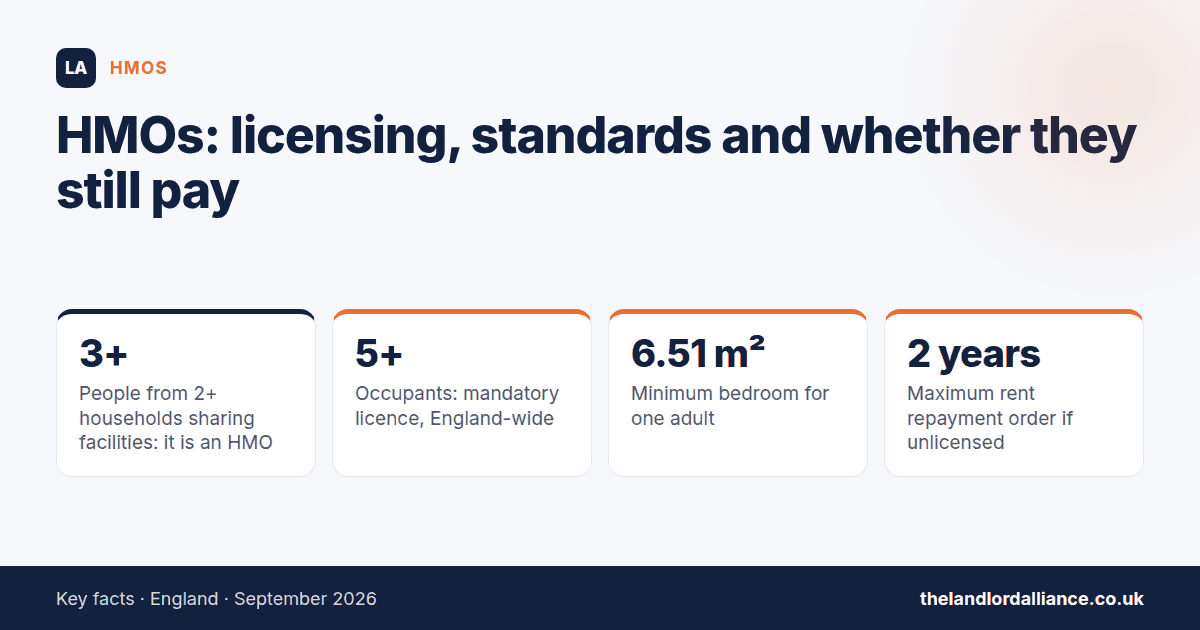
An HMO is three or more people from two or more households sharing a kitchen, bathroom or toilet. Five or more and it needs a mandatory licence anywhere in England; below that it depends entirely on whether your council has designated an additional licensing scheme, which is a street-level question rather than a national one. Two things have changed the economics recently and neither is widely understood: since December 2023 most HMOs are treated as a single dwelling for council tax with the landlord liable, and the Renters’ Rights Act pushed rent repayment orders for unlicensed operation up to two years’ rent. HMOs still produce the best gross yields in residential property. They also carry the most ways to lose money quickly.
What counts as an HMO
The definition in section 254 of the Housing Act 2004 is broader than most people assume, and it does not depend on what you call the arrangement.
| Occupancy | Is it an HMO? | Does it need a licence? |
|---|---|---|
| A couple and their children | No — one household | No |
| Two friends sharing a flat | No — only two people | No |
| Three unrelated sharers | Yes | Only if the council has an additional licensing scheme covering it |
| Four unrelated sharers | Yes | Only under additional licensing |
| Five or more, two or more households | Yes — a large HMO | Yes. Mandatory, everywhere in England. |
| A couple plus three unrelated sharers | Yes — five people, four households | Yes. Count people, not tenancies. |
The counting mistake. The threshold is about people, not tenancy agreements or bedrooms. One joint tenancy signed by five sharers is a large HMO requiring a mandatory licence. So is a four-bed house where one bedroom holds a couple. Landlords who assume a single agreement keeps them out of the regime are the ones who end up facing a rent repayment order.
The three licensing regimes
| Regime | What it covers | Where it applies |
|---|---|---|
| Mandatory | HMOs with 5 or more occupants in 2 or more households sharing facilities | All of England. No council designation needed. |
| Additional | Smaller HMOs — typically 3 or 4 occupants | Only where the council has designated a scheme. Varies by ward, sometimes by street. |
| Selective | All private rented property in the area, HMO or not | Only in designated areas, usually targeting low housing demand or antisocial behaviour. |
Licences last up to five years, cost a few hundred to well over a thousand pounds depending on the council, and require the licence holder to pass a fit and proper person test. The full detail on applying, the conditions attached and what happens if you get it wrong is in HMO licensing.
Room sizes and standards
Since October 2018 mandatory licences carry statutory minimum room sizes for sleeping accommodation:
| Occupancy of the room | Minimum floor area |
|---|---|
| One person aged over 10 | 6.51 m² |
| Two people aged over 10 | 10.22 m² |
| One person aged under 10 | 4.64 m² |
| Any room under 4.64 m² | Cannot be used as sleeping accommodation at all, and you must notify the council it exists |
Floor area under a ceiling below 1.5 metres does not count towards the minimum. That single rule disqualifies a great many attic rooms that look adequate on a floor plan.
Council tax: the change that caught landlords out
Before December 2023, valuation officers could and often did band each room in an HMO separately, leaving each tenant liable for their own council tax. The Council Tax (Chargeable Dwellings and Liability for Owners) (Amendment) (England) Regulations 2023 changed that from 1 December 2023: an HMO is now treated as a single dwelling, and the owner is liable for the council tax rather than the occupiers.
For most HMO landlords this was welcome — it removed the absurdity of six separate Band A bills on one house. But it also confirmed council tax as a landlord cost, permanently, in a model where bills are usually included in the rent anyway. If you are underwriting an HMO on a spreadsheet built before 2024, check that line. Detail and the exceptions are in who pays council tax in an HMO.
Planning permission
A small HMO for three to six people falls in planning use class C4, and in most areas you can convert from a family home (C3) to C4 under permitted development rights. Seven or more people is sui generis and always needs full planning permission.
Article 4 directions are the trap. Many councils have removed the C3 to C4 permitted development right in areas with high HMO concentrations, meaning you need planning permission even for a three-person share. Buying a house intending to convert it, in an Article 4 area, without checking first, is the most expensive mistake available in this part of the market — and licensing and planning are separate: a licence is not permission, and permission is not a licence.
Do the numbers still work?
HMOs typically produce gross yields well above a single let of the same property, because five rents beat one. The gap narrows more than people expect once the real costs are in:
- Bills included. Gas, electricity, water, broadband and now council tax, all landlord costs, all exposed to inflation you cannot pass on mid-tenancy.
- Licensing and compliance. The licence fee, fire doors, interlinked alarm systems, emergency lighting, fire risk assessment, and often annual rather than five-yearly electrical checks under licence conditions.
- Turnover. Five tenancies churn faster than one. Every void is a room, not a house, but there are five times as many chances of one.
- Management. Self-managing an HMO is a job. Agents charge more for them, and rightly.
- Finance. HMO mortgages price above standard buy-to-let and the lender pool is smaller, particularly above six bedrooms or where a licence is pending.
The honest position: a well-run HMO in a strong rental location still outperforms a single let on cash return, and it does so by being an operating business rather than a passive investment. A badly run one loses money faster than any other residential asset, because the fixed costs continue whether the rooms are full or not. If the appeal is the yield number rather than the work, it is the wrong asset.
Read next
Is a three-bed house let to three friends an HMO?
Yes, if they are three separate households sharing a kitchen or bathroom. Whether it needs a licence depends on whether your council operates an additional licensing scheme covering that address.
Does one joint tenancy avoid HMO status?
No. The test counts people and households, not agreements. Five sharers on one joint tenancy is still a large HMO needing a mandatory licence.
How much does an HMO licence cost?
It varies widely by council — commonly several hundred to over a thousand pounds for a five-year licence, sometimes charged per room. Check your own authority’s fee schedule.
Can I let a room smaller than 6.51 m²?
Not to an adult in a licensed HMO. Rooms below 4.64 m² cannot be used for sleeping at all, and you must tell the council they exist.
Who pays the council tax?
Since 1 December 2023 an HMO is a single dwelling for council tax and the owner is liable, not the individual tenants.
Do I need planning permission?
Usually not for three to six occupants, unless the council has an Article 4 direction removing permitted development rights — and many have. Seven or more always needs permission. Check before you buy, not after.
Sources. Housing Act 2004, sections 254–259 and Part 2; Licensing of Houses in Multiple Occupation (Mandatory Conditions of Licences) (England) Regulations 2018 (SI 2018/616); Council Tax (Chargeable Dwellings and Liability for Owners) (Amendment) (England) Regulations 2023 (SI 2023/1175); Town and Country Planning (Use Classes) Order 1987 as amended; Renters’ Rights Act 2025 (c. 26) on rent repayment orders; GOV.UK HMO licence guidance. Checked 8 September 2026.
Related: All landlord guides · Free calculators · Compliance checklist