The short version
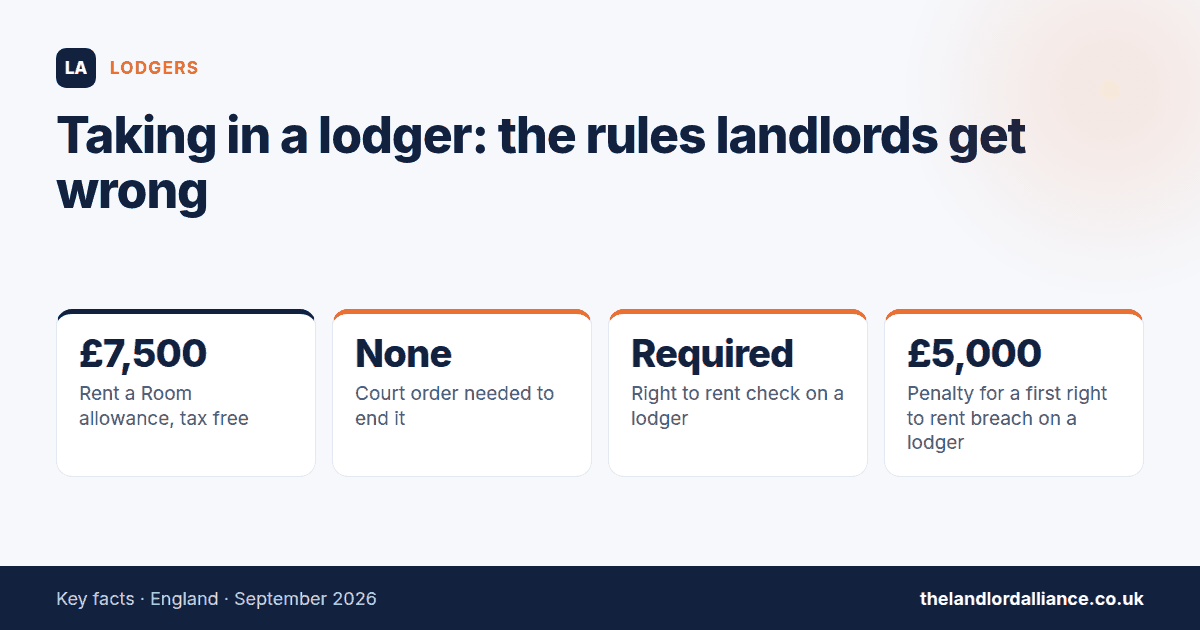
A lodger lives in your home and shares living accommodation with you. That makes them an excluded occupier, not a tenant, and almost everything landlords know about letting stops applying: no deposit protection, no assured tenancy, no section 8, and no court order needed to end the arrangement. What does still apply is gas safety, a right to rent check, and the general law on harassment — you can ask a lodger to leave on reasonable notice, but you can never use force. On the upside, the Rent a Room scheme lets you receive up to £7,500 a year tax free.
What makes someone a lodger
Two things: you live in the property as your only or main home, and the lodger shares living accommodation with you — a kitchen, bathroom or living room. Sharing only a hallway or a staircase is not enough.
| Arrangement | Status | Consequence |
|---|---|---|
| You live there; lodger shares your kitchen | Excluded occupier | Reasonable notice, no court order |
| You live in a separate self-contained flat in the same building | Not excluded on the sharing basis | Notice and a court order needed |
| You move out and let the whole property | Assured tenancy | Full Renters’ Rights Act regime applies |
| Two or more lodgers in your home | Still excluded occupiers | But check whether the property becomes an HMO |
If you move out, everything changes. An arrangement that started as a lodger agreement can become a tenancy the moment you stop living there and stop sharing. That converts a simple notice into a section 8 claim, and it means deposit protection and every other obligation applies from that point. Do not treat “lodger” as a permanent classification.
The Rent a Room scheme
You can receive up to £7,500 a year from letting furnished accommodation in your only or main home without paying tax on it. If two people share the income — a couple, or joint owners — the threshold is £3,750 each.
- Under £7,500: the exemption is automatic. Nothing to declare, unless you already file a return, in which case you claim it.
- Over £7,500: choose either to pay tax on the excess above £7,500 with no expenses claimed, or to declare the income and claim actual expenses in the normal way. Whichever produces the lower bill.
- It counts gross. If you charge inclusive of bills, the whole payment counts towards the threshold — £650 a month is £7,800 and takes you over.
- Furnished only, and in your own home. It does not apply to a self-contained flat or to a property you do not live in.
What you still have to do
| Obligation | Applies? |
|---|---|
| Right to rent check | Yes. Before they move in. First breach penalty for a lodger is £5,000. |
| Annual gas safety check | Yes. The duty covers residential lettings including lodgers. |
| Smoke alarms | Yes in practice, and sensible regardless |
| Deposit protection | No — not an assured shorthold tenancy |
| EPC | Not for a lodger in your own home |
| Written statement of terms | No — that is for assured tenancies. A written agreement is still strongly advisable. |
| Renters’ Rights Act regime | No |
Permissions to get first
- Your mortgage lender. Most residential mortgages permit a lodger but many require consent. Ask, in writing.
- Your insurer. A lodger changes the risk. Failing to disclose can void the policy at the point you need it.
- Your freeholder, if you are leasehold. Many leases restrict sharing or subletting.
- Your council, on council tax. A lodger who is a countable adult removes your 25% single person discount. Full-time students and some others are disregarded.
- The benefits position, if you claim. Lodger income can affect Universal Credit, housing benefit and council tax support differently — check before, not after.
Ending it
Because a lodger is an excluded occupier, you do not need a court order. You give reasonable notice — normally the length of the rent period, so a month for a monthly arrangement — preferably in writing, and preferably matching whatever your agreement says.
No court order does not mean no rules. Harassment of a residential occupier is a criminal offence. Do not change the locks while they are out with their belongings inside, remove doors, cut off heating or water, or threaten them. Give proper notice, keep it civil, and if they will not go at the end of it, take advice rather than acting.
A short checklist
- Confirm mortgage, insurance and lease permit it.
- Carry out a right to rent check before they move in.
- Put the arrangement in writing — see our lodger agreement template.
- Take an inventory of the room and shared areas, with photographs.
- Get the gas safety check done and give them a copy.
- Tell the council about the council tax change.
- Keep a record of what you receive, for the Rent a Room threshold.
Read next
Is a lodger a tenant?
No. A lodger who shares living accommodation with a resident landlord is an excluded occupier, with far fewer statutory protections and no security of tenure.
Do I need a court order to evict a lodger?
No. Reasonable notice is enough, normally the rent period. You must never use force or harassment.
How much can I earn tax free?
£7,500 a year under the Rent a Room scheme, or £3,750 each if two people share the income. It counts gross, including bills.
Do I have to protect a lodger’s deposit?
No. Deposit protection applies to assured shorthold tenancies, not to excluded occupiers.
Do I need a right to rent check?
Yes. It applies to lodgers, and the penalty for a first breach is £5,000.
Does taking a lodger make my home an HMO?
Not usually with one lodger. With more people from more households it can, which brings licensing into play — check before you let a second room.
Sources. Protection from Eviction Act 1977, sections 1, 3A and 5; HMRC Rent a Room scheme guidance and HS223; Gas Safety (Installation and Use) Regulations 1998; Home Office right to rent code of practice; Housing Act 2004 on HMOs; Local Government Finance Act 1992 on council tax discounts. Checked 8 September 2026.
Related: All landlord guides · Landlord tax · Compliance checklist