The short version
The Auction Accelerator is an online property auction course for £149 on buying UK property at auction without getting burned: finding the bargains, reading the legal pack and analysing the lot, funding a purchase on a tight deadline, bidding safely in the room or online, and turning the property into profit by flipping, BRRR or holding. Lifetime access. One of the Landlord Alliance property investment courses, and in The Big Property Accelerator (£199 for all six).
Auctions are where you find the properties nobody else could buy — the probate house with no heating, the flat with forty years left on the lease, the tenanted terrace the owner wants rid of this month. They are also where a buyer who skipped the legal pack finds out about the £15,000 of buyer’s fees in the special conditions after the hammer has fallen. The course is mostly about what you do before you bid, because after you bid there is nothing left to do but pay.
 Or 3 interest-free payments of £49.67 with Klarna — pay in 3 at checkout, no fees if you pay on time.
Best value: The Big Property Accelerator, £199. All six strategy courses — HMO, Lease Option, Serviced Accommodation, BRRR, Rent to Rent and Auction — for less than two bought separately (£149 each). Lifetime access and updates. Fundamentals is not included. See what is in the bundle, or buy the Auction Accelerator on its own below.
What is the Auction Accelerator?
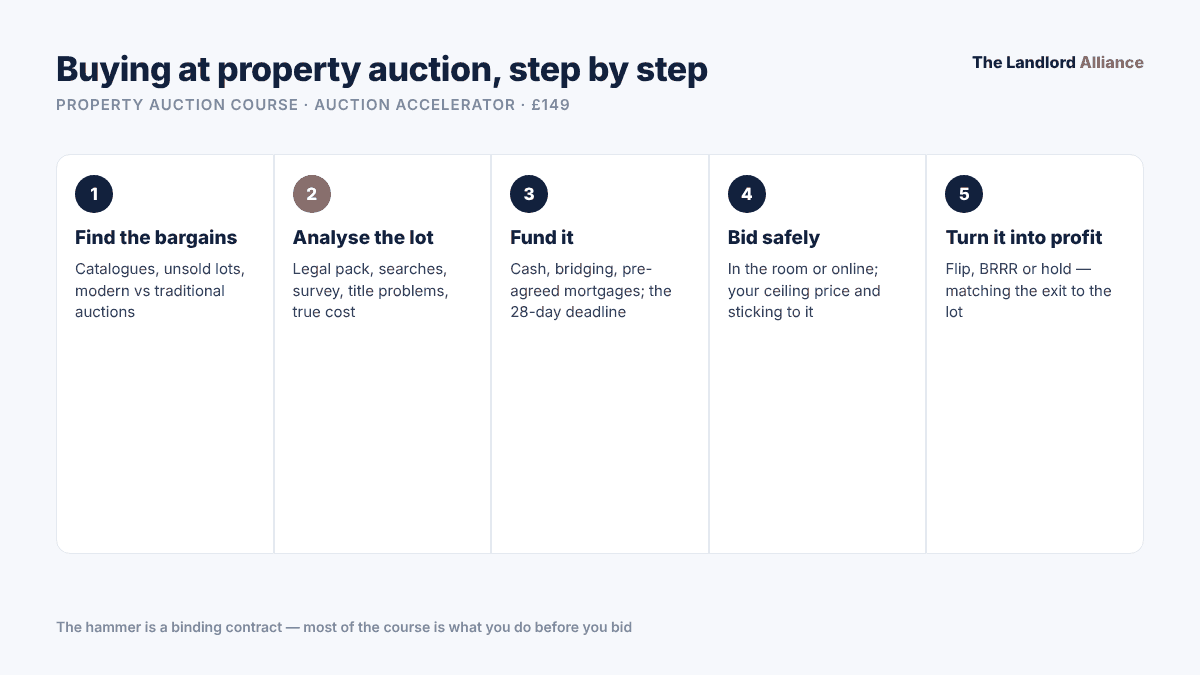
It is an online, self-paced programme on buying UK property at auction as an investor: where the lots come from and how to spot the under-priced ones, how to read a legal pack and survey a lot you may only see once, how to have the money ready for a 28-day completion, how to bid to a ceiling and stop, and how to choose the exit — resale, refurbish-and-refinance, or hold as a rental — before you buy rather than after.
Property auction course contents
| Section | What it covers |
|---|---|
| Finding auction bargains | Catalogues, unsold lots, traditional against modern-method auctions, and why some lots are cheap for a reason |
| Analysing lots | Reading the legal pack, searches, title problems, tenancies in place, surveys, the true cost of the lot after fees |
| Bidding safely | In the room or online: setting a ceiling before you walk in, proxy and telephone bids, and what happens the moment the hammer falls |
| Funding deals with tight deadlines | Cash, bridging, and mortgages agreed in advance; the 10% deposit on the day and the completion deadline |
| Turning auction properties into profit | Flip, BRRR or hold — matching the exit to the lot, and the lots to avoid altogether |
Traditional auction or modern method?
| Traditional auction | Modern method (online, conditional) | |
|---|---|---|
| When you are committed | Fall of the hammer — exchange on the day | On paying the reservation fee; exchange later |
| Paid on the day | Deposit, usually 10%, plus auction fees | Reservation fee, often several thousand pounds, usually non-refundable |
| Completion | Fixed, commonly 28 days | Longer, commonly 56 days — mortgage buyers can use it |
| Where the bargains are | Problem lots cash buyers want | More ordinary homes; fewer deep discounts |
| Main risk | Cannot complete in time and lose the deposit | Fee lost if you withdraw; price can look low until the fee is added |
Read the special conditions. Buyer’s premiums, the seller’s legal costs, search fees and arrears can all be passed to the buyer in the special conditions of sale, and they are legally part of the price. The analysing-lots section shows you where to find them and how to add them to your ceiling before you bid.
Who this auction course is for
Investors with cash or bridging capacity who want to buy below market and are willing to do the work on the legal pack. Landlords who want tenanted lots or probate houses to refurbish. And BRRR investors, for whom the auction room is one of the best sources of properties where the uplift is real. It is not the course for someone buying a home to live in with a standard mortgage.
At a glance
- Format
- Online video, self-paced
- Structure
- 5 sections
- Access
- Lifetime, with updates
- Price
- £149 (or 3 × £49.67 with Klarna), or in the £199 bundle (3 × £66.33)
- Certificate
- Yes, on completion
- Level
- Advanced — Fundamentals first if you are new
Frequently asked questions
How does buying property at auction work in the UK?
At a traditional auction, the fall of the hammer is exchange of contracts: you pay a deposit, usually 10%, on the day and complete within a fixed period, often 28 days. There is no survey, no chain and no renegotiation after you win. At a modern-method auction you pay a reservation fee and have longer to complete, but the fee is typically non-refundable. The course covers both and when each suits you.
Why are auction properties cheaper?
Some are not — competitive lots sell above guide. The ones that are cheap are usually cheap for a reason in the legal pack: a short lease, a title defect, a sitting tenant, a structural problem, a seller who needs certainty. The analysing-lots section is about finding the reason before you bid, and deciding whether it is a problem you can fix at a price that still works.
How much does the Auction Accelerator cost?
£149 on its own, or as one of the six courses in The Big Property Accelerator for £199. Lifetime access and updates.
Can I pay in instalments?
Yes. At checkout you can pay £149 in full by card, or choose Klarna and pay in three interest-free instalments of £49.67 (no fees if you pay on time). The £199 bundle works the same way at £66.33 a payment.
Can I get a mortgage on an auction property?
Sometimes, if it is mortgageable and the lender can work to the deadline, which means an agreement in principle and a valuation before the auction. Many buyers use cash or bridging and refinance afterwards. The funding section goes through each route and what has to be in place before you raise your hand.
What is in an auction legal pack?
Title documents, searches, the special conditions of sale, any leases or tenancy agreements, planning and building regulation information, and the seller’s replies to enquiries. The special conditions often include extra fees payable by the buyer. The course walks through a pack line by line.
Do I need the Fundamentals course first?
Auctions are unforgiving of mistakes: once the hammer falls you are committed. If you have never bought a property, do Fundamentals of Property Investing first so the due diligence, valuation and finance material is already in place.
Auction Accelerator — £149
Standalone checkout for this course is being set up on The Landlord Alliance. Until it opens, the fastest way in is The Big Property Accelerator: this course plus five others for £199, lifetime access and updates.
Get it in the bundle — £199Or 3 interest-free payments of £66.33 with Klarna — pay in 3 at checkout, no fees if you pay on time.
Before any auction, value the lot from sold comparables, not the guide price, and run the end numbers through the free rental yield calculator. If the lot is tenanted, read the Renters’ Rights Act guide — you inherit the tenancy as it stands.
Position as at 1 November 2026. Course content is general education from a landlord and investor, not financial, legal or tax advice. Property values and rents can fall as well as rise.
Sources: course syllabus as published.
Related: All property investment courses · The Big Property Accelerator · BRRR Accelerator · Buy-to-let guide