The short version
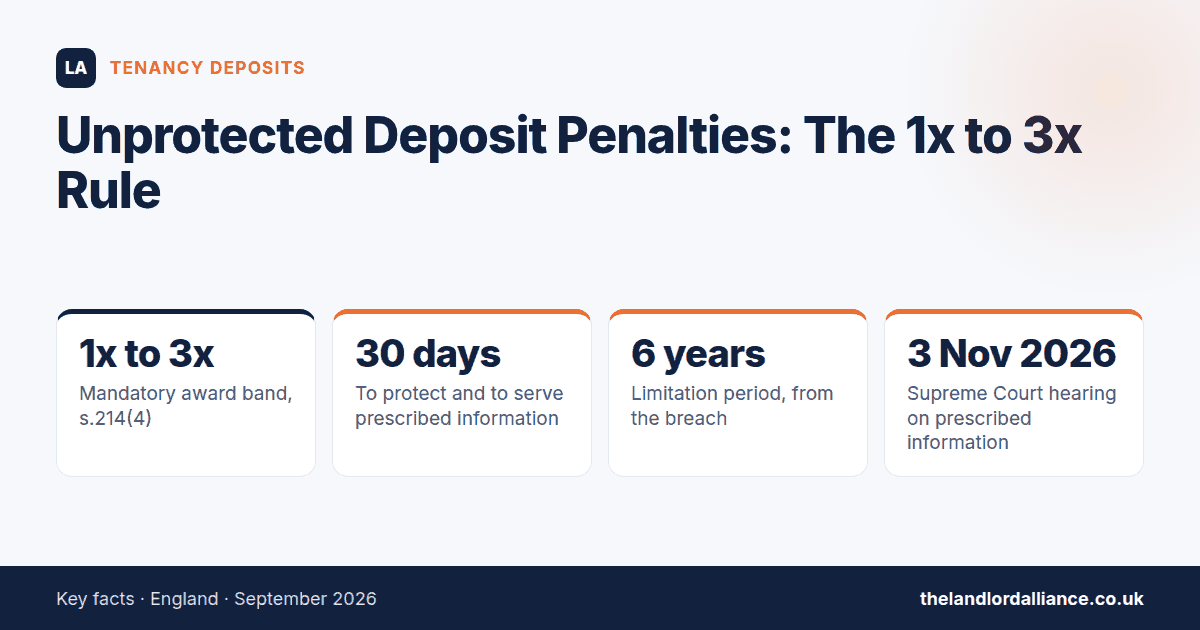
If you miss the thirty-day deadline to protect a deposit or to serve the prescribed information, the court must order you to pay the tenant between one and three times the deposit. Not "up to" three times, as gov.uk puts it — there is a mandatory floor of one times, and no discretion to award nothing. Protecting late or returning the deposit does not remove that liability; it only moves you towards the bottom of the band. Separately, since 1 May 2026 a non-compliant deposit stops the court making a possession order — though not on Grounds 7A or 14, and late compliance now cures it. Once the landlord register reaches your region, failing to register creates a second possession bar with the same antisocial behaviour carve-out.
This is the one area of landlord law where the government's own guidance is more comforting than the statute. Read gov.uk and you would think the penalty is discretionary and capped. Read section 214 and you find a mandatory award with a floor. I have set out both below, with the statutory wording, because a landlord who plans around the gov.uk version is planning around something that is not the law.
What section 214 actually says
Here is the operative subsection, in full:
s.214(4): "The court must order the landlord to pay to the applicant a sum of money not less than the amount of the deposit and not more than three times the amount of the deposit within the period of 14 days beginning with the date of the making of the order."
Two words carry the weight. Must — the court has no discretion over whether to award. Not less than the amount of the deposit — there is a floor of one times, so the minimum outcome for a proven breach is the whole deposit again, on top of returning it.
It was not always like this. Before 6 April 2012 the award was a flat three times with no discretion at all. Section 184(9) of the Localism Act 2011 replaced "equal to" with "not less than… and not more than", which introduced a range — but the range starts at one, not at zero.
Where gov.uk gets it wrong
The gov.uk page on what happens if a landlord does not protect a deposit says: "The court may also order the landlord to pay you up to 3 times the deposit within 14 days of making the order."
| gov.uk says | The statute says |
|---|---|
| The court may order | The court must order |
| Up to 3 times the deposit | Not less than the deposit and not more than 3 times |
| No minimum stated | A mandatory floor of 1x the deposit |
The error runs in the landlord's favour, which is why it survives. It also means a landlord who has been reassured by it walks into court expecting the judge to have a discretion the judge does not have.
How the multiplier is decided
Once a breach is established, the only live question is where in the one-to-three band the award falls. The leading decision is Okadigbo v Chan [2014] EWHC 4729 (QB), a High Court appeal decided by Males J.
The landlords there had missed a 31 August 2012 deadline, protected on 5 March 2013 and served prescribed information on 8 July 2013. They were first-time landlords letting their own home who had been let down by their agents. The judge below put them at the lowest end of the scale of culpability and awarded one times — £1,520. The appeal was dismissed: the judge "was entitled to regard the question of culpability as the most relevant factor".
What drives the number
- Culpability
- The primary factor. Deliberate or repeated failures sit high; a first-timer let down by an agent sits low
- Whether it was put right
- Late compliance does not remove liability but does reduce quantum
- Scale of the operation
- A professional portfolio landlord is expected to know the rules
- What it is not
- Not the tenant's loss. The award is a penalty, not compensation, so no loss needs to be shown
You will see Okadigbo described as a Court of Appeal case establishing the one-times floor. It is neither. It is a High Court decision, and the floor comes from the face of the statute. There is no Court of Appeal authority on the floor — the two Court of Appeal cases people cite, Gladehurst and Tiensia, were both decided under the pre-2012 regime and have both since been reversed by statute.
Who can claim, and for how long
A former tenant can claim. Section 214(1A), inserted by the Localism Act 2011, says so expressly: subsection (1) also applies where the tenancy has ended, and the reference to the tenant is then to a person who was a tenant. This reversed Gladehurst Properties Ltd v Hashemi [2011] EWCA Civ 604, which had held the opposite — and which is still occasionally quoted on landlord sites as though it were current law.
A "relevant person" can also claim in their own right: anyone who paid the deposit on the tenant's behalf under arrangements made with the tenant. A parent or guarantor who paid has their own cause of action.
| Situation | Return of the deposit | The s.214(4) penalty |
|---|---|---|
| Tenancy still running | s.214(3) — court must order repayment or payment into a custodial scheme | Mandatory |
| Tenancy ended | s.214(3A) — court may order repayment of all or part | Mandatory |
Limitation is six years from the breach — that is, from the expiry of the thirty-day period. In Lowe v The Governors of Sutton's Hospital in Charterhouse [2024] EWHC 646 (Ch), Adam Johnson J held that a section 214(4) claim is an action to recover a sum recoverable by virtue of an enactment under section 9 of the Limitation Act 1980, not a specialty carrying twelve years. The practical effect in that case was stark: of eight successive tenancies, only the last was in time.
Six years, per tenancy, from each breach. A landlord who renewed the same tenant annually without protecting can face a separate claim for each tenancy still within the window. That is how a £1,200 deposit becomes a five-figure exposure.
The possession bar changed completely on 1 May 2026
Section 215 was substituted in its entirety by section 26(5) of the Renters' Rights Act 2025, commenced by SI 2026/421. Almost everything written about it since — including a scheme operator's own leaflet — describes the old rule.
The bar attaches to the possession order, not to the notice. The old section 215 said no section 21 notice could be given. The new one says the court may make an order for possession only if the deposit is held in an authorised scheme and the prescribed information has been served. You are not stopped from serving a section 8 notice or issuing a claim. You are stopped from winning it.
Three further features of the new section, each of which matters:
Late compliance cures it
s.215(2) counts the scheme's initial requirements as met if complied with "whether or not within the period mentioned by section 213(3)". Protecting late now unlocks possession. This is new and it is landlord-favourable.
Only s.213(5) and (6)(a) are gateways
The thirty-day deadline for prescribed information is in s.213(6)(b), which is deliberately excluded from s.215(3). Serving prescribed information late does not block possession — it must simply have been served, in the prescribed form.
Grounds 7A and 14 are carved out
s.215(4) disapplies the bar entirely for antisocial behaviour possession, "whether or not any other grounds for possession are met". A landlord relying on Ground 14 alongside Ground 8 is not barred as to the 7A or 14 element.
Returning the deposit lifts it
s.215(5) — returned in full, or with deductions the tenant has agreed. A unilateral deduction does not cure it. So does a s.214 application that has been determined, withdrawn or settled.
The distinction that matters most: curing the breach lifts the possession bar. It does not remove the financial penalty. Section 214 asks only whether the thirty-day deadline was met, and there is no cure provision in section 214 corresponding to section 215(5). In Okadigbo the deposit had been protected and the information served before the case was heard, and the penalty was still ordered — the late compliance went to the multiplier, not to liability.
If you have read that late compliance defeats the claim outright, you have read Tiensia v Vision Enterprises Ltd [2010] EWCA Civ 1224. It is dead law: section 184(6) of the Localism Act 2011 rewrote section 214(2)(a) specifically to reverse it.
No reported case has yet interpreted the new section 215. The only judgment since May 2026 to engage with section 215 at all applies the old version.
Prescribed information carries the identical penalty
This is the most under-appreciated exposure in the whole regime. Section 214 refers to "section 213(3) or (6)" in the same breath, and section 213(6)(b) imposes the same thirty-day deadline. So a landlord who protected the deposit perfectly on day one, but never served compliant prescribed information, faces exactly the same mandatory one-to-three-times award — and the same possession bar.
The prescribed information is a longer list than most landlords serve. One item catches people repeatedly: article 2(1)(b) of the 2007 Order requires the information in the scheme administrator's own leaflet explaining sections 212 to 215. Another is article 2(1)(g)(vii), the certificate signed by the landlord confirming the information is accurate and that the tenant was given the opportunity to sign.
Live litigation, and it could change the position. Lowe — the same case as the limitation decision — is now before the Supreme Court as UKSC 2025/0143, with a hearing listed for 3 November 2026. Two issues: whether the information requirement is satisfied where the landlord refers to a clause in a tenancy agreement that was not attached and whose numbering was wrong, and whether the confirmation requirement is met where only a covering letter is signed and the certificate itself is not.
The Court of Appeal in Lowe [2025] EWCA Civ 857 dismissed the tenant's appeal, applying the "reasonable recipient" principle from Mannai v Eagle Star: the wrong clause number was an obvious error a reasonable recipient would have understood, and a signed covering letter with the information attached was "substantially to the same effect" as a signed certificate. That is currently good law, and the Court of Appeal built on it again in Hamer v Levy [2026] EWCA Civ 662 in May 2026, where prescribed information with a wrong address, a wrong digit in a phone number and no signed certificate was still held sufficient.
If the Supreme Court reverses, every landlord whose prescribed information contains an error or an unsigned certificate is re-exposed — and so is the Hamer line that rests on it. Do not treat the current position as settled. Fix your paperwork now rather than relying on a case that is under appeal.
Note also what these cases do not say. Ayannuga v Swindells [2012] EWCA Civ 1789 is often cited for the proposition that any error is fatal. It is not: it was a case where the required information was not referred to at all, and the objection was to a tenant having to conduct their own research to find it.
Non-money deposits: the obscure trap
Section 213(7) says no person may, in connection with an assured tenancy, require a deposit consisting of property other than money. "Property" means moveable property under s.213(10), so a car, a watch or goods are caught; land is not. "Money" under s.212(8) means cash or otherwise, so bank transfers are money and are protectable normally.
gov.uk mentions that such items are not protected by a scheme, but omits both consequences:
| Provision | Consequence |
|---|---|
| s.214(5) | The property is recoverable from whoever holds it, by the person who gave it |
| s.215(6) | The court may not make an order for possession until the property is returned |
So a landlord holding a watch as security cannot obtain a possession order even on antisocial behaviour grounds until it is handed back. That is the one situation in the entire regime where the Ground 7A and 14 carve-out does not rescue you, and as far as we can find it is not stated anywhere on gov.uk.
What to do if you have already missed the deadline
Do, today
- Protect the deposit now, even though it is late — it cures the possession bar and reduces the multiplier
- Serve compliant prescribed information now, in the prescribed form, with a signed certificate
- Check every current tenancy, not just the one that prompted this
- Check renewals within the last six years — each is a separate potential claim
- Keep the evidence of what you did and when
Don't
- Assume returning the deposit removes the penalty — it removes only the possession bar
- Make a unilateral deduction and call the deposit "returned" — s.215(5) requires full return or agreed deductions
- Rely on gov.uk's "up to 3 times" framing
- Rely on Tiensia, which was reversed by statute in 2012
- Serve a section 8 notice without fixing the deposit first, unless you are on Ground 7A or 14
Can the court award nothing?
No. Once a breach of s.213(3) or (6) is established the award is mandatory and the minimum is one times the deposit. The discretion is only over where in the one-to-three band it falls.
I protected it on day 35. Am I liable?
Yes. The deadline is thirty days from receipt. Late protection cures the possession bar and will push the award towards the floor, but liability is established the moment day thirty-one arrives.
My agent was supposed to do it. Does that help?
It goes to culpability and can bring you to the one-times floor — that is exactly what happened in Okadigbo. It does not transfer liability. The duty in s.213 is the landlord's.
Can a tenant claim after they have moved out?
Yes, expressly, under s.214(1A). The six-year limitation period runs from the breach, not from the end of the tenancy.
Does an unprotected deposit stop me evicting for antisocial behaviour?
No, if the deposit was money — Grounds 7A and 14 are carved out of the bar. Yes, if you took a non-money deposit, because s.215(6) is not carved out.
What about a renewal of the same tenancy?
Section 215B treats the requirements as complied with for a replacement tenancy between the same parties for the same premises where the same deposit continues to be held in the same scheme. That is what now neutralises the old Superstrike problem going forward.
A missed thirty-day deadline is the most expensive mistake in letting
The Landlord Alliance tracks protection dates and prescribed information against every tenancy, and tells you before the window closes rather than after. £10 a month, cancel anytime.
See what is includedEngland only. Position as at 31 August 2026. General information from a landlord, not legal advice. The prescribed information position is under appeal to the Supreme Court, listed for 3 November 2026.
Sources: Housing Act 2004 ss.212–215B; Renters' Rights Act 2025 s.26 and Schedule 6 para 11; SI 2026/421; SI 2007/797; Limitation Act 1980 s.9; Localism Act 2011 s.184; Okadigbo v Chan [2014] EWHC 4729 (QB); Lowe v Governors of Sutton's Hospital [2024] EWHC 646 (Ch) and [2025] EWCA Civ 857, UKSC 2025/0143; Hamer v Levy [2026] EWCA Civ 662; Gladehurst v Hashemi [2011] EWCA Civ 604; Ayannuga v Swindells [2012] EWCA Civ 1789; Superstrike v Rodrigues [2013] EWCA Civ 669.
Related: Tenancy deposits: the complete guide · Protection schemes compared · Deductions and disputes · Section 8 grounds for possession