
With a new Prime Minister expected in Downing Street within days, Generation Rent has published its wish-list for the rental sector — five demands it wants the incoming government to adopt, describing the Renters’ Rights Act as “only a first step”. The headlines sound alarming. This is what each demand would actually mean for you, and — more usefully — how seriously to take each one.
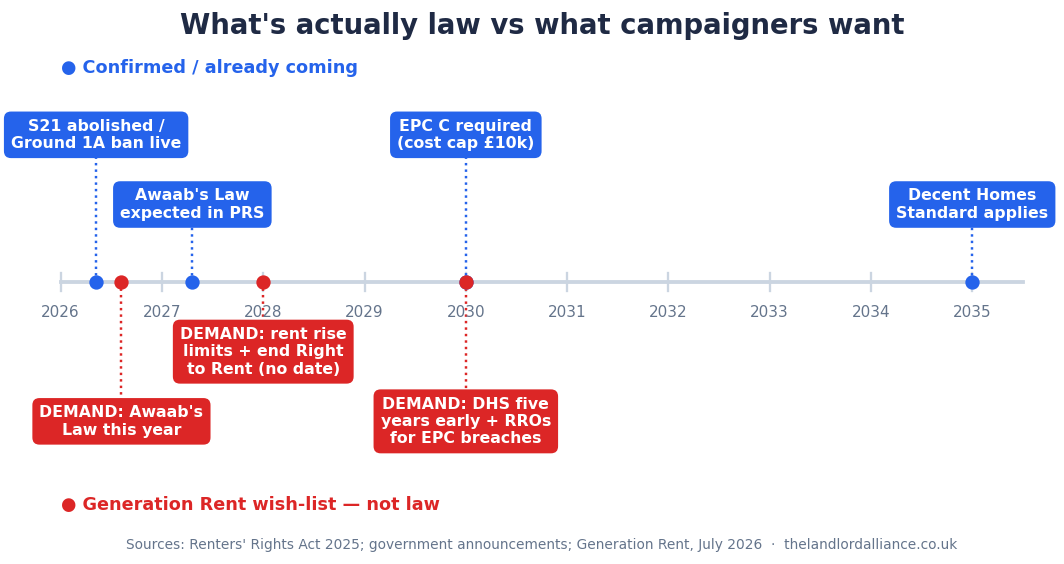
First, the crucial context: none of these are law, and none are government policy. This is a campaign group lobbying an incoming PM. But campaign wish-lists have a habit of previewing the direction of travel, and two of the five are really about speeding up things that are already coming. Here’s how the demands sit against what’s actually legislated:
Demand 1: limit rent increases
The group’s complaint is that while the Act lets tenants challenge rent rises at the First-Tier Tribunal, nearly seven in ten tenants have never heard of it — and that the tribunal benchmarks against market rents, which campaigners say are unaffordable. Their fix: move tribunal decisions away from market prices.
What it would mean for you: that’s rent control by another name. If tribunals stopped using market evidence, a challenged rent increase could be held below the market indefinitely.
Our read: successive governments — including this one, during the Act’s passage — have explicitly rejected rent controls in England. Awareness campaigns for the tribunal? Very likely. Changing its benchmark? A much bigger fight.
Demand 2: bring the Decent Homes Standard forward to 2030
The Decent Homes Standard is already coming to the private rented sector — the current timetable applies it from 2035. The demand is to pull that forward five years, and to implement Awaab’s Law (fixed timescales for fixing hazards like damp and mould) this year rather than later.
What it would mean for you: the same repairs and standards, on a compressed schedule. If your properties are in good order, little changes but the date. If you own older stock with known issues, five years of headroom disappears.
Our read: Awaab’s Law in some form is close to inevitable — it’s in the Act; only the commencement date is in question. Treat it as arriving soon and you can’t be caught out.
Demand 3: enforce EPC C with Rent Repayment Orders
EPC C by 2030 (with a £10,000 per-property cost cap) is confirmed policy. The new part is enforcement: campaigners want tenants to be able to claim back rent through a Rent Repayment Order if the property doesn’t comply.
What it would mean for you: RROs can run to 12 months of rent. A non-compliant EPC would stop being a fine-and-a-deadline problem and become a “your tenant can reclaim a year’s rent” problem.
Our read: the deadline is real regardless of whether the RRO bolt-on happens. Every month closer to 2030, retrofit contractors get busier and dearer. Landlords who plan the work in 2026–27 will pay less than those who panic in 2029.
Demand 4: abolish Right to Rent
The group claims the immigration checks make some landlords refuse tenants without British passports, and wants the checks scrapped entirely.
What it would mean for you: one less compliance step per tenancy — this is the only demand on the list that would reduce landlord workload.
Our read: unlikely. Right to Rent is immigration policy, not housing policy, and no incoming government has signalled any appetite to unwind it. Keep doing the checks properly.
Demand 5: two months’ rent as moving compensation
Where a landlord regains possession to sell or move family in, the demand is a mandatory waiver of the tenant’s final two months’ rent, to fund their moving costs.
What it would mean for you: using Ground 1A or 1 would carry an automatic cost of two months’ income on top of the void — and on top of the 12-month re-letting ban if your sale falls through. Selling with the tenant in place would look even more attractive than it already does.
Our read: no precedent in England and a hard sell politically, but it shows where campaigners want the pressure: making possession expensive.
Putting it together
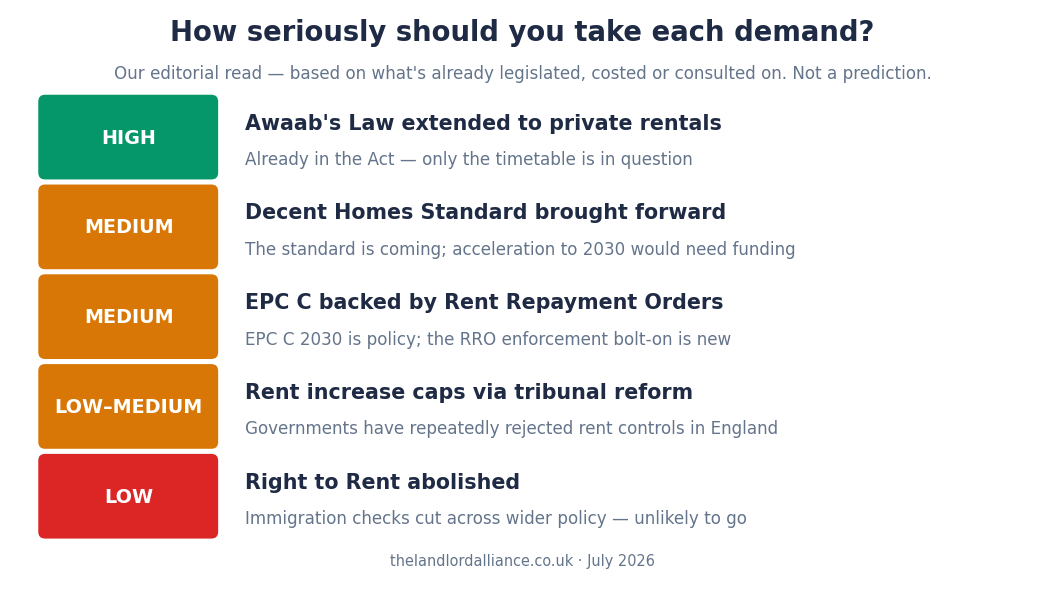
The pattern in that chart matters more than any single demand: the demands most likely to happen are the ones about property condition — Awaab’s Law, the Decent Homes Standard, EPC C. The politically hard ones are about money. So the practical response isn’t to worry about rent caps that may never come; it’s to get your certificates, hazards and energy ratings in a state where an accelerated timetable would cost you a to-do list, not a crisis.
That’s exactly what the Alliance’s compliance tracker is for — red, amber or green on every certificate, on every property, so a change of Prime Minister changes nothing about how ready you are.
James, Founder — The Landlord Alliance
Source: Generation Rent via Landlord Today, 13 July 2026. Likelihood ratings are our editorial opinion, not a prediction. This article is general information, not legal advice.
Background: the Renters’ Rights Act 2026 — the complete landlord guide, covering everything that changed on 1 May and what is still to come.