The short version
The Rent to Rent Accelerator is an online rent to rent course for £149 on earning from property you do not own: finding landlords who want guaranteed rent, setting up compliant contracts, turning single lets into HMOs or serviced accommodation, marketing your service, running the units and scaling with systems. Lifetime access. One of the Landlord Alliance property investment courses, and in The Big Property Accelerator (£199 for all six).
Rent to rent is sold as the no-money strategy and it is closer to the no-mortgage strategy: you still need set-up cash and a buffer, because you pay the owner every month whether the rooms are full or not. What it does give you is a property business without a deposit or a lender, and a way to learn HMO or serviced accommodation operations on someone else’s asset. The course is built around the two things that decide whether it works — a contract that protects everyone, and numbers that survive an empty month.
 Or 3 interest-free payments of £49.67 with Klarna — pay in 3 at checkout, no fees if you pay on time.
Best value: The Big Property Accelerator, £199. All six strategy courses — HMO, Lease Option, Serviced Accommodation, BRRR, Rent to Rent and Auction — for less than two bought separately (£149 each). Lifetime access and updates. Fundamentals is not included. See what is in the bundle, or buy the Rent to Rent Accelerator on its own below.
What is the Rent to Rent Accelerator?
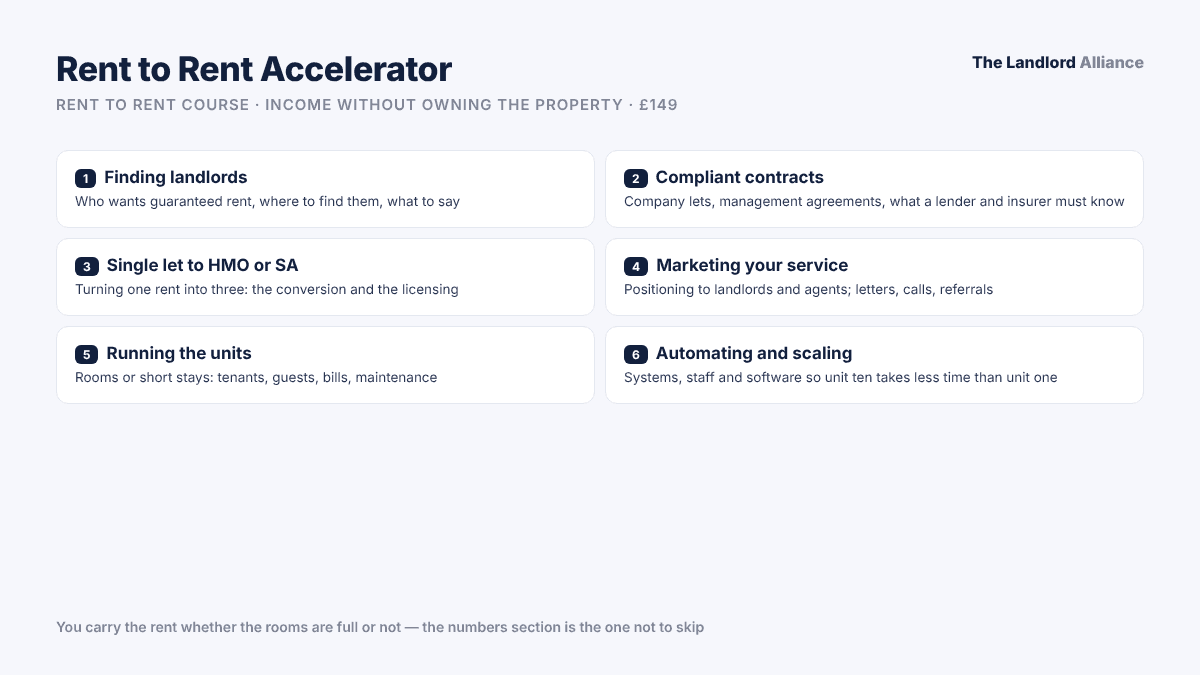
It is an online, self-paced programme on building a rent-to-rent business in the UK: finding owners who would rather have a guaranteed rent than the hassle, agreeing a company let or management agreement that their lender and insurer accept, converting the property to rooms or short stays where that is allowed, letting and running it, marketing to the next owner, and putting systems in place so it scales.
Rent to rent course contents
| Section | What it covers |
|---|---|
| Finding landlords open to guaranteed rent | Who says yes and why — tired landlords, accidental landlords, portfolio owners — where to find them and what to say first |
| Setting up compliant contracts | Company lets and management agreements, what the landlord’s lender and insurer need to know, deposits, and what makes an agreement enforceable |
| Turning single lets into HMOs or serviced accommodation | Which houses convert, the licensing and planning checks, furnishing and set-up, and when to leave it as a single let |
| Marketing your service to landlords | Positioning guaranteed rent honestly, letters, calls, agents and referrals, and the objections you will hear |
| Running the units | Tenants or guests, bills, maintenance, inspections, and the landlord relationship over a three- to five-year term |
| Automating and scaling | Systems, software and staff so the tenth unit takes less of your time than the first |
Where rent to rent makes money, and where it loses it
| Line | Single let, rent to rent | Rent-to-HMO or rent-to-SA |
|---|---|---|
| Income | One rent, usually little above what you pay the owner | Room rents or nightly rates — the margin is here |
| Set-up cost | Deposit, first month, light refresh | Deposit, first month, furniture, fire safety, licence fee, listing photos |
| Running cost | Low | Bills, cleaning, management time, platform fees |
| Risk | Low margin leaves no room for voids | Guaranteed rent due in empty months; licensing and planning must be right |
| Who is the landlord | You, to your tenant | You, to every room tenant or guest |
The agreement is the business. An owner who has not told their lender, an insurer who did not know, a “tenancy” that was really a sub-let — these end with you out of the property and out of your set-up money. The contracts section covers what a compliant agreement contains, what the owner must disclose, and what to walk away from.
Who this rent to rent course is for
People who want to be in property without a deposit or a mortgage and are prepared to run it as a job, at least at first. Landlords who want to add managed units without buying more. And investors planning HMOs or serviced accommodation who want to learn the operations on a rented property before committing capital to one.
At a glance
- Format
- Online video, self-paced
- Structure
- 6 sections
- Access
- Lifetime, with updates
- Price
- £149 (or 3 × £49.67 with Klarna), or in the £199 bundle (3 × £66.33)
- Certificate
- Yes, on completion
- Before this
- Fundamentals, unless you already let property
Frequently asked questions
What is rent to rent?
You rent a property from its owner on a longer agreement — typically three to five years — pay them a guaranteed rent whether or not it is occupied, and let it out yourself, usually room by room as an HMO or nightly as serviced accommodation. Your profit is the gap between what you collect and what you pay the owner plus bills and running costs.
Is rent to rent legal in the UK?
Yes, when it is set up properly: the owner knows and agrees in writing, their mortgage lender and insurer allow it, the agreement is a company let or management agreement rather than a standard tenancy, and you hold any HMO licence and meet the landlord duties for the people you let to. Done informally, it is where most of the horror stories come from. The contracts section is the heart of the course.
How much does the Rent to Rent Accelerator cost?
£149 on its own, or as one of the six courses in The Big Property Accelerator for £199. Lifetime access and updates.
Can I pay in instalments?
Yes. At checkout you can pay £149 in full by card, or choose Klarna and pay in three interest-free instalments of £49.67 (no fees if you pay on time). The £199 bundle works the same way at £66.33 a payment.
How much money do I need for rent to rent?
Typically a deposit and first month’s rent to the owner, plus furnishing and set-up if you are converting to rooms or short stays, plus a cash buffer for the months when rooms are empty and the guaranteed rent is still due. The numbers section is built around that buffer.
Who is the landlord under the Renters’ Rights Act if I rent to rent?
You are, for the people you let rooms to in England. The Act’s duties — the tenancy terms, notices, deposit rules, the property standards — fall on you as their immediate landlord. Pair the course with the free Renters’ Rights Act guide on this site, which is kept current.
Do I need the Fundamentals course first?
Rent to rent does not need a mortgage, but it does need you to understand licensing, tenancy law and the numbers. If you have never let a property, do Fundamentals first; existing landlords can start here.
Rent to Rent Accelerator — £149
Standalone checkout for this course is being set up on The Landlord Alliance. Until it opens, the fastest way in is The Big Property Accelerator: this course plus five others for £199, lifetime access and updates.
Get it in the bundle — £199Or 3 interest-free payments of £66.33 with Klarna — pay in 3 at checkout, no fees if you pay on time.
You are the landlord to the people you let to, so read the Renters’ Rights Act guide and the HMO licensing guide before you sign anything, and check the address in the free property licensing checker.
Position as at 1 November 2026. Course content is general education from a landlord and investor, not financial, legal or tax advice. Property values and rents can fall as well as rise.
Sources: course syllabus as published; Housing Act 2004, Part 2 (HMO licensing); Renters’ Rights Act 2025.
Related: All property investment courses · The Big Property Accelerator · HMO Accelerator · Serviced Accommodation Accelerator