The short version
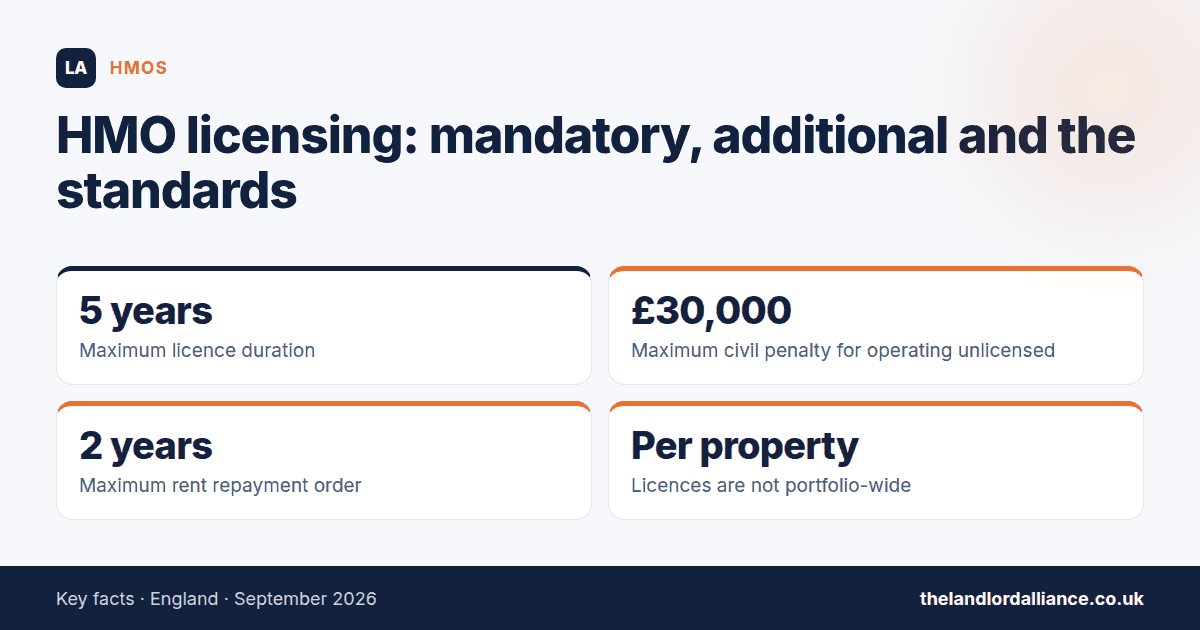
Five or more occupants from two or more households sharing facilities means a mandatory licence, everywhere in England, with no council designation required. Below five, licensing depends on whether your council has designated an additional scheme — and those change. A licence lasts up to five years, requires a fit and proper licence holder, and carries conditions on room sizes, amenities and waste. Operating without one is now materially more expensive than it was: a civil penalty of up to £30,000 or prosecution with an unlimited fine, plus a rent repayment order of up to two years’ rent that the tenant can apply for themselves.
Which scheme applies to you
| Scheme | Trigger | How to check |
|---|---|---|
| Mandatory | 5+ occupants, 2+ households, sharing a kitchen, bathroom or toilet | Nothing to check. It applies everywhere in England. |
| Additional | Smaller HMOs, usually 3 or 4 occupants, where the council has designated a scheme | Your council’s licensing page, by postcode. Designations can cover the whole borough or a few wards. |
| Selective | All private rented homes in a designated area, HMO or not | Same page. A single let can need a licence under this even with one tenant. |
Check the address, not the town. Additional and selective schemes are frequently drawn at ward or street level. Two houses a few hundred metres apart can sit on opposite sides of a designation boundary. Check the specific address on the council’s own map before you exchange contracts.
What the licence requires
Every mandatory licence carries statutory conditions, and councils add their own on top.
The statutory conditions
- Room sizes. 6.51 m² minimum for one person over 10, 10.22 m² for two, 4.64 m² for a child under 10. Rooms under 4.64 m² cannot be slept in at all, and you must notify the council that they exist.
- Maximum occupancy per room, stated on the licence, which cannot be exceeded.
- Waste. Compliance with the council’s scheme for storage and disposal of household waste — a genuinely common enforcement trigger, because bins are visible from the street.
- Gas safety. An annual certificate supplied to the council on request.
- Electrical safety. Declarations and certificates on request.
- Smoke and carbon monoxide alarms, installed and maintained.
What councils add
Amenity standards vary by authority and are where most refusals and conditions arise: the ratio of occupants to bathrooms and toilets, kitchen worktop length and storage per person, cooker and sink provision, heating in every room, and fire precautions. Fire safety is usually the largest capital item — fire doors with intumescent strips and closers, an interlinked detection system to a specified grade, emergency lighting on escape routes, and a written fire risk assessment.
Ask your council for its published amenity standards before you buy or convert. They are public documents, and they will tell you whether a five-bed conversion needs a second bathroom before it will ever be licensed.
Fit and proper person
The licence holder must be a fit and proper person, and must be the most appropriate person to hold it — usually the owner or the managing agent. The council considers unspent convictions involving fraud, violence, drugs or sexual offences, breaches of housing or landlord law, discrimination in a business context, and previous licence refusals or revocations.
It also considers whether the proposed holder has the resources and management arrangements to run the property properly. Naming an overseas owner with no UK presence as licence holder invites a refusal; naming a competent agent usually does not.
Applying
- Check the designation for the specific address, and confirm whether planning permission is also needed — licensing and planning are separate consents and neither substitutes for the other.
- Get the property to standard first where you can. An application on a property that plainly fails the amenity standards invites conditions with short deadlines.
- Apply before you let. A duly made application protects you from the offence while it is being determined. Letting first and applying later does not.
- Expect an inspection, and a schedule of works with deadlines attached to the licence.
- Diarise the renewal for at least three months before expiry. A lapsed licence is an unlicensed HMO from the day it expires.
The application is the protection. Section 72 of the Housing Act 2004 makes it an offence to control or manage an unlicensed HMO, but there is a defence where a valid application has been duly made and is outstanding. That makes the date you apply one of the most important dates in the whole process.
What it costs to get wrong
| Consequence | Exposure |
|---|---|
| Civil penalty | Up to £30,000 per offence, imposed by the council without a court hearing |
| Prosecution | Unlimited fine, and a criminal record for the licence holder |
| Rent repayment order | Up to two years’ rent, applied for by the tenant or the council |
| Banning order | For serious or repeat offences, with entry on the rogue landlord database |
| Management order | The council takes over management of the property and collects the rent |
There is a second consequence that gets overlooked: while a property is unlicensed, possession is harder to obtain, and the compliance failure sits on your record for the fit and proper test on every future application, for every property.
If you think you are already unlicensed
Apply now rather than waiting to be found. A duly made application gives you a defence going forward, it demonstrates cooperation, and councils treat voluntary regularisation very differently from a landlord discovered through a tenant complaint. It does not erase past liability, and it will not stop a rent repayment order for the period you were unlicensed — but it stops the exposure growing, which on a two-year multiplier matters a great deal. Take advice before you contact the council if the exposure is large.
Read next
Do I need a licence for a three-bedroom house share?
Only if your council has an additional licensing scheme covering that address. Three sharers is an HMO but not automatically a licensable one. Check the postcode on the council’s licensing map.
How long does an application take?
Commonly two to six months depending on the authority and whether an inspection identifies works. You can let while a duly made application is outstanding.
Can my letting agent hold the licence?
Yes, and often they should — the licence holder must be the most appropriate person, which for a hands-off owner is usually the managing agent. Make sure your contract says who is responsible for renewal.
Does a licence cover more than one property?
No. One licence per property, each with its own fee and its own conditions.
What happens if I sell an HMO?
The licence does not transfer. The buyer must apply for their own, and a sale with a licence in the seller’s name and no application from the buyer leaves the property unlicensed from completion.
Is planning permission the same as a licence?
No. They are separate consents from different parts of the council. You can hold planning permission and still be operating an unlicensed HMO, and vice versa.
Sources. Housing Act 2004, Part 2 and sections 61–78 (including section 72 on offences and the duly made application defence); Licensing of Houses in Multiple Occupation (Mandatory Conditions of Licences) (England) Regulations 2018 (SI 2018/616); Licensing of Houses in Multiple Occupation (Prescribed Descriptions) (England) Order 2018; Housing and Planning Act 2016 on civil penalties, banning orders and rent repayment orders; Renters’ Rights Act 2025 (c. 26). Checked 8 September 2026.
Related: HMOs explained · All guides · Free calculators