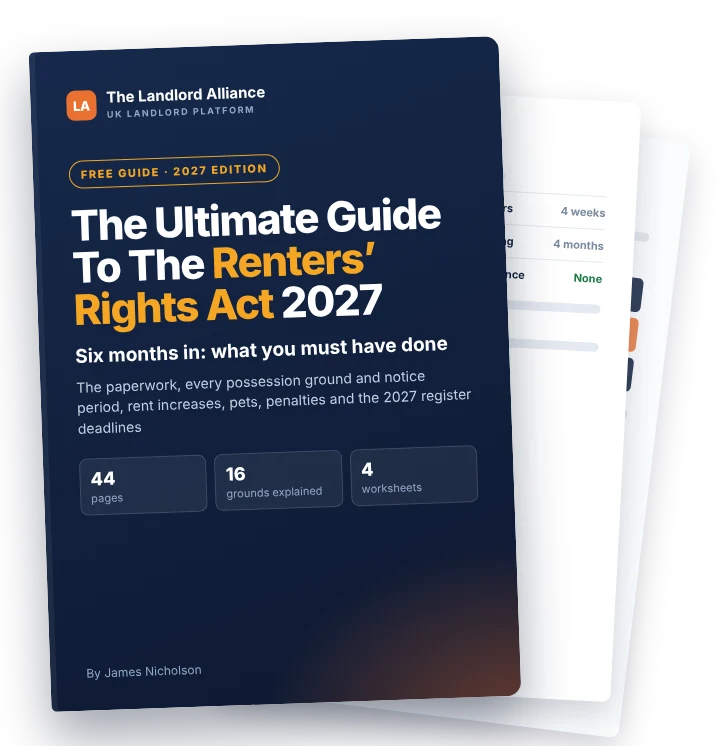
The Ultimate Guide To The Renters’ Rights Act 2027
Section 21 has gone and every tenancy in England changed on 1 May 2026. Six months in, this free guide sets out the landlord’s side of the new law in plain English: what you must have done, how to get a property back now, how to raise the rent so it holds, and the deadlines still to come in 2027.
- The paperwork: the Information Sheet, the written statement, and how to serve so it counts
- Every main possession ground, with its notice period, in one table
- How long a rent arrears case really takes now
- Rent increases by Form 4A, pets, and the penalties of up to £40,000
- The landlord register deadlines for every region, a 30-day plan and four worksheets
Written by James Nicholson, landlord and founder of The Landlord Alliance
Get the free guide
We’ll email you the PDF straight away.
The Renters’ Rights Act timeline
Most of the Act has been in force since 1 May 2026 (GOV.UK). Two deadlines have passed, and the next phase starts in December with the landlord register.
ASTs, fixed terms and section 21 ended. New grounds, Form 3A and Form 4A.
Deadline to give existing tenants the Information Sheet.
Register your rental property opens, region by region, at £65 a property each year.
Every private landlord must join the new landlord ombudsman.
Five parts, 14 chapters, four worksheets
Written for landlords in England, whether you have one tenancy or fifty. Every fact is traced to legislation.gov.uk or GOV.UK, and the notice periods, deadlines and penalties are in tables you can check in seconds.
The new rules for every tenancy
- What happened on 1 May 2026
- Which document each tenancy needs
- Bidding, rent in advance, discrimination
- Pets and the 28-day rule
Getting your property back
- Form 3A and the grounds
- Rent arrears and Ground 8
- Selling or moving back in
- Behaviour, breaches and the rest
Rent and money
- Rent increases that hold up
- Penalties and rent repayment orders
- Keeping your numbers working
What’s coming next
- The landlord register, by region
- Ombudsman, Awaab’s Law, Decent Homes
- Rent challenges moving to the Valuation Office
The toolkit
- A 30-day plan
- Tenancy compliance audit
- Possession ground finder
- Rent increase planner and pet record
The official Information Sheet
- The government’s four pages, unaltered
- What your tenants were told
- How to serve the real one
How long a rent arrears case takes now
A £1,000 a month tenancy where the tenant stops paying on 1 March. Ground 8 now needs three months’ rent owed and four weeks’ notice, and the Ministry of Justice’s latest figures put the median time from claim to repossession at 25.9 weeks.
The guide shows how to stop arrears getting there, and why Grounds 10 and 11 always go on the notice too.
Includes the Renters’ Rights Act Information Sheet
The government’s four-page sheet is reproduced at the back, so you can see exactly what your tenants were told. To serve it, GOV.UK says you must send the PDF downloaded from its own page as an attachment or a printed copy, never a link, to every tenant named on the agreement. Our Information Sheet guide covers who needs it, and our Renters’ Rights Act guide covers every change.
Missed the 31 May deadline? The duty didn’t end with the deadline. Give it now and keep proof: chapter 2 of the guide shows how.
Renters’ Rights Act FAQ
What is the Renters’ Rights Act?
The Renters’ Rights Act 2025 is the law that reformed private renting in England. Its main changes came into force on 1 May 2026: assured shorthold tenancies and fixed terms ended, section 21 was abolished, possession now needs a ground under section 8, rent can only rise once a year by Form 4A, and there are new rules on pets, rental bidding, rent in advance and discrimination.
Can landlords still use section 21?
No. Section 21 was abolished on 1 May 2026, and the last day to start court action on a section 21 notice served before then was 31 July 2026. Landlords now need one of the grounds for possession, served on Form 3A with the right notice period.
Do I have to give tenants the Information Sheet?
If a tenancy was agreed before 1 May 2026 with a written agreement, you had to give every named tenant the government’s Renters’ Rights Act Information Sheet 2026 by 31 May 2026, as the PDF itself, not a link. A tenancy agreed since 1 May needs a written statement of terms instead. If you missed it, give it now: the fine is up to £7,000.
When do landlords have to register?
Register your rental property opens on 15 December 2026, starting in the West Midlands, and each region gets three months. The last deadline is 14 November 2027 for the South West. It costs £65 a property each year, and the deadline depends on where the property is.
Is the guide legal advice?
No. It is general information about the law in England, written by a landlord and checked against legislation.gov.uk and GOV.UK on 20 November 2026. Take advice from a solicitor before you serve notice or go to court.
Is the guide really free?
Yes. Enter your first name and email and we’ll send you the PDF. The guide mentions The Landlord Alliance and our training courses, and you can unsubscribe from our emails at any time.
Get The Ultimate Guide To The Renters’ Rights Act
Every rule, every ground, every deadline, plus a 30-day plan, four worksheets and the official Information Sheet.
Law: England onlyUpdated 20 November 2026General information, not legal advice
Sources include the Renters’ Rights Act 2025, GOV.UK guidance for landlords, the Register your rental property guidance and the Ministry of Justice’s possession statistics. The full list is at the back of the guide.