The short version
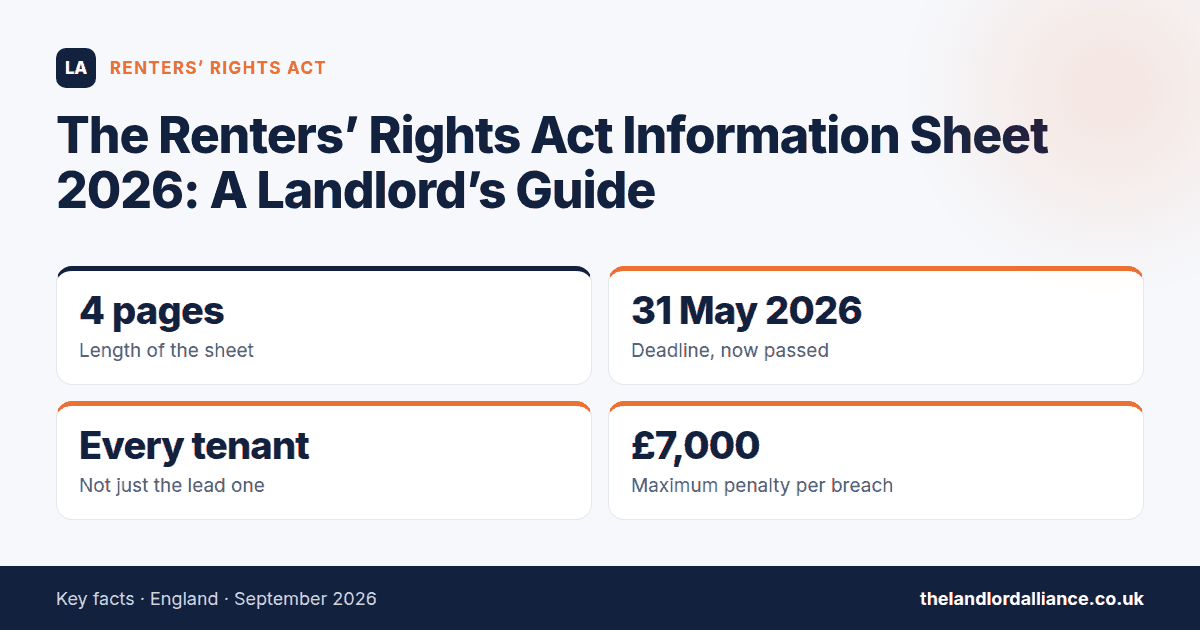
The Renters’ Rights Act Information Sheet 2026 is a four-page document published by the government explaining to tenants what changed on 1 May 2026. Landlords of tenancies that already existed on that date had to give it to every named tenant by 31 May 2026. It is not the same thing as a written statement of terms, which is what new tenancies need instead. Failing to serve it carries a civil penalty of up to £7,000 per breach.
Of all the obligations the Act created, this is the one landlords most often didn’t know existed. It isn’t complicated and it costs nothing to comply with — which is precisely why being caught out by it is so annoying.
What it is
When the Act commenced, every existing assured shorthold tenancy in England converted automatically into a periodic assured tenancy. Tenants had no say in that and, in most cases, no idea it had happened. The information sheet is the government’s answer to that problem: a plain-English explanation of the new rights and how tenancies now work, written for tenants rather than for us.
It is published by MHCLG on GOV.UK, it is free, and it must be given as published. You don’t write your own version, you don’t put your logo on it, and you don’t summarise the interesting bits. The point of a standard document is that every tenant in England gets the same information.
The duty at a glance
- Applies to
- Tenancies that existed on 1 May 2026
- Does not apply to
- Tenancies granted on or after 1 May 2026
- Who receives it
- Every named tenant, individually
- Deadline
- 31 May 2026
- Format
- The published document, given to the tenant
- Extra duty if verbal tenancy
- A written statement of terms as well
- Penalty
- Civil penalty up to £7,000 per breach
Information sheet or statement of terms?
Two different documents, two different jobs — this trips people up constantly
| Information sheet | Written statement of terms | |
|---|---|---|
| Purpose | Explains the change in the law | Sets out the terms of a specific tenancy |
| Who writes it | The government | You |
| Contents | Identical for everyone | Specific to that tenancy |
| Who needs it | Tenancies existing on 1 May 2026 | New tenancies from 1 May 2026 |
| When | By 31 May 2026 | At the start of the tenancy |
| Can you edit it | No | It’s yours — but it must cover the required terms |
There is one situation where both were required for an existing tenancy: where there was no written tenancy agreement at all. A verbal tenancy that converted on 1 May needed the information sheet and a written statement of the terms, because otherwise the tenant has nothing in writing describing what they’ve actually got.
Where to get it
From GOV.UK, and only from GOV.UK. Search for “Renters’ Rights Act Information Sheet 2026” and download the current PDF from the official publication page. Do not use a copy hosted on a letting agent’s site or a landlord forum — those get out of date, and the government has already updated the document once since publication.
Accessible versions exist for tenants who need them. If a tenant asks for large print, braille or another format, direct them to the publication page rather than producing your own version.
Check you have the current version before you send it. The sheet was published in March 2026 and updated in June. If you downloaded a copy in April and have been sending that one, you have been sending a superseded document.
Serving it properly
Three rules, and they matter more than they look:
Attach the PDF. A link to GOV.UK is not the same as giving someone the document. If a tenant later disputes receipt, an email with the file still attached is a far better record than one containing a URL.
Serve every named tenant. Joint tenants are each entitled to it. Sending it to whoever pays the rent, with an instruction to pass it on, is not service on the others.
Keep the record. Date, time, method, recipients, and the sent item itself with the attachment intact — stored somewhere that will outlive your current laptop and your current agent.
The full detail, including a covering email you can copy and what a defensible record looks like, is on how to serve the information sheet.
The deadline has passed. What now?
31 May 2026 was nearly three months ago. If you didn’t serve it, you are in breach of a duty that continues until you discharge it — which also means it is still within your power to stop the breach today.
Serve it now, dated now, and keep the record. A landlord who put it right voluntarily before any enforcement contact is in a very different position from one still in breach when a council comes calling. What you must not do is backdate anything.
I’ve written the full remediation position — what the penalty realistically looks like, how councils actually assess it, and what to do in what order — on what to do if you missed the 31 May deadline.
Questions
Do I need to serve it for a tenancy that started in June 2026?
No. That tenancy was granted after commencement, so it needs a written statement of terms instead.
My tenant is on a fixed term that runs to December. Does it still apply?
Yes — and note that the fixed term no longer has effect. The tenancy converted to periodic on 1 May like every other, which is exactly the kind of thing the information sheet explains.
Can my agent serve it on my behalf?
Yes, and most did. Confirm it actually happened and get a copy of the record for your own file rather than assuming.
What if the tenancy ended before 31 May?
If the tenancy had already ended, there was no tenant to serve. If it ended between 1 and 31 May, the duty arose while they were still your tenant.
Is there a penalty if I serve it late?
The breach is the failure to serve by the deadline, so serving late doesn’t erase it. It does stop it continuing, and it is strong evidence of cooperation if a council ever looks.
Does it apply in Wales or Scotland?
No. This is England only.
Every deadline, every property, tracked
The Landlord Alliance app holds your compliance dates and documents against each tenancy and warns you before something is due. £10 a month, cancel anytime.
See what’s includedEngland only. Position as at 20 August 2026. General information from a landlord, not legal advice.
Related: the full Renters’ Rights Act guide · how to serve it · missed the deadline? · tenancy agreements in 2026