The short version
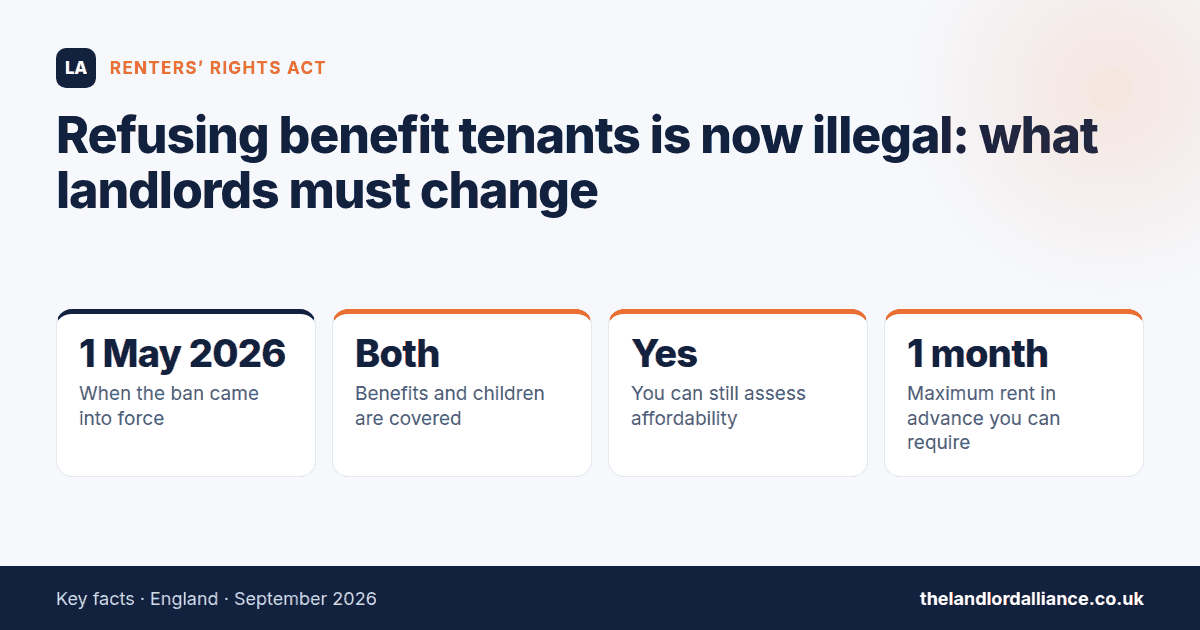
Since 1 May 2026 it has been unlawful in England to refuse to let to someone because they receive benefits, or because they have children. That covers advertising, the terms you offer, and the decision itself — so a “no DSS” ad, a policy of asking only benefit claimants for a guarantor, or quietly declining every applicant with children are all caught. What you can still do is assess affordability and creditworthiness on the same basis for everyone. Benefit income counts as income. The lawful question is whether the household can afford the rent, not where the money comes from.
What is prohibited
| Practice | Position |
|---|---|
| “No DSS”, “no benefits”, “professionals only” in an advert | Unlawful. Applies to your own listings and to instructions you give an agent. |
| Refusing an application because the applicant receives Universal Credit or housing benefit | Unlawful |
| Refusing an application because the household includes children | Unlawful |
| Requiring a guarantor only from benefit claimants | Unlawful — applying stricter terms is discrimination even if you would have accepted them with one |
| Asking for six months’ rent up front from a benefit claimant | Unlawful twice over — discriminatory, and rent in advance is capped at one month for everyone |
| Telling an agent you would “rather not” have benefit tenants | Unlawful. The agent acting on the instruction does not launder it. |
| Inviting offers above the advertised rent | Unlawful. Rental bidding is banned separately — you must advertise a price and cannot accept more. |
What you can still do
The ban does not require you to let to someone who cannot afford the property. It requires you to apply the same test to everyone.
- Assess affordability on total household income, including benefits, pensions and disability payments. Universal Credit including the housing element is income.
- Run credit checks, on the same basis for every applicant, with consent.
- Take landlord and employment references.
- Require a guarantor, provided you require one from everyone who fails the same affordability threshold, and can show that is what you do.
- Decline someone who genuinely cannot afford the rent, or whose references are poor, or who has relevant adverse credit — and record why.
Write your criteria down before you advertise. A documented, consistent affordability standard — “household income of at least 30 times the monthly rent, or a UK homeowner guarantor” — applied to every applicant is both good practice and your defence. A decision you cannot explain afterwards looks like the decision the law prohibits.
The practical problem this created
Two of the informal ways landlords used to de-risk a marginal applicant closed on the same day. You can no longer take a large sum of rent in advance, and you can no longer apply extra conditions selectively. That is the intended effect, and it does leave a genuine gap for applicants who fail conventional affordability.
What remains is the guarantor, properly referenced and properly documented, and rent guarantee insurance — which is worth more than it was, precisely because the alternatives have gone. Note that the insurance requires the tenant to have passed referencing to the insurer’s standard, so the two work together rather than as substitutes.
Universal Credit in practice
Two mechanisms matter if your tenant receives Universal Credit:
- Managed payments to landlords. The housing element can be paid directly to you where the tenant is in arrears of two months or more, or where they are assessed as vulnerable. The route is an application to DWP, and it is worth knowing before you need it.
- The Local Housing Allowance rate caps the housing element by area and household size. Where the rent exceeds LHA, the tenant must fund the difference from other income — which is exactly the sort of affordability question you are entitled to ask about.
Our guide to Universal Credit and direct payments covers the mechanics, including why applying can affect a Ground 8 claim.
What it costs to get wrong
Discrimination claims are brought by the applicant, and the remedies include damages and a declaration. Enforcement also sits with local authorities, which can impose financial penalties. Beyond the money, the practical exposure is evidential: adverts are archived, agents keep records of instructions, and applicants increasingly screenshot listings.
Review your live adverts today. An old listing on a portal with “no DSS” in the description is the easiest possible case against you, and it takes two minutes to fix.
Read next
Can I still say “no DSS”?
No. It is unlawful in adverts, in instructions to an agent, and in the decision itself.
Can I refuse someone who cannot afford the rent?
Yes, provided you apply the same affordability test to everyone and can evidence it. Benefit income counts towards affordability.
Can I ask for a guarantor?
Yes, if you require one from every applicant who fails the same threshold. Asking only benefit claimants or only families is discrimination.
Can I ask for rent in advance instead?
Only one month’s rent in advance, from anyone. That cap applies to all tenants, so it cannot be used selectively.
What about my mortgage or insurance conditions?
If a lender or insurer imposes terms that would require you to discriminate, change provider. A contractual condition does not override the law, and it will not be a defence.
Does this apply to lodgers?
The Renters’ Rights Act provisions are aimed at assured tenancies. Taking a lodger into your own home is a different arrangement — but general discrimination law still applies to how you advertise and select.
Sources. Renters’ Rights Act 2025 (c. 26), provisions on rental discrimination and rental bidding, commenced 1 May 2026 by SI 2026/421; Equality Act 2010 on indirect discrimination; DWP guidance on Universal Credit managed payments to landlords. Checked 8 September 2026.
Related: The Renters’ Rights Act · All guides · Tenant referencing