Information, not advice. We do not sell insurance and take no commission from any provider named here. Prices and cover limits are taken from published policy information in September 2026 and change often.
The short version
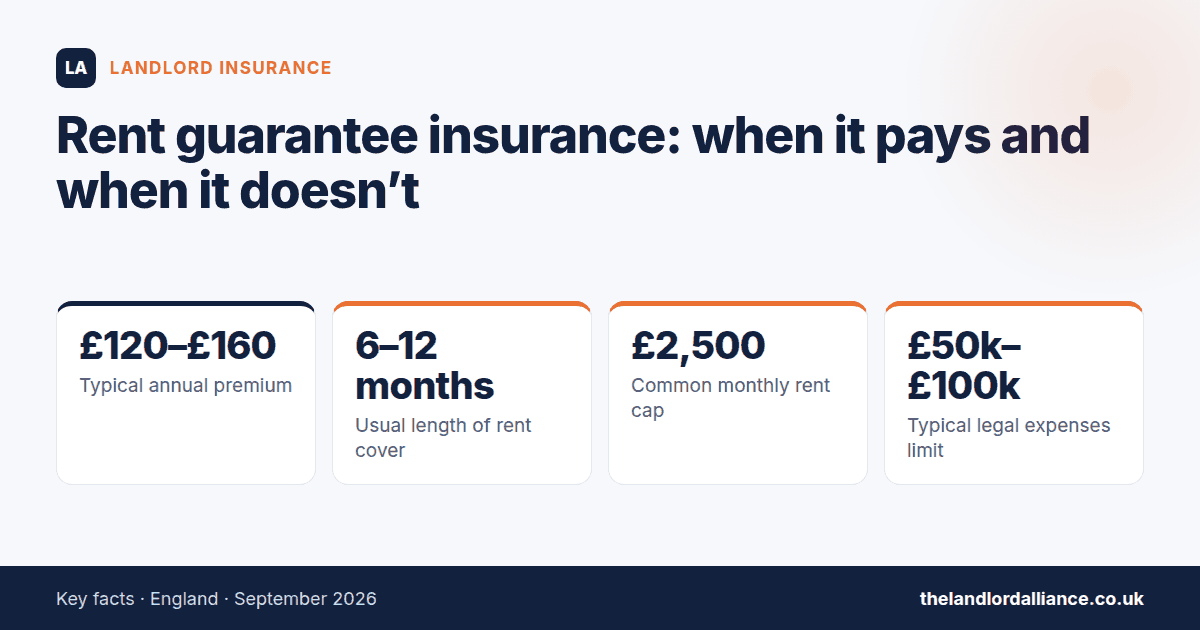
Rent guarantee insurance pays your rent when a tenant defaults and funds the legal work to get possession. It costs roughly £120–£160 a year for a typical property, and it has become materially more useful since section 21 was abolished, because the route to possession is now slower and more expensive. The catch is that almost every declined claim comes down to the same two things: the tenant was not referenced to the insurer’s standard before the tenancy began, or the landlord did not serve a valid notice promptly once arrears started. Neither is discovered until you claim.
What it is, and what it is not
Rent guarantee insurance covers tenant default: the tenant stops paying, and the policy pays the rent up to a monthly cap for a set number of months while you pursue possession. Most policies bundle legal expenses cover for the possession claim itself.
It is not the same as loss of rent cover, which is part of a buildings policy and pays only when the property is uninhabitable after an insured event such as a fire or flood. If your tenant simply stops paying, loss of rent pays nothing. This is the most common misunderstanding in landlord insurance and it is usually discovered at the worst possible moment. Our landlord insurance guide sets out how the covers fit together.
Why it matters more than it did
Before May 2026, a landlord facing arrears had section 21: two months’ notice, no reason required, and an accelerated procedure. That is gone. Possession now requires a ground under section 8, and the mandatory arrears ground has been tightened — Ground 8 needs three months of arrears and four weeks’ notice.
In cash terms, that means the exposure between the first missed payment and vacant possession is longer than it used to be, and the arrears at the point you can even serve notice are larger. On £1,100 a month, three months of arrears before you can serve is £3,300 before the clock on the notice period even starts. The product is priced against a risk that has genuinely grown.
What voids a claim
This is the section worth reading twice, because the exclusions do more work than the cover.
| Condition | What it means in practice |
|---|---|
| Referencing before the tenancy | The tenant must have passed referencing to the insurer’s standard before they moved in. Letting to someone who failed referencing, or letting without referencing at all, voids the policy. Retrospective referencing does not fix it. |
| Guarantor conditions | Where the reference was accepted subject to a guarantor, the guarantee must actually be in place, signed before the tenancy started, and in the form the insurer requires. |
| Prompt notification | Most policies require you to notify the insurer within a set window — often 30 days — of the first missed or part payment. Waiting three months to see if it resolves itself is the classic mistake. |
| Valid notice | You must serve the correct notice correctly. A defective section 8 notice is not just a delay in court — it can be a breach of the policy condition. |
| Pre-existing arrears | Arrears that existed before the policy started are excluded. You cannot buy cover once the tenant has already stopped paying. |
| Compliance | Deposit protected and prescribed information served, valid gas and electrical certificates. Non-compliance can weaken the possession claim, and insurers exclude what they cannot enforce. |
| Legitimate disputes | Rent withheld because of a genuine disrepair claim is generally not covered. That is a dispute, not a default. |
The interaction people miss. Since 1 May 2026 you cannot take more than one month’s rent in advance, and refusing a tenant because they receive benefits is unlawful. Both of the old informal ways of de-risking a marginal applicant have closed. That leaves referencing and a properly documented guarantor — which are exactly the two things your rent guarantee policy will ask about when you claim. The paperwork at the start of the tenancy is the insurance.
What to check before you buy
- The monthly cap against your actual rent. A £2,500 cap is generous for most of the country and inadequate in parts of London. Cover above that exists but costs more — some policies go to £5,000.
- How many months of rent, and what happens after possession. Some policies stop paying at the possession order; better ones continue to the date vacant possession is actually obtained, which given current court timescales is the difference that matters.
- The excess. Commonly the first month’s arrears. No-excess policies exist and cost more; whether that is worth it depends on how likely you think a short, self-resolving arrears episode is.
- Whether legal expenses are included or bolted on, and the limit. £50,000 to £100,000 is typical and is ample for a straightforward possession claim.
- Who conducts the litigation. Most policies require you to use the insurer’s panel solicitor. That is normal, but it means you are not choosing your own representation.
- Whether it covers a tenancy that is already running. Many policies can be taken out mid-tenancy only if the rent account is clean and the original referencing meets their standard.
Is it worth it?
The arithmetic is straightforward. At roughly £140 a year against a £1,100 monthly rent, the premium is about 1% of annual rent. One default that runs six months costs £6,600 in rent plus legal costs — roughly forty-seven years of premiums.
So it is not a close call on expected value if your risk of default is anywhere near typical. Where it is a genuinely close call: a long-standing tenant with years of clean payment history, a low-rent property where the absolute exposure is small, or a landlord with enough cash reserve and enough properties to self-insure the risk across a portfolio. What does not make sense is buying it and then failing the referencing condition — that is paying a premium for nothing.
A note on membership bundles. Some landlord bodies include or discount rent guarantee cover as part of a membership. That can be good value, but compare the underlying policy on its own terms — the cap, the months, the exclusions — rather than assuming the bundled version matches the standalone one. Our view on whether one of those memberships pays is in is NRLA membership worth it.
Read next
How much does rent guarantee insurance cost?
Typically £120–£160 a year for a standard property in September 2026, with higher premiums for higher rent caps, longer cover periods or no excess.
Does it pay from the first missed payment?
Usually not. Most policies carry an excess equal to the first month’s arrears, then pay from month two up to the cap. Check whether your policy backdates to the first missed payment once the claim is accepted.
Can I buy it after the tenant stops paying?
No. Pre-existing arrears are excluded on every mainstream policy. Cover has to be in place before there is a problem.
Does it cover damage as well as rent?
No. Rent guarantee covers rent and legal costs. Damage is a matter for the deposit, or for malicious damage cover on your buildings policy if you added it.
What if my tenant was referenced by an agent, not the insurer?
Usually acceptable if the reference meets the insurer’s standard, but check before you rely on it. “The agent referenced them” is not the same as “they passed the referencing this policy requires”.
Does it still work now section 21 has gone?
Yes, and the legal expenses element is more valuable than it was. What changed is timing: possession takes longer, so check how many months of rent the policy pays and whether it runs to vacant possession rather than stopping at the order.
Sources. Published policy information and premiums from mainstream UK rent guarantee providers, September 2026; Renters’ Rights Act 2025 (c. 26); Housing Act 1988 Schedule 2 as amended. Checked 7 September 2026. Cover varies between insurers — read your own policy wording.
Related: Landlord insurance · All guides · Free calculators