The short version
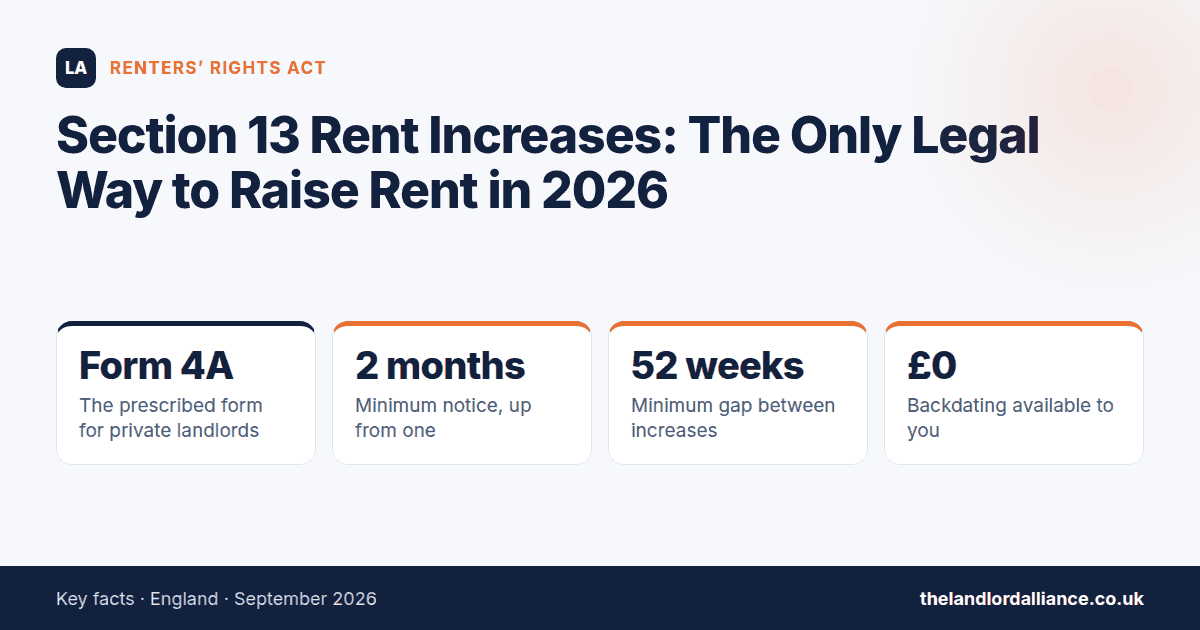
Since 1 May 2026, a section 13 notice is the only lawful way to raise the rent on an assured tenancy. Rent review clauses in your agreement no longer work. You must use Form 4A, give at least two months’ notice, and you can only do it once every 52 weeks. If the tenant challenges it at tribunal, the tribunal can hold the rent or lower it — it can no longer set it higher than you asked for, and it cannot backdate.
Rent increases used to be the part of letting that mostly took care of itself — a clause in the agreement, a letter, done. That route is closed. What replaced it is more procedural, and the procedure is unforgiving: get the form, the notice period or the timing wrong and the increase simply doesn’t take effect.
Why your rent review clause stopped working
The Act provides that the rent for a period cannot exceed the rent for the previous period except by a section 13 notice, a tribunal determination, or a written agreement following a tribunal decision. A contractual rent review clause is none of those things, so it has no effect — regardless of what your tenancy agreement says or when it was signed.
This catches out landlords with older agreements containing an annual RPI or fixed-percentage uplift. Those clauses are still printed in the document and are still legally inert. If you increased a rent this year by relying on one, that increase was not validly imposed.
If you’ve raised rent since 1 May without a Form 4A, the increase probably isn’t valid, and the tenant may be entitled to treat the old rent as the rent due. Take advice before pursuing arrears calculated on an invalid increase — going to court on the wrong figure is worse than the shortfall.
The rules
| Requirement | The rule | What changed |
|---|---|---|
| Form | Form 4A | Form 4 is now social housing only |
| Notice period | At least two months before the new rent starts | Was one month for monthly tenancies |
| Frequency | Once every 52 weeks | Now explicit and strict |
| Route | Section 13 only | Rent review clauses ineffective |
| Tribunal outcome | Open-market rent, capped at your proposed figure | Tribunal can no longer set it higher |
| Backdating | None | Tribunal can no longer backdate to the notice date |
| Hardship deferral | Tribunal may push the start date back | Limited to two months from determination |
Form 4A, not Form 4
This is a genuine trap, because Form 4 still exists and is still the correct form — for social housing. Private landlords need Form 4A, introduced by the 2026 prescribed forms regulations. A large number of guides, templates and even some agent packs still reference Form 4. Serving the wrong prescribed form is not a technicality a tribunal will overlook.
Get the current version from GOV.UK’s assured tenancy forms page each time. Don’t reuse a saved copy from last year.
The 52-week rule
The new rent cannot take effect earlier than 52 weeks after the date the last increased rent took effect. Note that it runs from when the previous increase took effect, not from when you served the last notice, and not from the tenancy anniversary. If you increased the rent from 1 September 2025, the earliest a new increase can take effect is 1 September 2026 — and with two months’ notice, you needed to serve by the start of July.
What happens if the tenant challenges it
The tenant can apply to the First-tier Tribunal (Property Chamber) before the proposed start date. The tribunal then determines the open-market rent for the property.
Here is the change that matters most, and the one landlords consistently misjudge:
Tribunal outcomes, before and after
- Before 1 May 2026
- Tribunal set an open-market rent — which could be higher than the landlord proposed
- Since 1 May 2026
- The rent is the open-market rent, or your proposed rent, whichever is lower
- Effect on tenants
- Challenging is now risk-free. Their worst case is paying what you asked
- Effect on landlords
- Expect far more challenges. Your figure needs evidence behind it
- Backdating
- Gone. The new rent starts from the notice date or the first period after determination
Under the old regime, the risk of the tribunal setting a higher rent was a real deterrent — most tenants didn’t chance it. That deterrent has been removed deliberately. The practical consequence is that an ambitious increase now gets tested rather than absorbed, and the cost of losing is that you spend months at the old rent with no backdating.
How to make your figure defensible
The tribunal is deciding what the property would let for on the open market today. So bring what an agent would bring:
Evidence that works
- Three to five genuinely comparable local lettings
- Same bedroom count, condition and area
- Recent — within the last few months
- Actual let prices, not asking prices where you can get them
Strengthen it with
- Improvements you have made since the last increase
- An EPC upgrade or new kitchen or bathroom
- A written agent appraisal
- Photographs of current condition
What won’t help
- Your mortgage costs going up
- A percentage uplift with nothing behind it
- Asking prices from portals with no lettings evidence
- Comparables from a different area or property type
Practical timing
- Work back from the 52-week date
- Add two months for notice
- Serve early rather than at the last moment
- Diarise the next eligible date immediately
The mortgage point deserves emphasis, because it’s what most landlords lead with and it carries no weight at all. The tribunal is assessing the property’s market rent, not your cost base. However genuinely your costs have risen, it is not an argument that works in that room.
Questions
Can I agree an increase with the tenant instead?
You can agree a rent in writing, and many landlords will prefer that to a formal notice. But if there is any chance of a dispute later, a section 13 notice is the route with the clearer legal footing.
What if the tenant just doesn’t pay the new rent?
If the notice was valid and unchallenged, the new rent is the rent, and non-payment builds arrears in the normal way. If the notice was defective, it doesn’t — which is why the form and timing matter.
Can I increase the rent in the first year of a tenancy?
The 52-week rule runs from the start of the tenancy for a first increase, so in practice no.
Does the tenant have to be given a reason?
No. Section 13 doesn’t require justification — but if it goes to tribunal, market evidence is effectively the justification.
What if the tribunal sets a rent lower than I proposed?
That becomes the rent, from the date it determines. You cannot recover the difference for the intervening period.
Know your next eligible increase date
The Landlord Alliance app tracks the 52-week clock on every tenancy and reminds you when to serve, so you don’t lose a year to a missed notice period. £10 a month, cancel anytime.
See what’s includedEngland only. Position as at 20 August 2026. General information from a landlord, not legal advice.
Sources: Housing Act 1988 ss.13 and 14ZB as amended; Renters’ Rights Act 2025 ss.6–7; the Assured Tenancies (Prescribed Forms) (England) Regulations 2026, SI 2026/354.
Related: the full Renters’ Rights Act guide · periodic tenancies · section 8 grounds