The short version
Every tenancy in England is now an assured periodic tenancy. It rolls month to month with no end date. The tenant can leave on two months’ notice at any time. You can only end it on a section 8 ground. Rent goes up once a year by section 13 notice and no other way. There is no fixed term, no break clause, and no expiry — the tenancy continues until one side lawfully ends it.
What “periodic” actually means
A periodic tenancy runs in repeating periods — almost always months — and simply continues, period after period, indefinitely. There is no end date written into it and nothing expires.
Landlords used to meet periodic tenancies only at the tail end of a fixed term, when a twelve-month AST rolled over into a statutory periodic tenancy because nobody got round to renewing. That rolled-over state is now the only state. There is no fixed term to precede it.
| Old fixed-term AST | Assured periodic tenancy | |
|---|---|---|
| Length | Six or twelve months typically | No end date. Continues indefinitely |
| Tenant leaving early | Bound for the term unless a break clause applied | Two months’ notice, any time |
| Your income certainty | Guaranteed for the term | Two months at a time |
| Ending it, landlord | Section 21 after the term, or section 8 | Section 8 ground only |
| Renewal | New agreement or roll to periodic | Nothing to renew |
| Rent increases | Rent review clause or at renewal | Section 13 notice, once every 52 weeks |
| Rent period | Any | Monthly or shorter |
The asymmetry, stated plainly
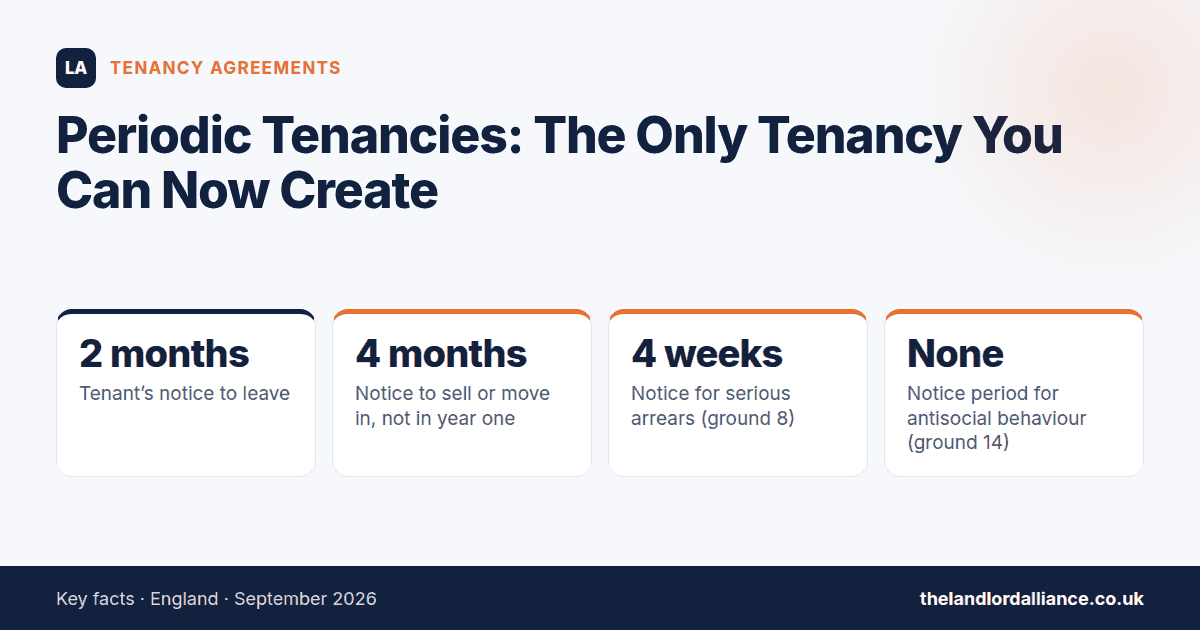
A tenant can end the tenancy on two months’ notice from the first day. You cannot end it at all without a ground — and the two most common landlord reasons, selling and moving in, need four months’ notice, can’t be used in the first twelve months, and trigger a twelve-month re-letting ban afterwards.
Notice, both directions
- Tenant leaving
- Two months. Available immediately. No reason needed
- You, selling (ground 1A)
- Four months. Not in year one. Twelve-month re-letting ban follows
- You, moving in (ground 1)
- Four months. Not in year one. Same ban
- You, serious arrears (ground 8)
- Four weeks, once three months’ arrears have built
- You, antisocial behaviour (ground 14)
- No notice period — proceedings can begin immediately
I don’t think there’s much point pretending this is neutral. It isn’t, and landlords planning around the old assumptions will get caught. The practical consequences worth absorbing:
You can’t rely on a fixed income window. If your figures assume twelve months of guaranteed rent, rebuild them on two. Void risk is now continuous rather than concentrated at term end.
Tenant quality matters more than it did. You’ve lost the ability to wait out a poor tenant until the term expires and then serve a section 21. Referencing and affordability checks are now doing considerably more work — and they remain expressly permitted.
Selling needs planning about sixteen months out. Four months’ notice plus a twelve-month ban from notice expiry. Deciding in March to sell in June is no longer possible with a tenant in place. Full detail on the grounds.
Practical points landlords ask about
When does the tenant’s notice take effect?
It must be at least two months, and government guidance indicates it should expire on or before a rent payment date. Build the two-month minimum into your expectations and check the specific dates rather than assuming a rounded month.
Joint tenants
Any one joint tenant can serve notice, and doing so ends the tenancy for everybody — including sharers who wanted to stay. A shorter notice period has to be agreed with all of them, not just the one leaving.
This catches out student and sharer lets particularly. One person leaving can unravel the whole arrangement, and the remaining occupiers have no automatic right to continue. If you want to keep them, you’re granting a new tenancy on current terms.
Can I ask the tenant to commit for longer?
You can ask. It won’t bind them. Any term purporting to prevent a tenant giving two months’ notice is of no effect, and dressing it up — an incentive that claws back if they leave early, a “loyalty discount” reversed on departure — risks being read as a penalty for exercising a statutory right. I’d steer well clear.
What about rent periods?
A rent period longer than a month is of no effect and the tenancy defaults to monthly. Weekly and fortnightly still work. Quarterly does not.
If you have a tenancy on quarterly rent, that term is inert and the tenancy is running monthly whatever the paperwork says. Worth reconciling your rent account before it turns into a disputed arrears figure.
Questions
Does my existing fixed term still run?
No. It ceased to have effect on 1 May 2026. The tenancy is periodic regardless of what the agreement says.
Can a tenant leave in the first month?
They can serve notice immediately, and it takes effect two months later. So the shortest possible tenancy is around two months.
Do I need to renew the tenancy each year?
No. There’s nothing to renew — it continues until lawfully ended.
Can I agree a shorter notice period with the tenant?
Yes, in writing. For joint tenancies you need agreement from all of them.
How do I increase the rent?
Section 13 notice on Form 4A, two months’ notice, once every 52 weeks. See the rent increase guide.
What happens if the tenant just stops paying?
Arrears build as normal. At three months you have a mandatory ground 8 with four weeks’ notice — provided the deposit is properly protected, which now bars section 8 too.
Two months’ notice means two months to react
Track notice dates, rent increase anniversaries and arrears thresholds across every tenancy, so nothing lands as a surprise. £10 a month, cancel anytime.
See what’s includedEngland only. Position as at 20 August 2026. General information from a landlord, not legal advice.
Sources: Housing Act 1988 s.4A as inserted by RRA 2025 s.1; RRA 2025 ss.20–21; Protection from Eviction Act 1977 as amended.
Related: tenancy agreements in 2026 · what happened to ASTs · the Renters’ Rights Act · section 8 grounds