The short version
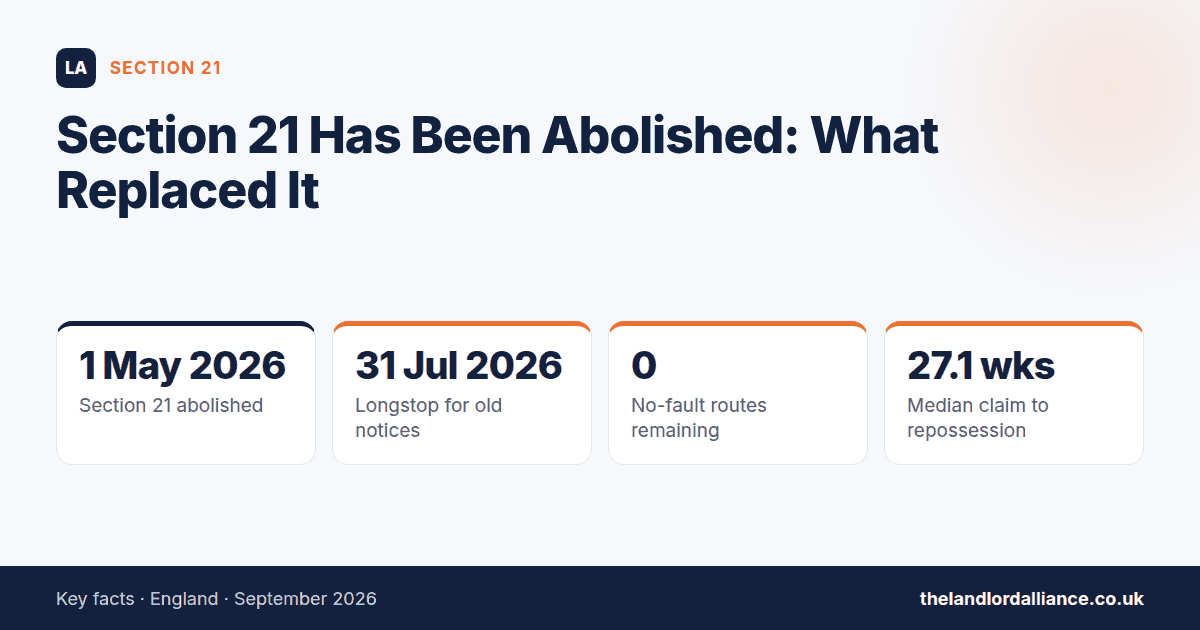
Section 21 was abolished on 1 May 2026. You cannot serve one, and there is no replacement for it — no-fault possession no longer exists in England. Every possession claim now needs a section 8 ground, evidence for that ground, and the notice period that ground carries. If you were holding a section 21 notice served before 1 May, it is almost certainly dead: unless you had already asked the court to issue the claim form by 31 July 2026, it expired.
Section 21 did a lot of work for landlords, and most of the questions I get in the Landlord Alliance community are still shaped by it — people asking how long a section 21 takes, or whether they can serve one “just in case”. The honest answer is that the tool is gone and the replacement is a different shape entirely. This page explains what actually happened, what it means if you were mid-process, and what you use instead.
What happened to section 21
The Renters’ Rights Act removed the entire chapter of the Housing Act 1988 that created assured shorthold tenancies. Section 21 lived inside that chapter, so it went with it. This wasn’t an amendment — the provision was repealed outright.
| Before 1 May 2026 | Now |
|---|---|
| Section 21: two months, no reason needed | Abolished. No equivalent exists |
| Accelerated possession — paper only, often no hearing | Not available. Every section 8 claim gets a hearing |
| Fixed term, then section 21 at the end | No fixed terms. Tenancy continues until lawfully ended |
| Section 8 as the harder alternative | Section 8 is the only route |
There is no “section 21 replacement”. Some coverage framed the reform as swapping one notice for another. It didn’t. The Act removed no-fault possession and expanded the section 8 grounds instead. If you want the property back, you now need a reason that fits a ground.
If you served a section 21 before 1 May 2026
Schedule 6 of the Act set out transitional rules. They have now run out, but it is worth knowing exactly where you stand, because the answer differs depending on how far you had got.
| Your position on 1 May 2026 | What the Act allowed | Position today |
|---|---|---|
| You had already asked the court to issue the claim form | Notice stays valid until the proceedings conclude. The tenancy stays an AST until then | Still live. Your claim continues as an AST possession claim |
| Notice served, claim not yet requested | Valid until the earlier of its own expiry or three months from 1 May | Dead. The three-month longstop ended 31 July 2026 |
| No notice served | — | Section 8 only |
The point people miss is that the deadline was for requesting issue of the claim form, not for serving the notice or for the notice’s own expiry date. A notice served in April 2026 with six months of life left in it still died on 31 July if you hadn’t started the claim.
The same longstop applied to old section 8 notices. Schedule 6 paragraph 17 mirrors the section 21 rule: a section 8 notice served before 1 May 2026 also had to have its claim requested by 31 July. This catches people out because the coverage focused almost entirely on section 21. If you are sitting on a pre-May section 8 notice, serve a fresh one on the current Form 3A.
One narrow exception: a Breathing Space moratorium can extend those periods, so a small number of pre-commencement notices may still be alive. If that applies to you, take advice on your specific dates rather than assuming.
What you use instead
Section 8, on a ground. The grounds most landlords will actually reach for:
| Ground | When it applies | Notice | Type |
|---|---|---|---|
| 1A | You intend to sell | 4 months | Mandatory |
| 1 | You or close family moving in | 4 months | Mandatory |
| 8 | Three months’ or 13 weeks’ arrears | 4 weeks | Mandatory |
| 10 / 11 | Some arrears / persistent late payment | 4 weeks | Discretionary |
| 12 | Breach of a tenancy obligation | 2 weeks | Discretionary |
| 14 | Antisocial behaviour | None — file immediately | Discretionary |
Two things make this meaningfully harder than section 21 was, and they are worth planning around rather than discovering:
Selling now costs you about sixteen months. Ground 1A needs four months’ notice, and afterwards you cannot let or even market the property to let for twelve months from the notice expiry date. On my three-bed in Hastings at £1,500 a month, that ban costs roughly £20,800 once you add council tax on an empty property, insurance and standing charges. Breaching it is a criminal offence with a £40,000 civil penalty as the alternative to prosecution.
Every claim gets a hearing. The accelerated paper route died with section 21. Median time from claim to repossession is currently 27.1 weeks on the latest Ministry of Justice figures, and that is before you add the notice period on the front.
Questions landlords are asking
Can I still serve a section 21 notice?
No. The provision was repealed on 1 May 2026. There is nothing to serve.
My section 21 was served in April and expires in October. Can I use it?
Only if you asked the court to issue the claim form before 31 July 2026. If not, the notice is dead regardless of its own expiry date.
Is there any no-fault route left?
No. Every possession claim needs a ground under section 8.
What if my tenant agrees to leave?
A tenant can end the tenancy themselves with two months’ notice, and nothing stops you agreeing a surrender. What you cannot do is pressure someone out — unlawful eviction penalties were increased by the same Act.
Does this apply to my existing tenants?
Yes. Every assured shorthold tenancy converted automatically on 1 May 2026.
What about Wales and Scotland?
Different regimes entirely. This page is England only.
Notice periods and deadlines, tracked
Four months on ground 1A, four weeks on ground 8, twelve months of re-letting ban afterwards. The app holds those dates against each property so they don’t creep up on you. £10 a month, cancel anytime.
See what’s includedEngland only. Position as at 31 August 2026. General information from a landlord, not legal advice. If you are mid-claim or facing a defended possession hearing, take advice on your specific circumstances.
Sources: Renters’ Rights Act 2025 s.2 and Schedule 6; Housing Act 1988 s.8 and Schedule 2 as amended; SI 2026/421; Ministry of Justice, Mortgage and landlord possession statistics April to June 2026.
Related: section 8 grounds · looking for a section 21 template? · the Renters’ Rights Act · tenancy agreements in 2026