The short version
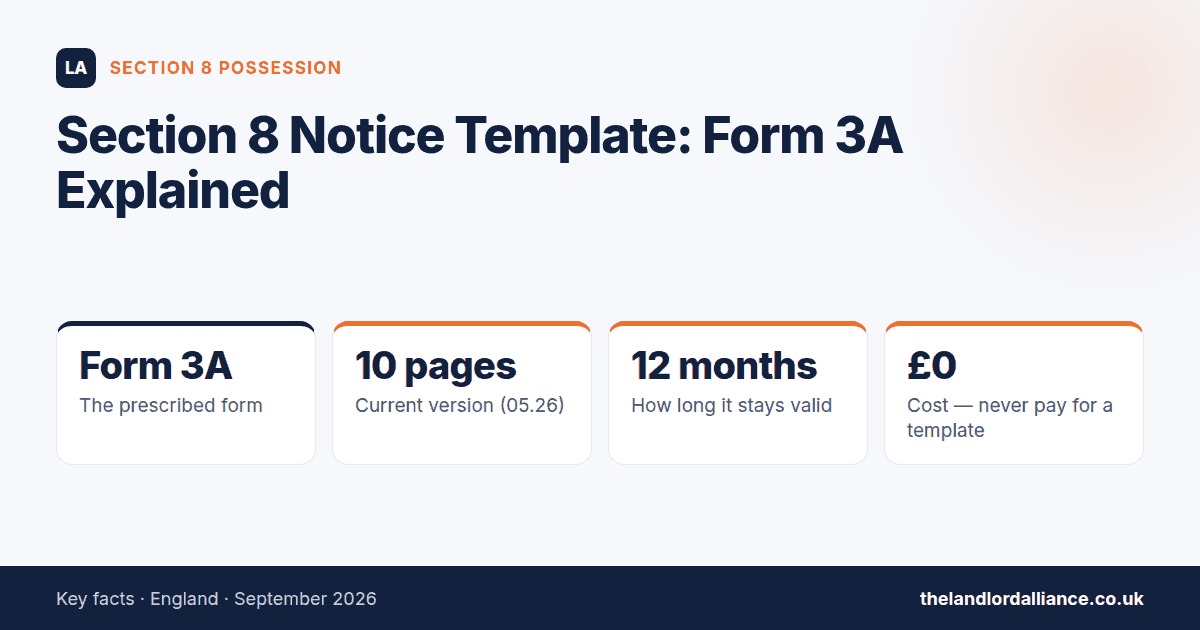
The section 8 notice for private tenancies in England is Form 3A. It is free from GOV.UK and you should download it fresh every time — unusually, it is not fixed in the regulations, so the government can replace it without new legislation. Form 3 still exists but is social housing only now. The two fields that decide whether your notice survives are 4.2, which needs the full legal wording of each ground, and 2.1, the earliest date you can apply to court.
A section 8 notice is the foundation of everything that follows. Get it wrong and you don’t find out at the point of serving — you find out months later at a hearing, having paid £415 to issue. This walks through the form field by field, and the defects that actually get notices thrown out.
Get the right form, every time
Download Form 3A from GOV.UK immediately before you serve. The regulations prescribe “the version published by the Secretary of State that has effect at the time the requirement applies” — the form is a living document, not a schedule to an SI. A copy saved three months ago may not be the prescribed form. The current version is marked (05.26) and runs to ten pages.
| Form | Use |
|---|---|
| Form 3A | Section 8 notice — private assured tenancies in England |
| Form 3 | Section 8 notice — social housing only since 1 May 2026 |
| Form 6A | The old section 21 notice. Obsolete — section 21 was abolished |
| Form 4A | Rent increase, not possession — see section 13 |
Filling it in, field by field
| Field | What goes in it | Risk |
|---|---|---|
| 1.1 / 1.2 | Every tenant’s full name; the property address | Missing a joint tenant invalidates service |
| 2.1 | Earliest date you can apply to court | Too early and the notice fails |
| 3 | Latest date — pre-printed, 12 months from service | Nothing to complete |
| 4.1 | Tick-box summary of common grounds | Optional — this is not the ground |
| 4.2 | Full legal wording of each ground from Schedule 2 | The most common fatal defect |
| 4.3 | Why each ground applies to this tenancy | Bare assertion is not particulars |
| 5.1–5.7 | Signature, capacity, date, contact details | Joint landlords each sign or authorise |
Field 4.2 — quote the ground in full
The form’s own note is blunt about this: insert the full legal wording from Schedule 2 for each ground, and “do not rely on the name of the ground only.” The statute behind it requires the notice to specify the ground and particulars of it.
The government publishes a separate document alongside Form 3A containing the exact wording for every ground. Copy from that rather than retyping from the Act — a paraphrase or a truncation is where notices die. Writing “Ground 8 — rent arrears” is not a ground.
Field 4.3 — the particulars
This is your explanation of why the ground applies here. On arrears that means figures and dates: what was due, what was paid, what the balance is now. On ground 1A it means the intention to sell and what evidences it. “The tenant is in arrears” is an assertion, not particulars.
Field 2.1 — the earliest date
The date must not fall before the longest notice period of any ground you cite. Cite two grounds and the longer governs.
| Grounds | Notice period |
|---|---|
| 1, 1A, 1B, 2, 2ZA–2ZD, 4A, 6, 6A, 6B | Four months |
| 5, 5A–5D, 5H, 7, 9 | Two months |
| 5E, 5F, 5G, 8, 10, 11, 18 | Four weeks |
| 4, 7B, 12, 13, 14ZA, 14A, 15, 17 | Two weeks |
| 7A or 14 | None — proceedings may begin immediately |
Where you cite an antisocial behaviour ground, proceedings can begin the same day even alongside longer-notice grounds. But you cannot use that to shorten a ground 1A re-letting ban — the Act closes that specifically.
What invalidates a notice
| Defect | Why |
|---|---|
| Wrong or superseded form | Form 3 on a private tenancy, or an outdated Form 3A |
| Ground named but not quoted in full | Form note 4.2 and the statute both require the wording |
| No particulars | The statute requires ground and particulars |
| Earliest date too early | Must clear the longest ground’s period |
| Ground 1 or 1A date inside year one | Specified date must be on or after the anniversary |
| Claim begun after 12 months | The notice has expired |
| A joint tenant omitted | Service incomplete |
| Unsigned or signed without authority | Joint landlords must each sign or authorise one |
| Arrears notice during a Breathing Space | Prohibited on grounds 8, 10 and 11 once notified |
On ground 8, a defective notice cannot be rescued. The court has a general power to dispense with the notice requirement where it’s just and equitable — but that power is expressly unavailable for grounds 7A, 7B and 8. Everywhere else you might argue your way out; on the mandatory arrears ground you cannot.
Separately, check the deposit before serving. An unprotected deposit or unserved prescribed information bars a possession order on section 8 grounds now, with only the antisocial behaviour grounds excepted. Curable — but cure it before you serve.
Serving it, and proving service
There is no statutory deemed-service rule for a section 8 notice, so the burden of proving good service is entirely yours.
Order of preference
- Whatever method the tenancy agreement specifies — this overrides everything
- By hand to the tenant — the most reliable
- Delivered to the property, through the letterbox
- Registered post to the property
Email only if
- The agreement clearly permits service by email
- Otherwise it is not good service
- Don’t assume a habit of emailing counts
Evidence it
- Keep the original
- A copy to every named tenant
- Certificate of service (N215), or
- Endorse the notice: served by whom, when
Then diarise
- The earliest date you can issue
- The 12-month expiry
- Any re-letting ban on grounds 1 / 1A
Questions
Can I download a section 8 template from a template site?
Don’t. The prescribed form changes without legislation, and third-party copies go stale. GOV.UK, free, every time.
Can I cite more than one ground?
Yes, and you usually should — grounds 8, 10 and 11 together on arrears, for instance. Remember the longest notice period governs the date.
Where do I find the legal wording?
The government publishes it as a separate document next to Form 3A. Copy it verbatim.
What if I make a mistake after serving?
Serve a fresh, correct notice. The clock restarts, but that is far better than discovering the defect at a hearing.
How long does the notice last?
Twelve months from service. A Breathing Space moratorium can extend that by up to eight weeks.
Can I add a ground later?
The court can give permission to alter or add grounds, but don’t rely on it. Get the notice right at the outset.
The dates that follow a notice
Earliest issue date, twelve-month expiry, re-letting ban end date — all calculated from the ground you used and held against the property. £10 a month, cancel anytime.
See what’s includedEngland only. Position as at 31 August 2026. General information from a landlord, not legal advice. Always download the current Form 3A from GOV.UK immediately before serving.
Sources: SI 2026/354 reg 3; Housing Act 1988 ss.8, 8(4AA), 8(5) as amended; Schedule 2 as amended; MHCLG Form 3A guidance for landlords and published ground wording.
Related: all 32 grounds · ground 8 arrears · ground 1A selling · the court claim