The short version
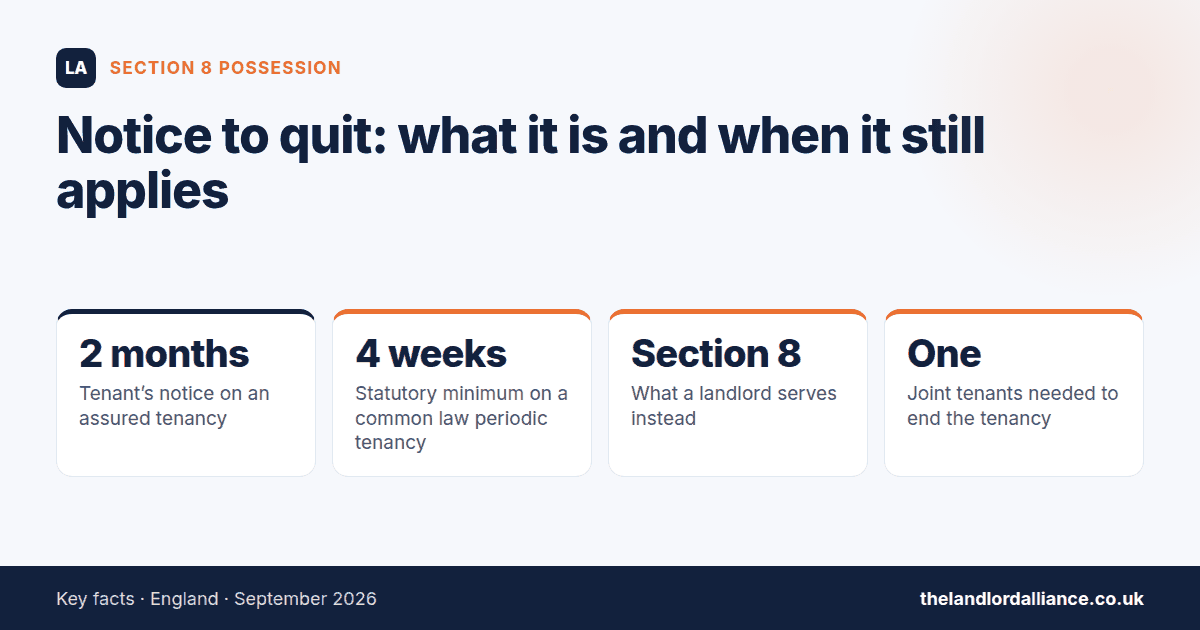
The phrase has changed hands. For an ordinary assured tenancy, a notice to quit is now the tenant’s document: under section 20 of the Renters’ Rights Act a tenant ends the tenancy by giving at least two months’ notice expiring at the end of a rent period. A landlord cannot end an assured tenancy with a notice to quit at all — you need a section 8 notice relying on a ground. Landlords still use a notice to quit in a narrow set of cases: common law tenancies that are not assured, and excluded occupiers such as lodgers.
Who serves what, now
| Situation | Correct notice | Period |
|---|---|---|
| Tenant ending an assured tenancy | Notice to quit | At least 2 months, expiring at the end of a rent period |
| Landlord ending an assured tenancy | Section 8 notice on a ground | Depends on the ground — 4 weeks to 4 months |
| Either party, common law periodic tenancy (not assured) | Notice to quit | At least 4 weeks, or one full period if longer |
| Landlord ending a lodger’s licence | Reasonable notice, usually in writing | Commonly the rent period; no court order needed |
| Ending a tenancy by agreement | Deed or agreement of surrender | Whatever both sides agree |
The tenant’s notice to quit
Since 1 May 2026 every assured tenancy is periodic, and the tenant leaves by giving notice. The requirements:
- At least two months. Shorter only if the landlord agrees.
- Expiring at the end of a rent period. On a tenancy with rent due on the 5th, a notice must expire on the 4th of a month, not mid-period.
- In writing.
- It cannot be unilaterally withdrawn. Withdrawal requires the landlord’s agreement — and on a joint tenancy, the agreement of every joint tenant too.
On a joint tenancy, one is enough. A notice to quit from any single joint tenant ends the tenancy for all of them, whether or not the others want to stay, and the remaining occupiers have no automatic right to continue. This catches out landlords and tenants equally — see joint tenancies.
When a landlord still uses one
Common law tenancies. A small category of lettings are not assured tenancies — a resident landlord letting to someone who is not sharing living accommodation, a company let, a tenancy at a very high or very low rent, or a letting of land with no dwelling. These are ended by notice to quit, and the Protection from Eviction Act 1977 sets the floor: at least four weeks, in writing, containing prescribed information, and expiring at the end of a period of the tenancy. You still need a court order to enforce it.
Excluded occupiers. A lodger sharing accommodation with a resident landlord is an excluded occupier. Reasonable notice is enough, no prescribed form applies, and no court order is required to recover possession — though using force is a criminal offence. See taking in a lodger.
Getting the dates right
Most defective notices fail on dates rather than content. Three rules:
- Identify the rent period from the tenancy agreement, not from when payments happen to arrive.
- Count from service, not from writing. Build in time for deemed service — check the agreement, and if in doubt allow extra days for post.
- Expire at the end of a period. A notice expiring mid-period is invalid, and a saving clause does not always rescue it.
Keep proof of service. A certificate of service, a dated photograph of the notice at the property, or a witness. Almost every contested possession claim starts with an argument about whether and when the notice was served.
What to serve instead, as a landlord
For an assured tenancy, a section 8 notice specifying the ground you rely on. The main ones:
| Ground | Use | Notice |
|---|---|---|
| Ground 8 | Serious rent arrears — three months | 4 weeks |
| Ground 1 | You or a close family member moving in | 4 months, not in the first 12 months |
| Ground 1A | Selling the property | 4 months, not in the first 12 months |
| Grounds 10 and 11 | Some arrears, or persistent late payment | 4 weeks — discretionary |
| Ground 14 | Antisocial behaviour | Immediate — discretionary |
Read next
Can a landlord serve a notice to quit on an assured tenancy?
No. Since section 21 was abolished you need a section 8 notice relying on a ground. A notice to quit has no effect on an assured tenancy.
How much notice must a tenant give?
At least two months, expiring at the end of a rent period, unless you agree to less.
Can a tenant withdraw a notice to quit?
Not unilaterally. It requires your agreement, and on a joint tenancy the agreement of every joint tenant as well.
What if a joint tenant serves notice and the others want to stay?
The tenancy ends for all of them. You may grant a new tenancy to those who remain, but you are not obliged to.
Does a notice to quit have to be in a prescribed form?
For a common law periodic tenancy it must contain prescribed information and give at least four weeks. A tenant’s notice on an assured tenancy must meet the statutory requirements as to period and expiry.
Do I need a court order after a notice to quit?
For a tenancy, yes. For an excluded occupier such as a lodger, no — but you must never use force.
Sources. Renters’ Rights Act 2025 (c. 26), section 20 on tenant notices to quit; Protection from Eviction Act 1977, sections 3, 3A and 5; Notices to Quit etc. (Prescribed Information) Regulations 1988; Housing Act 1988 Schedule 2 as amended. Checked 8 September 2026.
Related: Section 8 grounds · All guides · The Renters’ Rights Act