The short version
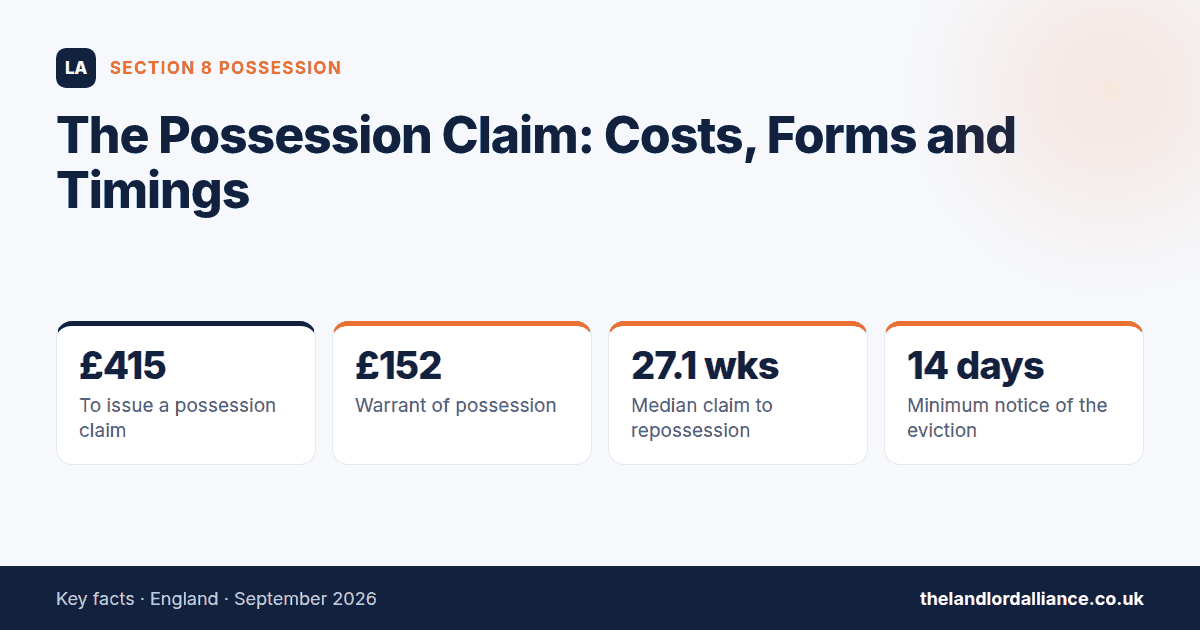
Once your section 8 notice expires you apply to the county court on forms N5 and N119. Issuing costs £415. Possession Claim Online is cheaper to use but arrears claims only — every other ground is paper. There is no accelerated paper route any more, so every section 8 claim gets a hearing. Median time from claim to actually getting the property back is 27.1 weeks, and that’s before the notice period. Budget eight months from serving to keys.
Most landlords have never taken a case past the notice stage, and the process is more procedural than difficult — but it is unforgiving about forms and dates. This is the whole route, with current fees and the real timings from Ministry of Justice data rather than optimistic estimates.
Step 1: check the notice has expired
You cannot issue before the earliest date you specified in the notice, and you must issue within twelve months of serving it. Miss that window and you start again with a fresh notice.
Before you spend the fee, check the deposit is protected and the prescribed information was served. Since 1 May 2026 an unprotected deposit bars a possession order on section 8 grounds, not just the abolished section 21 — only the two antisocial behaviour grounds are excepted. It is the most common reason a good claim fails.
Step 2: choose your route
| Possession Claim Online | Paper (N5 + N119) | |
|---|---|---|
| Use when | Claiming only for rent arrears | Any other ground |
| Grounds | 8, 10, 11 | All grounds |
| Other remedies | Arrears, interest and costs only | As pleaded |
| Fee | £415 | £415 |
| Rent schedule | Two years, or from first default | Two years, or from first default |
| Not available if | Defendant is a child or protected party | — |
The practical consequence of PCOL being arrears-only is that in the post-section-21 world it covers grounds 8, 10 and 11 and nothing else. Selling under ground 1A, moving in under ground 1, breach of tenancy under ground 12 — all paper.
The accelerated possession procedure is effectively gone. It was never repealed — Civil Procedure Rules Part 55 Section II is still on the books — but it only ever applied to section 21 claims, so it has no remaining subject matter for private tenancies. There is no paper-only, no-hearing route on any section 8 ground.
Step 3: the forms and the fee
What you file
- N5 — claim form for possession
- N119 — particulars of claim, rented residential
- N215 — certificate of service for the notice
- A copy of the section 8 notice
- Rent schedule where arrears are claimed
Copies
- One set for the court
- One for each named tenant
- Filing by email: one email, 10MB, 25 pages max
| Court fee | Amount |
|---|---|
| Issue a possession claim (county court) | £415 |
| Issue in the High Court | £559 |
| Warrant of possession | £152 |
| Application without notice (N244) | £126 |
| Application on notice (N244) | £321 |
| Sealing a writ of possession (High Court) | £82 |
The government’s own landlord guidance has stale fees on it. The page on repossessing a rented property still quotes £148 for a warrant, £123 for an application and £80 for sealing a writ — those are the pre-13-July figures. The correct current numbers are £152, £126 and £82, per the fees order and the official EX50 fee list. Budget from those.
Step 4: the hearing
What the judge can do depends entirely on whether your ground is mandatory or discretionary — and this is the practical difference that matters most.
| Mandatory (grounds 1–8) | Discretionary (grounds 9–18) | |
|---|---|---|
| Test | Is the ground proved? | Proved and is an order reasonable? |
| If proved | Court must order possession | Court may order possession |
| Order type | Outright | Outright or suspended on terms |
| Possession date | Usually 14 days | Court has wider latitude |
| Hardship extension | Up to 6 weeks in exceptional cases | Can be longer |
The court can also adjourn — if there’s insufficient time, more information is needed, or the tenant genuinely cannot attend. It can dismiss the claim for procedural failure, non-attendance, an unproved ground, or if the tenant pays the arrears in full, and costs may follow against you.
A suspended order sets a possession date with conditions attached, typically rent plus something off the arrears. Meet the conditions and the tenant stays; breach them and you can apply for a warrant without a fresh hearing.
Step 5: enforcement
A possession order is not an eviction. If the tenant doesn’t leave on the date, you need a warrant.
County court bailiff route
- Form
- N325, or N325A if a suspended order was breached
- Fee
- £152
- Available for
- Six years from the order
- Court sends you
- EX96 (appointment) and EX97A (risk assessment)
- Return those
- At least 3 working days before the appointment
- Tenant’s notice
- At least 14 days of the eviction appointment
On the day, meet the bailiff outside, bring spare keys and arrange a locksmith. You are responsible for pets and belongings left behind. County court bailiffs cannot recover arrears or damages — that needs a separate money claim.
The High Court alternative. You can apply to transfer up for enforcement by a High Court Enforcement Officer, which the government describes as faster. You need the county court’s permission on form N244 (£126 without notice, £321 on notice), then form N293A, then £82 to seal the writ. So roughly £208 in court fees against £152, plus the HCEO’s own charges on top — those aren’t fixed by any fee order, so get a quote. I’d note honestly that no official data compares the two routes’ speed; the “faster” claim comes from the government and from enforcement firms, not from published figures.
How long it actually takes
These are the latest Ministry of Justice medians, for the quarter April to June 2026:
| Stage | Median | Same quarter 2025 |
|---|---|---|
| Claim → possession order | 7.6 weeks | 7.9 |
| Claim → warrant | 14.9 weeks | 15.1 |
| Warrant → repossession | 9.4 weeks | 10.1 |
| Claim → repossession | 27.1 weeks | 27.9 |
Two honest caveats. These figures cover only two months of activity after the Act commenced, and the MoJ itself says it is not yet clear how much of the movement is attributable to the reforms — so treat them as the best available rather than a settled post-reform picture. And there is no official published series for bailiff waiting times; if you see a “typical wait” figure quoted, it is someone’s estimate. The warrant-to-repossession median of 9.4 weeks is the closest official proxy.
Realistically: ground 8 at four weeks’ notice plus 27 weeks is about seven and a half months. Ground 1A at four months plus 27 weeks is closer to eleven months — and then the re-letting ban still has to run.
Questions
Can I do this without a solicitor?
Many landlords do, particularly straightforward arrears claims through PCOL. If the tenant defends, or you’re on a discretionary ground where reasonableness is argued, advice usually pays for itself.
Can I claim the arrears in the same case?
Yes, and you should. But a possession order doesn’t collect money — enforcing a money judgment is a separate step.
What if the tenant leaves before the hearing?
Take the keys, document the handover, and tell the court. You may still want to pursue the arrears as a money claim.
Can I evict them myself once I have the order?
No. Only a court bailiff or High Court Enforcement Officer can carry out the eviction. Doing it yourself is unlawful eviction, and the penalties for that were increased by the same Act.
Can the tenant stop the warrant?
They can apply to suspend it — £16 — and the judge decides whether it’s reasonable to delay. Suspension is far more likely on a discretionary ground.
Is there still a no-hearing route?
No. The accelerated procedure applied only to section 21 claims. Every section 8 claim is listed for a hearing.
Eight months of dates to keep straight
Notice served, notice expires, claim issued, order date, warrant, eviction. The app tracks each one per property so nothing slips. £10 a month, cancel anytime.
See what’s includedEngland only. Position as at 31 August 2026. General information from a landlord, not legal advice. Court fees change — check EX50 before budgeting.
Sources: CPR Part 55 and Practice Direction 55B; SI 2026/642 and EX50; MHCLG repossession guidance; Ministry of Justice, Mortgage and landlord possession statistics April to June 2026 (published 13 August 2026).
Related: all 32 grounds · completing Form 3A · ground 8 arrears · ground 1A selling