The short version
A tenancy agreement is the contract between a landlord and a tenant that sets out what each side has agreed. It is not the tenancy. The tenancy is the legal right to occupy the property, and it exists whether or not anyone ever writes anything down — which is why a landlord with no paperwork still has a tenant, with all the rights that come with one. What the document does is record the terms and, since 1 May 2026 in England, satisfy a legal duty to give the tenant a written statement of terms.
The answer, in one paragraph
A tenancy agreement is a contract giving someone the right to live in a property they do not own, in exchange for rent, for a period of time. It names the parties and the property, states the rent and when it is paid, and sets out the obligations on both sides. In England, a private tenancy of a home is almost always an assured tenancy, and since 1 May 2026 all of them are periodic — they roll on until somebody ends them properly.
The agreement is not the tenancy
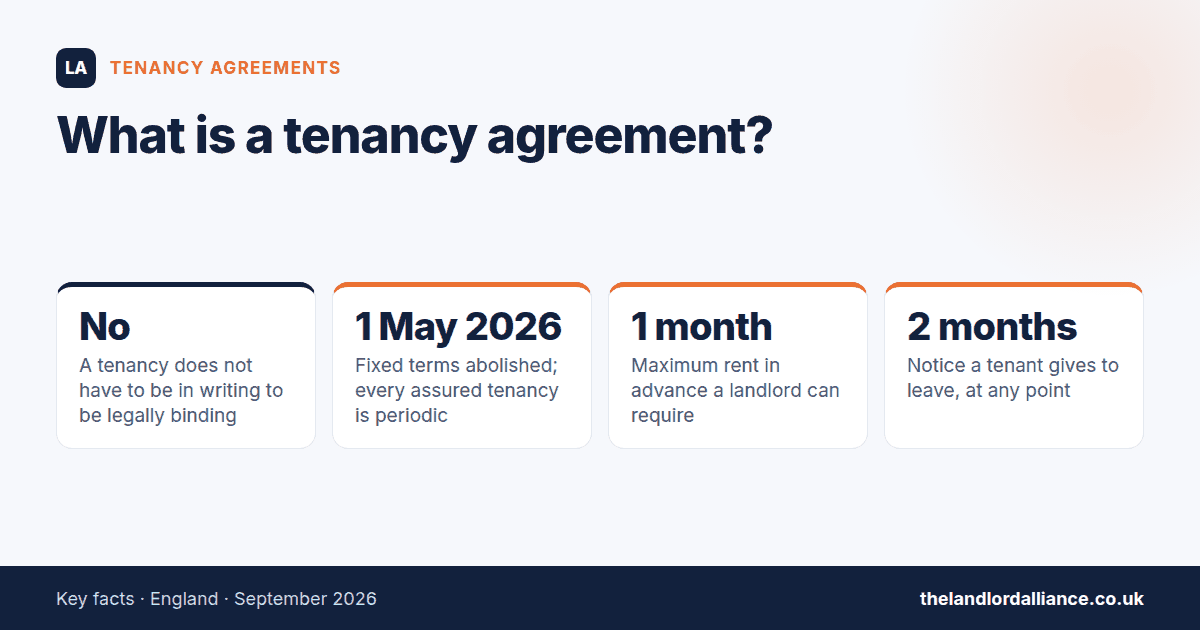
This distinction sounds academic and is not. The tenancy is a legal interest in land. It comes into existence when someone is given exclusive possession of a property for a rent, and it exists from that moment whether the arrangement was written, spoken over the phone, or never discussed at all.
Under section 54(2) of the Law of Property Act 1925, a tenancy for three years or less, at a market rent, taking effect immediately, needs no deed and no writing. A verbal agreement creates a real tenancy with real statutory protection.
What this means in practice. “There is no contract, so they are not really a tenant” is wrong, and it is the belief behind a good number of illegal evictions. If someone pays you rent and lives in your property with exclusive possession, they are a tenant. Removing them without a court order is a criminal offence under the Protection from Eviction Act 1977, paperwork or no paperwork.
The written agreement matters for a different reason: it is the evidence. Without it, both sides are arguing about what was agreed, and the courts will fall back on the statutory defaults — which are not written with the landlord in mind.
Tenancy, licence or lodger agreement?
What the document is called does not decide what it is. In Street v Mountford (1985) the House of Lords held that if the substance of the arrangement is exclusive possession for a term at a rent, it is a tenancy, however the paperwork is labelled. Calling an agreement a licence to avoid tenancy law does not work.
| Tenancy | Licence | Lodger agreement | |
|---|---|---|---|
| Exclusive possession | Yes — the occupier can exclude the owner | No — permission to be there, nothing more | No — the landlord lives there too |
| Typical use | Renting a house or self-contained flat | Genuine serviced accommodation, some employee housing | A room in the landlord’s own home |
| Court order needed to remove | Yes, always | Usually yes, for residential occupiers | No — excluded occupier, reasonable notice |
| Deposit protection | Required | Not for a true licence | Not required |
| Renters’ Rights Act applies | Yes | No | No |
What an agreement can and cannot do
A tenancy agreement sits underneath statute, not above it. You can agree terms that add to the legal position. You cannot agree terms that take away rights the law gives the tenant — those terms are simply void, and the rest of the agreement carries on without them.
| You can agree | You cannot — the clause is void |
|---|---|
| Who is responsible for the garden | A fixed term of any length, for tenancies from 1 May 2026 |
| Whether smoking is allowed | A blanket ban on pets, or on tenants with children or on benefits |
| How and when rent is paid | Rent in advance of more than one month |
| Rules on subletting and lodgers | Any clause removing the landlord’s repairing obligations under section 11 |
| Reasonable rules on decoration and alterations | A rent review or automatic annual uplift clause |
| How inspections are arranged | A right to enter without the tenant’s agreement |
Does it have to be signed?
No. A signature is useful evidence that both parties agreed to the terms, but a tenancy is created by the parties’ conduct — handing over keys, taking rent — not by ink. An unsigned agreement that both sides have acted on will usually be treated as the terms.
What has changed is that in England, for tenancies granted on or after 1 May 2026, the landlord must give the tenant a written statement of terms. That is a legal duty in its own right, separate from whether a contract exists. For most landlords the tenancy agreement and the statement are the same document, and our tenancy agreement guide sets out exactly what has to be in it.
What changed on 1 May 2026
The Renters’ Rights Act 2025 came into force for tenancy reform on 1 May 2026 and rewrote what a tenancy agreement can say.
- No fixed terms. Every assured tenancy is periodic from the first day. Existing fixed-term ASTs converted automatically on that date.
- No section 21. A landlord now needs a ground under section 8 to get possession.
- Rent increases only by section 13, once a year, on two months’ notice, challengeable at tribunal. Rent review clauses in the agreement do nothing.
- The tenant can leave at any point on two months’ notice. The landlord cannot.
- One month’s rent in advance is the maximum a landlord may require.
- Pets cannot be refused unreasonably, and refusing tenants on benefits or with children is unlawful.
The asymmetry in the third and fourth points is the real change to how letting works, and it is worth understanding before you draft anything: see periodic tenancies.
How long does a tenancy agreement last?
For tenancies in England from 1 May 2026, the honest answer is: until somebody ends it. There is no end date. The tenancy rolls month to month indefinitely. It ends when the tenant gives two months’ notice, when the landlord obtains possession on a valid ground, or when both sides agree to end it by surrender.
If your agreement still says “12 months from 1 June”, that clause has no legal effect for a tenancy granted after 1 May 2026, and an existing agreement containing it converted by operation of law. The document is not void — just that part of it.
Read next
Is a verbal tenancy agreement legal?
Yes. A tenancy of three years or less at a market rent can be created without any writing at all, and it carries the same statutory protection as a written one. The landlord still has a separate legal duty to give the tenant a written statement of terms.
What is the difference between a tenancy agreement and a lease?
In everyday use, none — a tenancy is a lease. “Lease” tends to be used for long terms, such as a 125-year flat lease, and “tenancy agreement” for renting a home. The legal nature is the same.
Can a landlord change the agreement during the tenancy?
Not unilaterally. Terms can only be changed by agreement between both parties. Rent is the exception, and it has its own statutory route: a section 13 notice, once a year, with two months’ notice.
Do I need a solicitor to write one?
No, and most landlords do not. What matters is that the document reflects the current law — a great many agreements circulating online still contain fixed terms and section 21 references and are actively misleading.
What if there are two tenants?
Joint tenants are jointly and severally liable, which means each of them is liable for all of the rent, not half of it. If one leaves, the tenancy does not automatically split.
Does the agreement need witnesses?
No. A tenancy for three years or less does not need to be executed as a deed, so witnesses are not required.
Sources. Renters’ Rights Act 2025 (c. 26) and Commencement No. 2 Regulations SI 2026/421; Law of Property Act 1925 s.54(2); Protection from Eviction Act 1977; Landlord and Tenant Act 1985 s.11; Consumer Rights Act 2015 Part 2; Street v Mountford [1985] UKHL 4; Shelter England guidance on the Renters’ Rights Act. Checked 7 September 2026.
Related: All landlord guides · Free calculators · The Renters’ Rights Act