The short version
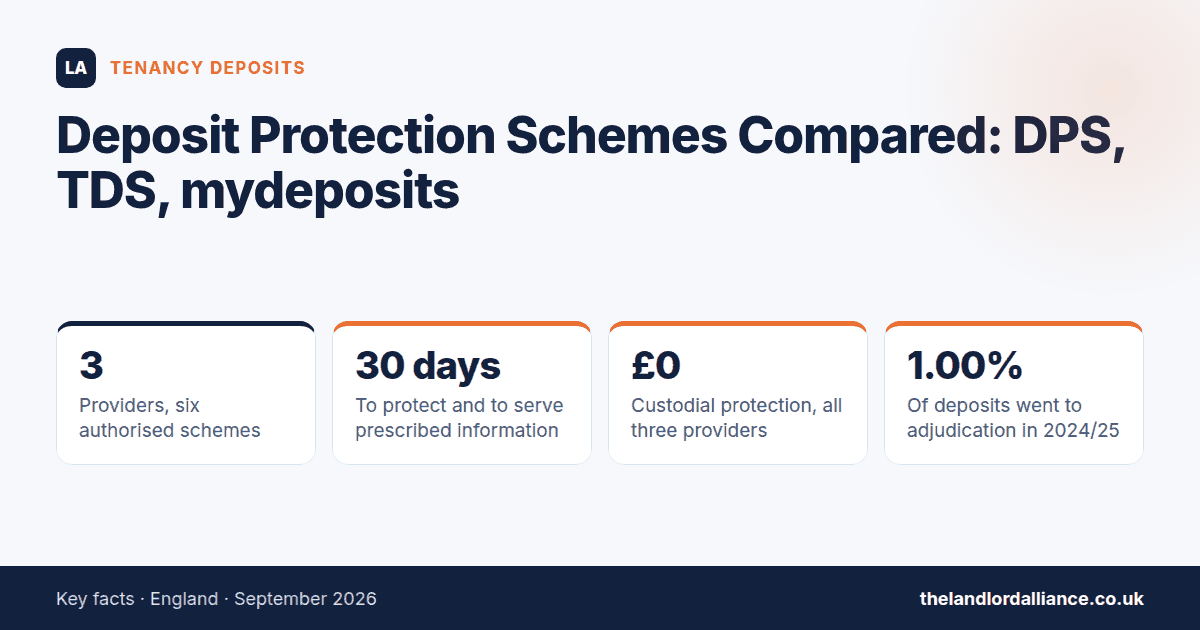
There are three providers — DPS, mydeposits and TDS — but six authorised schemes, because each provider runs a separately authorised custodial and insured scheme. Custodial is free with all three. Insured costs money and you keep the cash. The law is identical whichever you pick: protect within 30 days, serve the prescribed information within 30 days. What actually differs is who earns the interest, how fast a dispute is decided, and how much admin lands on you at the end of the tenancy.
I have used two of the three schemes across my own portfolio and moved between custodial and insured more than once. The decision is usually framed as a price comparison, which is the least interesting part of it — custodial is free everywhere, so the real question is whether you want the money or the simplicity. This page sets out what actually separates them, and what the law requires of you regardless of which one you join.
The three providers
Authorised under section 212 of the Housing Act 2004
Authorisation is by arrangements made by the Secretary of State, not by statutory instrument, so there is no SI to point at. The set has been stable for years.
| Scheme | Operating entity | Products |
|---|---|---|
| The Deposit Protection Service (DPS) | Trading name of Computershare Investor Services Plc | Custodial and insured |
| mydeposits | Tenancy Deposit Solutions Ltd, a subsidiary of HFIS Limited | Custodial and insured |
| Tenancy Deposit Scheme (TDS) | The Dispute Service Ltd | Custodial and insured |
Custodial versus insured
Custodial
You transfer the deposit to the scheme, which holds it in a designated account for the tenancy. Schedule 10 requires that account to contain nothing but deposits and the interest on them. At the end of the tenancy the scheme repays. Free with all three providers.
Insured
You keep the money and pay the scheme to insure it. The scheme guarantees the tenant receives what an adjudicator says they are owed — and then pursues you for it. You handle the repayment yourself, and only send money to the scheme if a dispute is raised.
The insurance in an insured scheme protects the tenant, not you. TDS puts it plainly in its own literature: if the deposit holder cannot pay, the scheme pays the tenant the adjudicated amount and claims on its insurers. The law requires the scheme to guarantee only that the tenant gets what they are entitled to.
What it costs
| Provider | Custodial | Insured |
|---|---|---|
| DPS | Free. No membership or renewal fee. | Landlords: £18.75 under £500, £27.75 for £500 and over. Agents £11.75 + VAT. |
| mydeposits | Free. | Restructured in July 2026 to an annual membership priced on the number of deposit allocations you hold, capped at £22.00 per deposit per year including VAT. Allocations are reusable when a tenancy ends. |
| TDS | Free. | Free to join, fee per deposit. NRLA member rates are £13.20 up to £499.99 and £17.95 at £500 and over. |
The most out-of-date fact in competing comparison pages. mydeposits abandoned its flat per-deposit insured fee in July 2026. Almost every comparison article still describes it as a one-off charge of roughly £26 to £30 per deposit. That pricing model no longer exists.
Interest: the difference nobody compares on
This is where the schemes genuinely diverge, and it is worth more than the fee difference on a long tenancy. Under Schedule 10 the scheme administrator may retain interest, so any payment of interest to a tenant comes from each scheme's own arrangements rather than from the statute.
| Scheme | Who gets the interest |
|---|---|
| DPS custodial | Payable to the tenant once the deposit has been held 183 days or more. DPS is explicit that even where you are entitled to keep part of the deposit, all accrued interest goes to the tenant. |
| mydeposits custodial | Accrues to the tenant from day one, calculated daily, reviewed monthly. The rate was 0.77% when we checked on 31 August 2026 — treat that as a moving number. |
| All insured schemes | You hold the money, so you hold the interest. Your tenancy agreement should say who receives it. |
How fast each scheme resolves a dispute
Adjudication is free with all three, evidence-based with no hearing and no site visit, and the decision is binding with no right of appeal. It is also voluntary — Schedule 10 paragraph 10 forbids a scheme from making it compulsory, so either party can refuse and go to court instead. What differs is speed.
| Scheme | Evidence window | Decision |
|---|---|---|
| DPS | 14 calendar days from notification, both parties | Published indicative timeline runs to roughly six to seven weeks end to end, then three to five business days to pay |
| TDS | 5 working days for the landlord or agent, then 5 working days for the tenant | Normally within 15 business days of consent and evidence, payment within a further 2 working days |
| mydeposits (insured) | 20 working days for landlord rebuttal, 3 working days for tenant comment | Within 28 calendar days of the adjudicator receiving it, distributed within 5 working days |
Silence counts as consent. Under Schedule 10 a party who disputes the amount but fails to respond to the question of whether they consent to adjudication is treated as having consented. TDS applies the same rule to a landlord who does not reply within five working days. Ignoring the scheme does not stall the process; it hands the decision to an adjudicator without your evidence in front of them.
What the law requires whichever scheme you choose
The scheme you pick changes nothing about your statutory duties. Both of these run from the date you receive the deposit, and both are 30 days.
At a glance
- Protect
- Comply with the scheme's initial requirements within 30 days of receipt — s.213(3)
- Inform
- Serve the prescribed information, in the prescribed form, within 30 days — s.213(5) and (6)
- Form
- Prescribed by the Housing (Tenancy Deposits) (Prescribed Information) Order 2007, SI 2007/797
- Contracting out
- Not possible. s.213(9) applies the section despite any agreement to the contrary
The prescribed information is a longer list than most landlords realise, and one item catches people out: the scheme administrator's own leaflet explaining sections 212 to 215 is itself a prescribed item under article 2(1)(b). Serving it is not a courtesy. Our guide to what happens when a deposit is not protected properly sets out what a defective service actually costs.
One thing your scheme may be telling you incorrectly
Section 215 of the Housing Act 2004 was substituted in its entirety on 1 May 2026 by section 26(5) of the Renters' Rights Act 2025. The old version said no section 21 notice could be given while a deposit was non-compliant. The new version says something different: the court may make an order for possession only if the deposit is protected and the prescribed information has been served.
The bar now attaches to the possession order, not to the notice. You are not prevented from serving a section 8 notice with a non-compliant deposit. You are prevented from winning the claim. TDS's own insured scheme leaflet, seventh edition revised March 2026, still says a landlord who has not correctly protected a deposit "cannot serve a notice" — that is the old section 21 rule and it is no longer the law.
Two consequences follow, and both favour landlords. Late protection now cures the possession bar, because s.215(2) counts compliance "whether or not within the period mentioned by section 213(3)". And possession on Ground 7A or Ground 14 is not blocked at all, whether or not any other ground is also relied on. None of that touches the financial penalty, which is a separate matter entirely.
How to actually choose
Custodial suits you if
- You would rather not hold someone else's money
- You want the scheme to handle repayment at the end
- You have a handful of properties and no agent
- You want the cheapest option, because it is free
Insured suits you if
- You want the deposit sitting in your account earning interest
- You are comfortable being the one who repays, on time, with the paperwork
- You hold enough deposits that the annual fee is small per unit
- You accept that a dispute means transferring the money to the scheme anyway
Before you take a deposit at all, check the amount is lawful — the cap is five or six weeks' rent depending on the annual rent, and the excess is a prohibited payment. Our deposit cap calculator does the arithmetic. If you are taking money before the tenancy is granted, the rules are different again: see holding deposits.
Can I move a deposit from one scheme to another mid-tenancy?
Yes, but it is a protection event and you must not leave a gap. Protect with the new scheme and serve fresh prescribed information. The safe sequence is to have the new protection in place before ending the old one.
Do I need a new protection when one joint tenant is replaced?
Usually yes. mydeposits flags specifically that a new protection is required where a tenant swap happens after a fixed term has ended — which, since 1 May 2026, is every tenancy, because they are all periodic.
Can one joint tenant block the release of a deposit?
Yes. TDS confirms that any one of joint tenants can object to protection being ended while the tenancy continues. Plan for that when a house share turns over.
Is the adjudicator's decision really final?
Binding, with no merits appeal to the scheme or to government. TDS offers only an internal review for an error of fact or law. Court remains available to either party as an alternative to adjudication, but not as an appeal from it.
How likely is a dispute?
Across all three schemes, 46,950 adjudications were run in the year to March 2025 against 4,706,470 deposits protected — exactly 1.00%, the highest rate since 2010. The overwhelming majority of deposits are returned without an adjudicator ever being involved.
Deposit compliance is the one mistake that blocks possession
The Landlord Alliance keeps your protection dates, prescribed information and notice deadlines in one place, so the thing that stops you getting possession is never the paperwork. £10 a month, cancel anytime.
See what is includedEngland only. Position as at 31 August 2026. General information from a landlord, not legal advice.
Sources: Housing Act 2004 ss.212–215 and Schedule 10; Renters' Rights Act 2025 s.26; SI 2026/421; SI 2007/797; published fee, interest and adjudication information from DPS, mydeposits and TDS; TDS Statistical Briefing 2024/25.
Related: Tenancy deposits: the complete guide · Unprotected deposit penalties · Deductions and disputes · Holding deposits