The short version
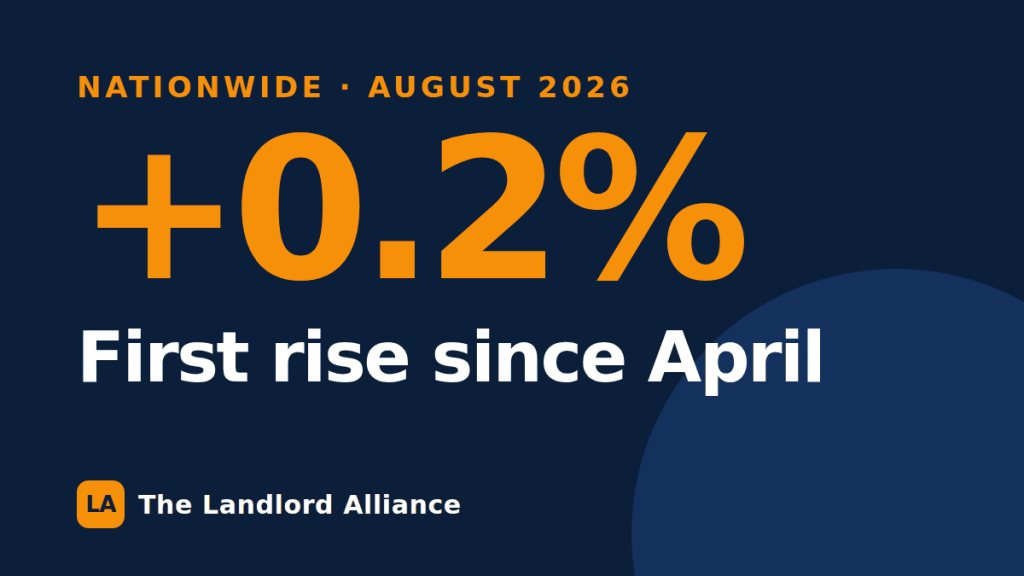
Nationwide says house prices rose 0.2% in August, the first monthly rise since April. That is not a recovery, it is noise inside a flat market — prices are still £3,415 below April's peak and mortgage approvals just hit a two-year low. The part that actually matters to a landlord is not in the headline: if you decide to sell today, you are not selling into today's market. Under Ground 1A your completion date lands deep into 2027.
I have talked this one through on video as well — the numbers, what is driving them, and the bit most coverage skips.
What the figures actually say
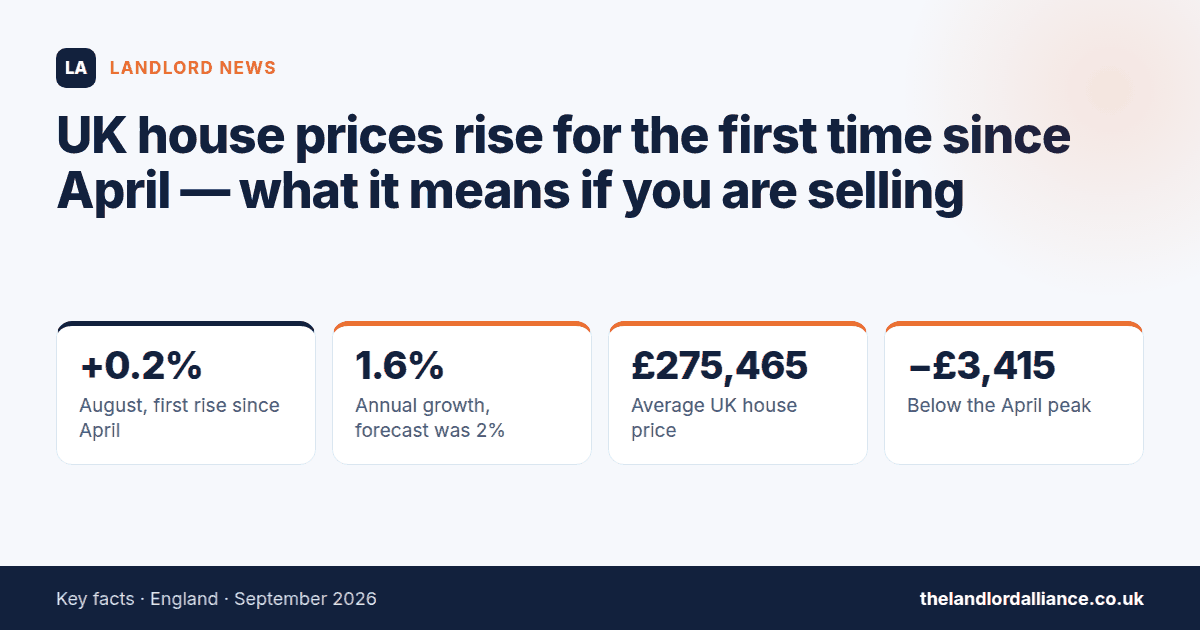
| Measure | August 2026 | Context |
|---|---|---|
| Monthly change | +0.2% | First rise since April. July was revised down from +0.1% to −0.1% |
| Annual change | 1.6% | Up from 1.4% in July, but below the 2% forecast |
| Average price | £275,465 | July average was £276,581 |
| Versus the peak | −£3,415 | April 2026 peak was £278,880 |
Robert Gardner, Nationwide's chief economist, put it plainly: "Market activity and house prices have remained subdued in recent months, in part reflecting the uncertain economic backdrop." He also made the point that gets lost in monthly headlines — underlying affordability is quietly improving, because house price growth is running well below earnings growth. Higher mortgage rates have eaten most of that gain, but not all of it.
The market underneath the headline
Two numbers tell you more about where this is going than the 0.2% does.
Fewer buyers financed, more homes competing. Nicky Stevenson at Fine & Country reckons stock is running around 5% higher than a year ago, which hands buyers the negotiating power and means properties sit longer. That combination — approvals at a two-year low, supply up — is not the shape of a market about to run away from you.
On rates, check your assumption. Base rate is 3.75% and the next decision lands on 17 September. A hold is the expected outcome, but markets are pricing a 0.25% increase by December — not a cut. Ian Futcher at Quilter: "While a hold remains the most likely outcome, it is becoming increasingly difficult to call with confidence." Mark Harris at SPF reports borrowers locking in rates several months before they need them. If your plan assumes the next move is downward, that plan is not priced on what the market currently expects.
The bit that never makes the coverage
Every article about this print is written for owner-occupiers, where deciding to sell and putting the board up are the same afternoon. That is not your position. Since 1 May 2026 the only route to vacant possession is a section 8 ground, and selling means Ground 1A, which carries four months' notice.
So the decision you are making today is not "do I like this month's number". It is a forecast about a market more than a year out.
Two details sharpen that further. The four months runs from the date of service, and your tenancy agreement will usually deem postal service to take effect some days after posting — so the clock starts later than you think. And Ground 1A carries a twelve-month condition: the possession date you specify cannot fall inside the first year of the tenancy. You can work both out on our section 8 notice period calculator.
And if the sale falls through
Take possession on Ground 1A and you cannot re-let or re-advertise the property for twelve months. That ban does not care whether your buyer completed. On a property letting at £1,500 a month, a collapsed sale costs roughly £20,800 in lost rent, council tax on an empty house, insurance and standing charges — on top of whatever the price moved in the meantime.
Which is why a 0.2% monthly print is close to irrelevant to the decision, and the shape of the market in late 2027 is close to everything.
What I would actually do
Worth doing
- Treat the sell-or-hold decision as a 2027 decision being made in 2026
- Check your deposit compliance before serving anything — since 1 May the court can only make a possession order if the deposit is protected and the prescribed information served
- Price realistically if you do go: stock is up 5% and buyers are scarce
- If you are staying, note that affordability is improving in the background — earnings are outpacing prices
Worth avoiding
- Reacting to a single monthly index print, in either direction
- Assuming the next rate move is downward — markets are pricing a rise by December
- Serving notice before you have a realistic sale plan, given the re-letting ban
- Forgetting that the notice period runs from service, not from the day you post it
The dates are what catch people out, not the market
The Landlord Alliance tracks your notice periods, deposit compliance and re-letting bans against each tenancy, so the thing that derails a sale is never the paperwork. £10 a month, cancel anytime.
See what is includedIf the reason you are selling is that the rent stopped, read the rent arrears process first — Ground 8 changed on 1 May 2026 and may be the faster route than Ground 1A, with no re-letting ban attached.
Price data is UK-wide; the possession law described here is England only. Position as at 1 September 2026. General information from a landlord, not legal or financial advice — take professional advice before serving notice or selling.
Sources: Nationwide House Price Index, August 2026; Bank of England mortgage approvals data; commentary from Robert Gardner (Nationwide), Ian Futcher (Quilter), Nicky Stevenson (Fine & Country) and Mark Harris (SPF Private Clients); Ministry of Justice possession statistics.
Related: Ground 1A: selling your property · Section 8 grounds for possession · Why the deposit blocks possession · Notice period calculator