The short version
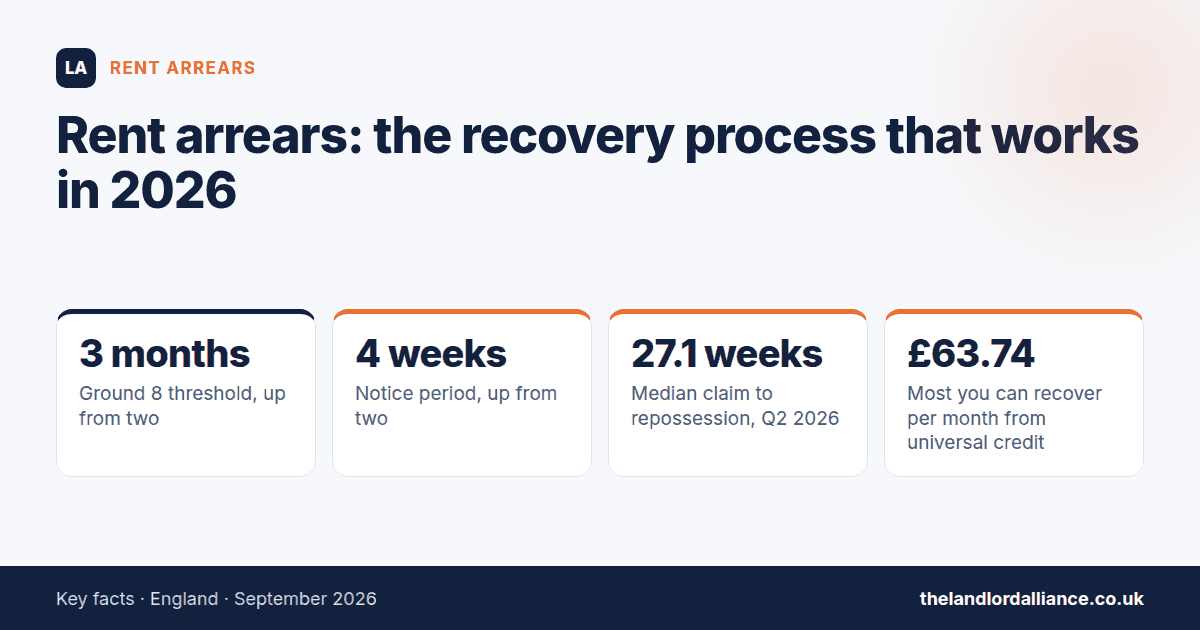
Since 1 May 2026 the mandatory arrears ground needs three months' rent unpaid, not two, and it has to be unpaid twice over — on the day you serve and again on the day of the hearing. The notice period doubled to four weeks. Universal credit that has been awarded but not yet paid is stripped out of the calculation entirely. And if your deposit paperwork is defective the court cannot make a possession order at all, whichever ground you use. Most arrears advice you will read online is describing the old rules.
Arrears are the problem every landlord thinks they understand until they are in one. I have been through it, and the thing that surprised me was how much of the standard advice is now simply wrong — not subtly out of date, but describing thresholds and notice periods that were replaced on 1 May 2026. This page sets out the process that actually works now, in the order you should do it, with the section numbers so you can check every step against the Act itself.
Do these four things first, in this order
| Step | Why it comes first |
|---|---|
| 1. Check your deposit compliance | Since 1 May 2026 the court may make a possession order only if the deposit is protected and the prescribed information was served. This bites on every ground except 7A and 14. Everything else is wasted effort until this is right |
| 2. Get the rent flowing again | If the tenant is on universal credit you can apply to have the housing element paid straight to you. That stops the hole getting deeper while you decide what to do |
| 3. Write, properly | A clear, dated arrears letter is how you discharge your pre-action obligations — and how you avoid crossing into an offence |
| 4. Only then think about possession | Serving too early on the wrong ground costs you four weeks and the fee |
Start with the deposit, every time. Section 215 of the Housing Act 2004 was rewritten on 1 May 2026. It no longer stops you serving a notice — it stops the court making the order. So nothing goes wrong until the hearing, which is the worst possible moment to find out. The good news is that late protection now cures it: s.215(2) counts compliance "whether or not within the period mentioned by section 213(3)". The full position is here.
Ground 8: what actually changed
Ground 8 is the mandatory arrears ground. If it is made out the court has no discretion — section 7(3) says it shall make the order. That is why landlords reach for it. Schedule 1 paragraph 24 of the Renters' Rights Act 2025 rewrote it.
| Before 1 May 2026 | Now | |
|---|---|---|
| Weekly or fortnightly rent | 8 weeks unpaid | 13 weeks unpaid |
| Monthly rent | 2 months unpaid | 3 months unpaid |
| Quarterly rent | One quarter | Repealed — no mandatory ground |
| Yearly rent | Three months | Repealed — no mandatory ground |
| Notice period | 2 weeks | 4 weeks |
| Universal credit | Counted in full | Disregarded where unpaid only because the award had not arrived |
Ground 8 at a glance
- Type
- Mandatory — s.7(3), the court shall order possession
- Threshold
- 13 weeks (weekly/fortnightly) or 3 months (monthly) of rent lawfully due
- Tested
- At the date of service and at the date of the hearing
- Notice
- 4 weeks — s.8(4AA)
- Form
- Form 3A (private sector). Form 3 is the social housing version
- Deadline
- Proceedings must begin within 12 months of service — s.8(3)(c)
- Dispensation
- Not available. s.8(5) forbids the court dispensing with notice for Ground 8
The twice-over test is what kills most Ground 8 claims. The threshold has to be met on the day you serve and on the day of the hearing. A tenant who pays a month down on the courthouse steps destroys the mandatory ground. That is not a loophole — it is the design. It is also why you should never plead Ground 8 on its own.
Always plead 8, 10 and 11 together
Grounds 10 and 11 are discretionary: under s.7(4) the court orders possession only if it considers it reasonable, and it can suspend or postpone. They are weaker. But since 1 May 2026 all three carry the same four-week notice period, so pleading all three costs you nothing in time.
| Ground | What it needs | What it catches |
|---|---|---|
| 8 mandatory | 13 weeks / 3 months, at service and at hearing | The serious, sustained arrears case |
| 10 discretionary | Some rent unpaid when proceedings begin, and in arrears at service. No threshold | The tenant who pays down below three months before the hearing |
| 11 discretionary | Persistent delay in paying. No arrears needed at all when proceedings begin | The chronic late payer who always clears the balance eventually |
The universal credit disregard, stated correctly
The new final paragraph of Ground 8 reads: "When calculating how much rent is unpaid for the purpose of this ground, if the tenant is entitled to receive an amount for housing as part of an award of universal credit… any amount that was unpaid only because the tenant had not yet received the payment of that award is to be ignored."
What it does
- Strips out arrears caused purely by the wait for a universal credit payment
- Applies before you test against the 13-week or 3-month threshold
What it does not do
- It is not a general benefits exemption — the word is only
- A shortfall between the housing element and the rent still counts in full
- It does not apply to housing benefit, or any benefit other than universal credit
- It applies to Ground 8 alone. Grounds 10 and 11 are untouched
- It does not cancel the debt — the money is still owed and still recoverable
gov.uk gets this wrong. Its guidance for landlords says flatly that "benefits are not counted when a tenant owes rent". That is not what the Act says. Only universal credit amounts unpaid only because the award had not yet been received are disregarded, and only for Ground 8. Work from the statute.
How long possession actually takes
Ministry of Justice figures for April to June 2026 — medians, all landlord types, England and Wales:
| Stage | Median weeks | Same quarter 2025 |
|---|---|---|
| Claim to order | 7.6 | 7.9 |
| Claim to warrant | 14.9 | 15.1 |
| Warrant to repossession | 9.4 | 10.1 |
| Claim to repossession | 27.1 | 27.9 |
There is no fast route for arrears, and there never was. The accelerated possession procedure in CPR Part 55 Section II only ever applied to a section 21 claim on an assured shorthold tenancy, and CPR 55.12(b) required possession to be the only claim. Both preconditions died on 1 May 2026. Arrears possession has always needed a Part 55 Section I claim with a hearing.
Do you have to follow a pre-action protocol?
Not the one people think. The Pre-Action Protocol for Possession Claims by Social Landlords says at paragraph 1.1 that it applies to claims "brought by social landlords (such as local authorities and housing associations)". It does not bind you.
What does apply is the general Practice Direction on Pre-Action Conduct and Protocols — reasonable exchange of information, and genuine consideration of settlement. A proper arrears letter is how you discharge it. And if you go on to sue for the money separately, the Pre-Action Protocol for Debt Claims very probably applies, which is a much more demanding regime with prescribed enclosures and a 30-day wait.
The four routes, and when each one is right
The mistake that costs the most
Do not apply the deposit to the arrears before the hearing. Ground 8 tests the threshold at service and again at the hearing. A five-week deposit set against a three-month threshold can pull you under the line and destroy your own mandatory ground. Apply it after the order, or at the end of the tenancy, and credit it against the money judgment. The one exception is where you need s.215(5)(a) — returning the deposit in full, or with agreed deductions, to cure a protection defect. Those two levers pull against each other, and you have to choose deliberately.
My tenant owes two months. Can I serve notice?
Not on Ground 8 — the threshold is three months for monthly rent. You can serve on Grounds 10 and 11, which have no threshold, but both are discretionary and the court decides whether possession is reasonable.
The rent is quarterly. What do I use?
Grounds 10 or 11. The quarterly and yearly limbs of Ground 8 were repealed on 1 May 2026, so there is no mandatory arrears ground for quarterly or annual rent at all.
Can I claim the arrears and possession in one claim?
Yes. CPR 55.2(1) covers a claim that "includes" possession, and PD 55A para 2.3 then requires an arrears schedule covering two years. Note CPR 55.9(2): a possession claim only goes to the small claims track if all parties agree, so the costs regime is different from a standalone money claim.
How long do I have to use the notice?
Proceedings must begin no later than twelve months from service — s.8(3)(c). After that the notice is spent and you start again.
Can the court waive the notice?
Not for Ground 8. Section 8(5) expressly forbids it. The court can dispense with notice for Grounds 10 and 11 if it is just and equitable.
Arrears are a dates problem before they are a money problem
The Landlord Alliance tracks rent due against rent paid, flags the day you cross the Ground 8 threshold, and holds your deposit compliance alongside it. £10 a month, cancel anytime.
See what is includedEngland only. Position as at 1 September 2026. General information from a landlord, not legal advice. Take advice before serving notice or issuing a claim.
Sources: Housing Act 1988 ss.7, 8 and Sch 2 Grounds 8, 10, 11; Renters' Rights Act 2025 Sch 1 para 24; SI 2026/421; Housing Act 2004 s.215 as substituted; CPR Part 55 and PD 55A; Pre-Action Protocol for Possession Claims by Social Landlords; Ministry of Justice, Mortgage and landlord possession statistics April to June 2026.
Related: Section 8 grounds for possession · Tenancy deposits · Renters' Rights Act 2026 · All guides