The short version
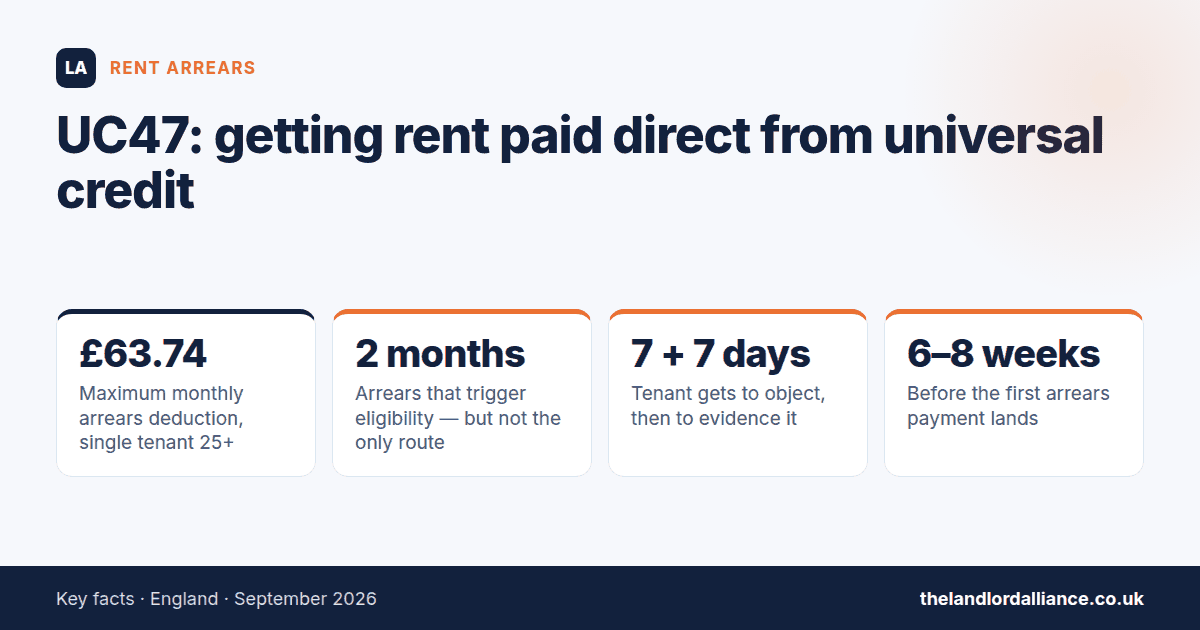
The UC47 form no longer exists. DWP withdrew it for English landlords in March 2018 and replaced it with an online service. What you are applying for is a managed payment to landlord — the housing element of universal credit paid straight to you — and separately a deduction from the tenant's standard allowance towards arrears, capped at 15% and worth at most £63.74 a month. It is discretionary, there is no right of appeal, and applying pauses your tenant's universal credit while DWP decides. It is a rent-collection tool, not a possession tool — and it can actively weaken a Ground 8 case.
"UC47" is still what landlords search for, so it is what this page is called. But if you go looking for the form you will not find one, and a good deal of the advice written around it describes a process that ended eight years ago. Here is what the system actually does now, and the one thing about it that almost nobody writes down.
The form is gone. Here is what replaced it
DWP removed the UC47 PDFs on 21 March 2018, noting that "the correct form will be provided by using the online service". The gov.uk landing page still carries the old UC47 title and says in terms that the online service "replaces the existing UC47 process". The only paper UC47 still attached to that page is the Welsh-language version.
Where to apply
- Service
- Apply for direct rent payments — directpayment.universal-credit.service.gov.uk
- Who
- Private landlords, letting agents and agencies. This is the only route open to a private landlord
- What you can ask for
- Ongoing rent, arrears, or both
- You will need
- Your bank details, and an email address you can receive a verification code at
If a site is offering you a "UC47 PDF download", it is serving a form that was withdrawn in March 2018. Social landlords have a second route through the Landlord Portal. Private landlords have exactly one.
Two different things, two different pots of money
This is the distinction that causes most of the confusion. They are separate applications on the same form, and they come out of different parts of the tenant's award.
| Managed payment to landlord | Third party deduction | |
|---|---|---|
| What it pays | The housing element, redirected to you | A slice of the standard allowance, towards arrears |
| Legal basis | The Secretary of State's power to pay a third party on the claimant's behalf, reg 58 of SI 2013/380 | Schedule 6 para 7 of SI 2013/380 |
| Amount | Up to the tenant's eligible housing costs — varies month to month | Between 10% and 15% of the standard allowance |
| Purpose | Stops new arrears forming | Chips away at the arrears already there |
How small the arrears deduction really is
Two changes on 30 April 2025 cut it, and most landlord sites still quote the old figures. The overall deductions cap fell from 25% to 15% under the Fair Repayment Rate, and the rent arrears maximum fell from 20% to 15%.
| 2026/27 monthly | Standard allowance | Arrears deduction at 15% |
|---|---|---|
| Single, 25 or over | £424.90 | £63.74 |
| Single, under 25 | £338.58 | £50.79 |
| Joint, both 25 or over | £666.97 | £100.05 |
| Joint, both under 25 | £528.34 | £79.25 |
Do the arithmetic before you pin your hopes on it. £63.74 a month is about £765 a year against a single tenant aged 25 or over — and less if any other deduction is in the queue ahead of you. Since 30 April 2026 child support maintenance sits above housing in the priority order, and the top-up above the 10% minimum ranks near the bottom. Three months' arrears on a £900 rent takes over three years to clear this way.
When DWP will agree to a managed payment
DWP's alternative payment arrangements guidance lists the grounds. A managed payment can be made where the tenant:
Arrears routes
Is in arrears of an amount equal to or more than two months' rent; or has continually underpaid over more than two months and built up arrears of at least one month's rent.
Vulnerability routes
Any Tier 1 or Tier 2 factor applies — including addiction, learning difficulties, severe or multiple debt, homelessness, domestic abuse, a mental health condition, being 16–17 or a care leaver, a history of rent arrears in the last 12 months, or limited English.
Continuity route
The tenant previously received housing benefit and it was paid direct to the landlord.
It is discretionary
DWP's guidance is explicit: the decision is discretionary and "there is no right of appeal against the decision", although it can be reviewed. Two months' arrears is a route in, not an entitlement.
You do not need arrears at all. DWP states plainly that "a claimant does not need to be in rent arrears to be considered for an APA". Answer "no" to the arrears question on the online service and it routes you straight to a list of vulnerability factors instead. Most landlord guidance misses this entirely.
What the application actually asks for
In order, as the service presents it:
| Step | What it wants |
|---|---|
| 1 | What you are applying for — direct rent, arrears, or both |
| 2 | Whether the tenant has missed two months or more of rent |
| 3 | If no: the reason, from a checklist of vulnerability factors, plus free text |
| 4 | If yes: how much is owed, the date of the first missed payment and the date of the most recent |
| 5 | Rent amount, including service charges, and the frequency |
| 6 | Tenant's full name, date of birth and address |
| 7 | Your name, phone, email and address |
| 8 | Email verification code, then your bank details |
You do not need the tenant's National Insurance number. The service matches on name, date of birth and address. Nearly every landlord site says you need the NINO. You do not — and you are not asked for the tenancy start date or a copy of the agreement either.
What happens next, and the risk in it
| Stage | What happens |
|---|---|
| Tenant is told | They get 7 days to object, then a further 7 days to provide evidence. gov.uk summarises this as "usually 14 days", but it is two separate windows |
| Grounds to object | Only two count: that they are not in arrears or the arrears are below the threshold, or that there is a live disrepair dispute with you |
| Evidence accepted | Rent books, rent statements, invoices. DWP will not accept bank statements as proof of rent payments. For disrepair it wants formal correspondence, not screenshots of texts |
| If they say nothing | The managed payment "may still be applied". If they do object, DWP "may still start deductions" |
| You are told | DWP notifies you of the decision. If refused it will not tell you why — and will not confirm whether your tenant is even claiming universal credit |
| First arrears payment | Normally 6 to 8 weeks from the date deductions start |
Applying is not risk-free. DWP pauses the tenant's universal credit while it decides. Its own advice is to apply shortly after the tenant has been paid, and for arrears deductions within seven days of their payment, to limit the disruption. A tenant who would otherwise have paid you that month may not be able to.
When the money arrives, and why it will not match your rent day
For private landlords the payment is made by BACS seven days after the end of the tenant's universal credit assessment period, monthly. The reference on your statement is the tenancy reference you gave, or the tenant's postcode and full name.
Because the payment follows the assessment period and not the tenancy, it will almost never land on the rent due date, and it will not drift back into line. If rent is due on the 1st you may be paid on the 19th, every month, indefinitely. Budget for the mismatch rather than treating the first one as a failure. Note too that the managed payment covers the housing element only — capped at the local housing allowance, reduced by earnings and non-dependant deductions. Any shortfall is still the tenant's to pay.
The part nobody writes down: this can cost you Ground 8
Since 1 May 2026, Ground 8 requires three months' rent unpaid (or thirteen weeks) both when you serve notice and again at the hearing. It also now carries this: any amount unpaid only because the tenant had not yet received their universal credit award is ignored.
How a managed payment works against you
- The money it pays reduces the arrears — and the threshold is tested again at the hearing. A managed payment starting mid-proceedings can pull you under three months and defeat an otherwise mandatory claim
- The pause while DWP decides can cause a missed month that is arguably arrears "unpaid only because" the award had not arrived — arrears the court must disregard. Your own application can manufacture them
How it works for you
- Once it is running, universal credit housing money is demonstrably reaching you on a fixed cycle. Arrears accruing after that date are the tenant's shortfall, not benefit delay — which makes the disregard much harder to invoke for the later period
- The remittance schedules are clean, date-stamped evidence of exactly what was paid and when
- Applied from the start of a claim, it prevents the initial-wait arrears forming at all
So decide what you are actually trying to do. If the goal is getting paid, apply — it is the single most effective thing available. If the goal is possession under Ground 8, understand that a managed payment cuts against you, and take advice on sequencing. This is new law with no reported decisions on the disregard yet, so treat any confident answer, including this one, with appropriate caution.
Local housing allowance is frozen again
The managed payment can only ever pay the housing element, and the housing element is capped by the local housing allowance for the area. For 2026/27 those rates are frozen for the third year running — SI 2026/5 fixes them at the determinations made on 31 January 2024. The last genuine uprating, to the 30th percentile of local rents, was April 2024.
Worth knowing which table you are reading. The Valuation Office file gives weekly housing benefit rates. DWP publishes a separate set of monthly universal credit rates, and those are the ones that govern your tenant's housing element. They are not interchangeable.
Tenants still on housing benefit
A small tail remains — mostly pension-age tenants, and people in supported, sheltered or temporary accommodation. The rules there are better for landlords.
| Housing benefit | Universal credit | |
|---|---|---|
| Threshold | 8 weeks' arrears | 2 months' arrears, or a vulnerability factor |
| At the threshold | Mandatory — the council shall pay direct, unless it is against the claimant's overriding interest | Discretionary — no entitlement, no appeal |
| Who decides | The local authority | DWP |
| Frequency | Usually four-weekly in arrears | Monthly, 7 days after the assessment period ends |
| Landlord vetting | "Fit and proper person" test applies | No equivalent |
Six things you have probably read that are wrong
| The claim | The position |
|---|---|
| "Download the UC47 form" | Withdrawn for English landlords in March 2018. Online service only |
| "You need the tenant's consent" | No. They get 7 days to object on two narrow grounds, and DWP may proceed anyway |
| "You need their National Insurance number" | No. Name, date of birth and address |
| "The deduction is 20% of the standard allowance" | Cut to a maximum of 15% on 30 April 2025 |
| "DWP will confirm whether your tenant claims" | No. A refusal will not say why, or whether they are claiming at all |
| "It covers the rent" | The housing element only, capped at a local housing allowance frozen since April 2024 |
Can I apply if I do not know whether my tenant claims universal credit?
You can apply. DWP will not tell you either way — a refusal notification will not confirm whether they are claiming. That is deliberate, on confidentiality grounds.
Can I ask my tenant for their universal credit login?
No. DWP prohibits it, and you must not make disclosing those details a condition of the tenancy.
The tenant is moving. Does the payment follow them?
No. Deductions and managed payments apply to the current address only. A managed payment ends from the end of the assessment period before the move, and you cannot recover arrears from a previous tenancy this way.
Does a managed payment count towards the 15% deductions cap?
It should not — it is payment of the housing element, not a deduction from the standard allowance. DWP's deductions guidance does not mention managed payments at all, so treat this as the sensible reading rather than a stated rule.
What if the tenant's earnings go up?
The housing element falls or stops, and so does the managed payment. The shortfall becomes the tenant's to pay. Where a managed payment is running you also have a duty to report changes you could reasonably know about, and you may be asked to repay overpaid benefit.
Know the day you cross the threshold
The Landlord Alliance tracks rent due against rent paid on every tenancy, flags the day arrears cross the Ground 8 line, and keeps your notice dates and deposit compliance in the same place. £10 a month, cancel anytime.
See what is includedEngland only. Position as at 1 September 2026. General information from a landlord, not legal or benefits advice. Benefit rates and DWP process change frequently — check gov.uk before acting.
Sources: Universal Credit (Claims and Payments) Regulations 2013 (SI 2013/380) reg 58 and Sch 6 paras 4, 5 and 7; SI 2026/322; DWP Alternative Payment Arrangements guidance; DWP Universal Credit and rented housing: guide for landlords; DWP Benefit and pension rates 2026/2027; Housing Benefit Regulations 2006 regs 95 and 96; SI 2026/5; Housing Act 1988 Sch 2 Ground 8 as amended.
Related: Rent arrears: the recovery process · Arrears letter pack · Money claims for arrears · Ground 8 threshold checker