The short version
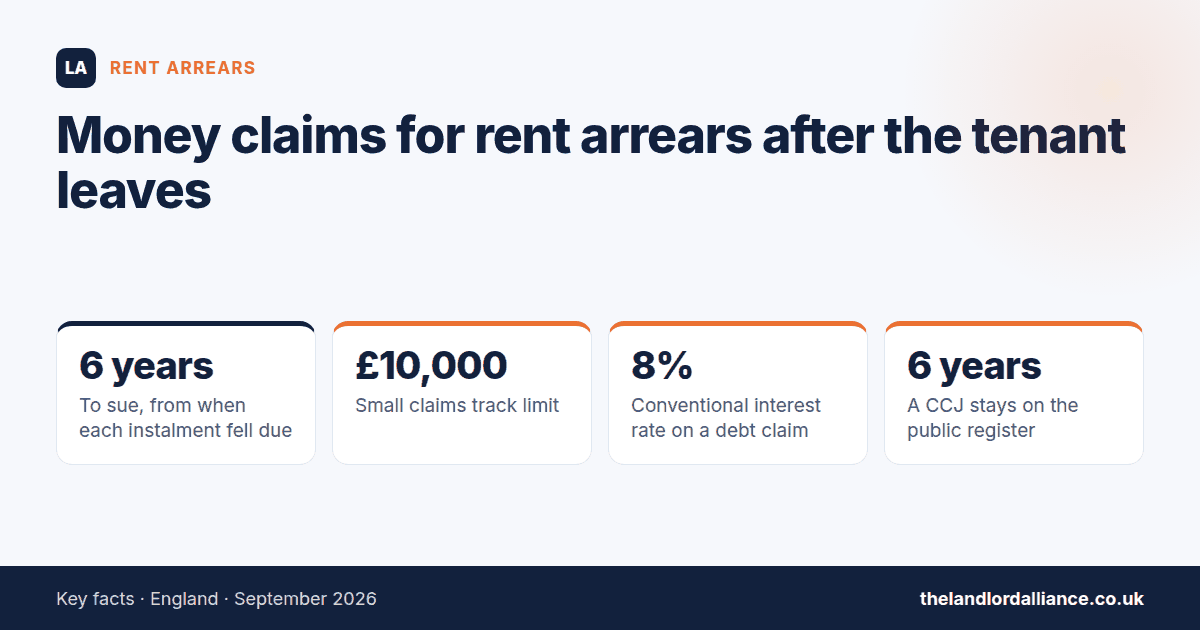
Arrears are a civil debt and you can sue for them for six years from the date each instalment fell due. Under £10,000 it is a small claim, and the issue fee on a £5,000 claim is £455. You can claim interest, but not under the Late Payment of Commercial Debts Act — that does not apply to residential rent. Getting judgment is the easy part; collecting it is not, and every enforcement route costs another fee. Before you start, work out whether the tenant has anything worth taking.
Most landlords think about a money claim only after the tenant has gone and the deposit has run out. That is usually the right moment, but it is also the moment when your leverage is at its lowest — so it is worth being clear-eyed about what a judgment actually gets you.
Before you issue: the Debt Protocol
The Pre-Action Protocol for Debt Claims applies to "any business (including sole traders and public bodies) claiming payment of a debt from an individual". There is no carve-out for residential rent. For a landlord suing a former tenant, work on the basis that it applies.
What compliance requires
- Letter of Claim
- Setting out the amount, whether interest or charges are continuing, and details of the agreement — with an offer to supply a copy
- Enclosures
- The prescribed Information Sheet, Reply Form and Financial Statement at Annexes 1 and 2. Not optional
- Then wait
- 30 days before issuing
- And wait again
- A further 30 days after receiving a completed Reply Form, or after supplying documents the tenant asked for. Reasonable extra time if they are getting debt advice
There is a ready-made Letter of Claim in the arrears letter pack.
Two genuinely unsettled points, which most sites state with more confidence than they should: whether a small private landlord counts as a "business" for paragraph 1.1, and whether the protocol applies to arrears claimed inside a possession claim. Neither is judicially settled. Complying costs you 30 days; not complying can cost you costs.
Where to issue, and what it costs
Under £10,000 the claim is normally allocated to the small claims track, where each side generally bears its own costs. Issue fees, from the current fee schedule:
| Claim value including interest | Issue fee |
|---|---|
| Up to £300 | £35 |
| £300.01 to £500 | £50 |
| £500.01 to £1,000 | £70 |
| £1,000.01 to £1,500 | £80 |
| £1,500.01 to £3,000 | £115 |
| £3,000.01 to £5,000 | £205 |
| £5,000.01 to £10,000 | £455 |
| £10,000.01 to £200,000 | 5% of the claim value |
Money Claim Online is still running, with an upper limit of £99,999.99. But gov.uk now routes new claimants to the newer Civil Money Claims service instead. Whichever you use, note the MCOL guidance that tenancy deposit scheme claims should not be issued through it — which matters, because a deposit penalty counterclaim is a live risk in any arrears claim.
Check your deposit compliance before you issue anything. A tenant who has been sued for arrears is a tenant with an incentive to look at your protection paperwork. If it is defective, section 214 gives them a counterclaim where the court must order between one and three times the deposit — potentially more than the arrears you are chasing. The detail is here.
Claiming arrears and possession together
You can. CPR 55.2(1) applies Part 55 to a claim that "includes" possession, and PD 55A paragraph 2.3 then tells you what the particulars must contain:
| Required | Detail |
|---|---|
| The amount due | At the start of proceedings |
| A schedule | Dates and amounts of all rent due and all payments made, for two years before issue — or from the first default if that was more recent — with a running arrears total |
| Daily rates | Of rent, and of interest |
| Previous steps | Everything you have already done to recover, with details of any court proceedings |
| The tenant's circumstances | In particular whether they receive social security benefits, and whether any payments are made direct to you |
| The grounds | Which possession grounds you rely on |
The costs consequence people miss. CPR 55.9(2): the court will allocate a possession claim to the small claims track only if all parties agree. Combine arrears with possession and you lose the automatic small claims costs protection — the fast track regime applies instead. A standalone money claim for the same sum would have kept it.
How long you have
Rent has its own limitation provision. Section 19 of the Limitation Act 1980: no action to recover arrears of rent, or damages for arrears of rent, after six years from the date on which the arrears became due.
Read that carefully: the clock runs from the date each instalment fell due, not from the end of the tenancy. Arrears roll off one month at a time. On a long-running arrears history the oldest months quietly expire while you are deciding what to do.
Interest — and the Act that does not apply
Contractual interest
If the tenancy agreement has a late-payment interest clause, sue on it. Plead it as interest "under the terms of a contract" per CPR 16.4(2)(a)(i). A penal or excessive rate risks challenge as an unfair term.
Statutory interest
County Courts Act 1984 s.69 lets the court include simple interest at such rate as it thinks fit. The section fixes no rate. 8% is the convention, borrowed from the judgment debt rate, and gov.uk says as much: "for other types of debt, the rate is usually 8%".
The Late Payment of Commercial Debts (Interest) Act 1998 does not apply to residential rent. Section 2(1) needs a contract for the supply of goods or services where both parties act in the course of a business. A residential tenancy is neither. So there is no 8% above base, and no £40 to £100 fixed compensation. Any landlord site telling you otherwise is wrong — and you cannot have contractual interest and s.69 interest for the same period either, because s.69(4) forbids it.
Whichever route, CPR 16.4(2) requires you to state the basis, the percentage rate, the date from which interest is claimed, the date to which it is calculated, the total, and the daily rate accruing after that. Particulars regularly get struck for missing those.
Enforcement: what each route costs
A judgment is a piece of paper. These are the ways to turn it into money, with current fees.
| Method | Form | Fee | When it works |
|---|---|---|---|
| Warrant of control (county court bailiff) | N323 | £96 | Debt of £5,000 or less. Bailiff asks for payment in 7 days, then attends |
| Writ of control (High Court enforcement) | N293A | £82 | Debt of at least £600. Between £600 and £5,000 you can choose either court |
| Attachment of earnings | N337 | £139 | The tenant is employed and you know where |
| Third party debt order | N349 | £139 | You know their bank, and there is money in it on the day |
| Charging order | N379 | £139 | They own property. Slow, but it survives |
| Order to obtain information | N316 | £69 | You have no idea what they have. Add £139 for bailiff service |
The honest position on collection. A tenant who could not pay the rent frequently cannot pay the judgment either. Attachment of earnings needs an employer. A third party debt order needs a funded account on the day it bites. A charging order needs property. If none of those apply, what you have bought for your issue fee is a mark on their credit file — which has value, but is not money.
What a CCJ actually does
| Situation | Effect |
|---|---|
| Judgment entered | Registered on the Register of Judgments, Orders and Fines for six years |
| Paid in full within one month | Can be removed from the register entirely — apply for a certificate of cancellation |
| Paid after one month | Marked "satisfied". Stays the full six years, but searchers can see it was paid |
Where the deposit fits
If you are also seeking possession on Ground 8, do not apply the deposit to the arrears first. The threshold is tested at service and again at the hearing, and a five-week deposit against a three-month threshold can pull you below the line and kill your own mandatory ground. Apply it after the order, and credit it against the money judgment. If the claim is purely for money and possession is not in play, none of that matters — apply it and sue for the balance.
Is it worth suing for two months' rent?
Do the arithmetic first. On £1,800 the issue fee is £115 and a warrant is another £96. If the former tenant has an employer or a house, probably yes. If they have neither and no fixed address, you are buying a credit-file entry.
Can I sue while the tenant is still in the property?
Yes, and you can join it to a possession claim. But note the small claims allocation point above, and that suing a sitting tenant tends to end any prospect of an agreed repayment plan.
Do I need a solicitor?
Not for a small claim. The track is designed for litigants in person and costs recovery is limited, which cuts both ways. Above £10,000, or where a deposit counterclaim is likely, take advice.
What if I do not know where they live now?
You need an address for service. A tracing agent is the usual route. Judgment obtained without proper service can be set aside, which wastes the fee.
Can I add my time or admin costs?
No. You can claim the debt, contractual or statutory interest, the court fee, and limited fixed costs. Your own time is not recoverable on the small claims track.
The schedule the court wants, already written
The Landlord Alliance records rent due against rent paid on every tenancy, so the two-year schedule and the daily rate are there when you need them. £10 a month, cancel anytime.
See what is includedEngland only. Position as at 1 September 2026. General information from a landlord, not legal advice. Court fees change — check the current EX50 before issuing.
Sources: Limitation Act 1980 s.19; County Courts Act 1984 s.69; Late Payment of Commercial Debts (Interest) Act 1998 s.2; CPR 16.4, 26.9, 26.12, 55.2 and 55.9; PD 55A paras 2.3, 2.3A and 2.4B; Pre-Action Protocol for Debt Claims; Civil court fees EX50; Register of Judgments, Orders and Fines Regulations 2005 reg 26; Housing Act 2004 s.214.
Related: Rent arrears: the recovery process · Arrears letter pack · Direct payment from universal credit · Deposit penalties