The short version
There is no prescribed form for a rent arrears letter, and no legal requirement to send one at all. But a clear, dated, unemotional letter is how you discharge your pre-action obligations, how you build the schedule the court will want, and — most importantly — how you stay the right side of two criminal offences that catch landlords who chase too hard. Four letters below, free and ungated. The fourth is not a letter at all.
The instinct when rent stops is to write something forceful. That instinct is expensive. The letters below are deliberately flat in tone, because tone is the thing that turns a debt into a criminal matter — and because a judge will read them.
Stage 1 — the reminder
Send this the moment a payment is missed. Same day, every time, no exceptions. Most arrears end here, and a consistent record of prompt, polite reminders is worth a great deal later.
[Date]

Dear [Tenant name]

Rent for [property address]

I have not received the rent payment of £[amount] that was due on
[date]. The balance outstanding is now £[total].

It may be that this has been an oversight, or that a payment has
crossed with this letter. If so, please ignore this.

If there is a problem, please tell me. It is much easier to sort
something out early, and I would rather know.

My payment details are unchanged:
[account name / sort code / account number / reference]

Please call or email me on [phone] / [email] if you would like to
discuss it.

Yours sincerely
[Name]
[Landlord / agent for the landlord]
Stage 2 — the formal notification
Two missed payments, or one month of silence. This one states the position, offers a route, and signposts what happens next without threatening it.
[Date]

Dear [Tenant name]

Rent arrears at [property address]

As at today the rent arrears on this tenancy are £[total]. The
schedule below sets out how that figure is made up.

  Date due      Rent due     Paid        Balance
  [dd/mm/yy]    £[  ]        £[  ]       £[  ]
  [dd/mm/yy]    £[  ]        £[  ]       £[  ]
  [dd/mm/yy]    £[  ]        £[  ]       £[  ]
                                          -------
  Total arrears                           £[total]

I would like to agree a way forward. I am willing to consider a
reasonable repayment arrangement on top of the ongoing rent, and
I would rather do that than take any other step.

If you are receiving universal credit, you may be able to have the
housing element paid to me directly, and a further amount taken
towards the arrears. This is often the simplest solution and it
costs you nothing. I am happy to explain how it works.

If you are struggling, free and independent advice is available
from Citizens Advice, Shelter and StepChange.

Please contact me within 14 days so we can agree something.

Yours sincerely
[Name]
Mentioning the universal credit route here is not a courtesy — it is often the fastest way to stop the arrears growing, and a tenant who hears about it from you is more likely to cooperate. See how direct payments actually work, including the reasons you might not want to apply if you are heading for possession.
Stage 3 — the Letter of Claim
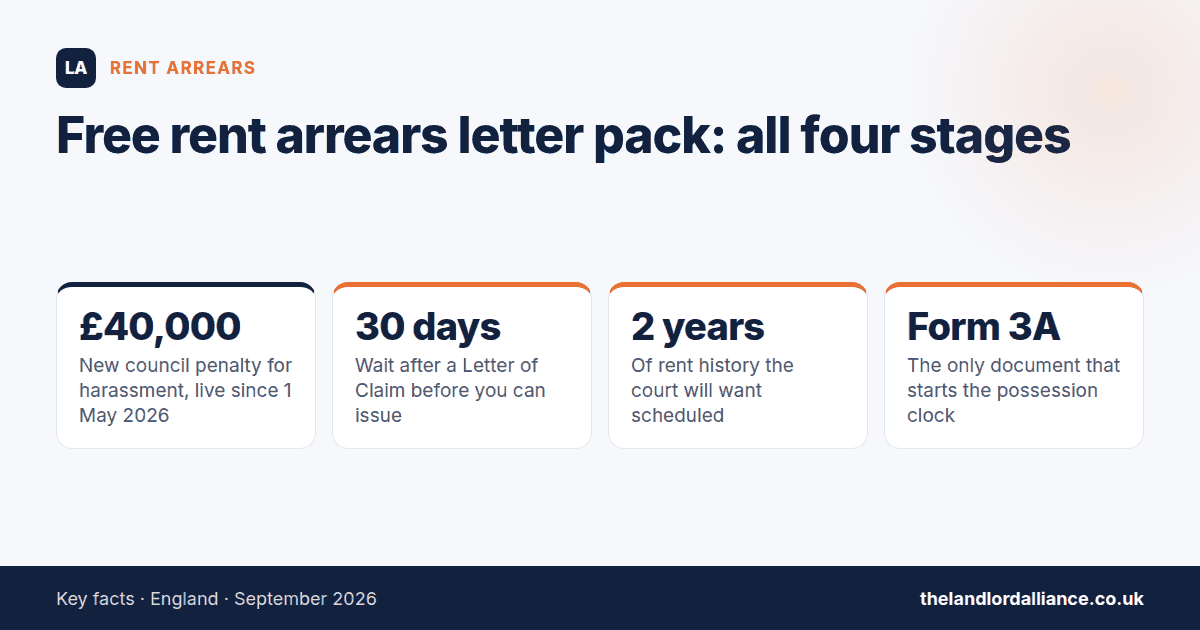
This is the formal pre-action letter for a money claim. If the Pre-Action Protocol for Debt Claims applies to you — and for a landlord suing a former tenant it very probably does — this letter has prescribed contents and prescribed enclosures, and you must then wait 30 days before issuing.
[Date]

Dear [Tenant name]

LETTER OF CLAIM
Rent arrears at [property address]

This letter is sent under the Pre-Action Protocol for Debt Claims.
Please read it and the enclosed Information Sheet carefully.

1. The debt
   You owe £[total] in rent arrears under a tenancy agreement dated
   [date] for [property address]. The tenancy [is continuing /
   ended on [date]].

2. How the debt arose
   The agreement is [written / oral]. [If written:] I enclose a
   copy. [If oral:] It was agreed on [date] between [parties],
   [where], on the following terms: [rent, frequency, due date].

3. How the amount is made up
   See the attached schedule of rent due and rent paid.

4. Interest and charges
   [Interest is claimed under clause [x] of the tenancy agreement
   at [rate] and continues to accrue at £[  ] per day.]
   [OR: No interest or charges are being added at this stage.]

5. Payment
   Please pay £[total] to [account details] within 30 days of the
   date of this letter.

6. If you cannot pay in full
   Complete the enclosed Reply Form and Financial Statement and
   return them to me. I will consider any reasonable proposal.

7. If you disagree
   Say so on the Reply Form and explain why.

8. Advice
   You can get free independent debt advice from Citizens Advice,
   StepChange or National Debtline. I would encourage you to.

If I do not hear from you within 30 days I may issue a claim in the
county court without further notice. That may result in a judgment
against you, which can affect your credit rating for six years.

Enclosed: Information Sheet, Reply Form, Financial Statement,
          schedule of arrears [, copy tenancy agreement]

Yours sincerely
[Name]
The enclosures are not optional. The Debt Protocol requires the Information Sheet, Reply Form and Financial Statement at Annexes 1 and 2 to go out with the Letter of Claim. Send the letter without them and you have not complied. If the tenant returns a completed Reply Form or asks for documents, further waiting periods apply. Full detail on the money claim page.
Stage 4 — this is not a letter
If you are going for possession, the thing that starts the clock is Form 3A, the prescribed notice under section 8 of the Housing Act 1988. No letter, however sternly worded, has any legal effect on possession. gov.uk's warning is worth repeating: do not change the wording of the form unless it says you can, or it may not be valid.
Before you serve Form 3A
- Check the deposit
- Since 1 May 2026 the court can make a possession order only if the deposit is protected and the prescribed information served — on every ground except 7A and 14
- Check the threshold
- Ground 8 needs 13 weeks or 3 months, at service and at the hearing
- Plead 8, 10 and 11
- All three now carry four weeks' notice, so there is no cost to pleading them together
- Diary the deadline
- Proceedings must start within 12 months of service
Work the dates out with the Ground 8 threshold checker, and read the full process before you serve anything.
The two offences that catch landlords chasing arrears
This is the part that matters more than the letters. Chasing rent too hard is not merely bad practice — it is criminal, and since 1 May 2026 it also carries a civil penalty.
Protection from Eviction Act 1977, s.1(3A)
A landlord or their agent commits an offence by doing acts likely to interfere with the peace or comfort of the occupier or their household, where they know or have reasonable cause to believe it is likely to make them give up occupation or stop pursuing a remedy. Note there is no need to prove intent under this subsection — that is what makes it the dangerous one. There is a defence of reasonable grounds.
Administration of Justice Act 1970, s.40
An offence to harass someone with demands for payment which, by their frequency, manner or occasion, or by any threat or publicity, are calculated to cause alarm, distress or humiliation. Also an offence to falsely represent that criminal proceedings lie for non-payment. Unpaid rent is a civil debt. Telling a tenant otherwise is itself the offence.
New on 1 May 2026 and largely unreported: a £40,000 civil penalty. Section 1A of the Protection from Eviction Act 1977 lets a local housing authority impose a financial penalty of up to £40,000 where it is satisfied beyond reasonable doubt that a section 1 offence was committed. No prosecution required. The enforcement route for harassment is no longer "the council takes you to the magistrates or does nothing".
Safe
- Written reminders at sensible intervals
- An accurate schedule of what is owed
- Offering a repayment arrangement
- Signposting free debt advice
- Serving Form 3A and issuing a claim
- Applying for direct payment from universal credit
Not safe
- Turning up unannounced or repeatedly
- Calling at unsocial hours, or many times a day
- Saying the police will be involved, or that non-payment is a crime
- Threatening to change the locks or cut off utilities
- Telling family, employers or neighbours
- Threatening eviction without a court order
Section 40(3) is your shield. The offence expressly does not cover anything reasonable and otherwise lawful done to secure payment of a debt owed to you, or to enforce a liability by legal process. A proportionate letter, an accurate Letter of Claim and issuing proceedings are all protected. It is volume, timing and false statements that do the damage.
And there is a costs sting. Under CPR 26.12(2) the court must not allocate a claim to the small claims track if it includes a tenant's claim against their landlord for harassment or unlawful eviction. A harassment counterclaim therefore escapes the small claims costs protection entirely, and exposes you to the other side's full costs on a claim you started to recover a few thousand pounds.
Two rules that do not apply to you
Both appear regularly on landlord and debt-collection sites, and both are wrong.
| The claim | The position |
|---|---|
| "FCA arrears-handling rules apply" | They do not. CONC 7 applies to firms doing consumer credit lending, hiring, peer-to-peer lending or debt collecting — and "debt collecting" is defined by article 39F of the Regulated Activities Order as procuring payment under a credit agreement or consumer hire agreement. Rent is neither |
| "The Consumer Protection from Unfair Trading Regulations 2008 apply" | Those regulations were revoked on 6 April 2025 by the Digital Markets, Competition and Consumers Act 2024. Any page still citing CPUTR 2008 is more than a year out of date. The replacement regime is Part 4 Chapter 1 of the 2024 Act |
Do I have to send a letter before serving notice?
No statute requires it. But the Practice Direction on Pre-Action Conduct applies to any claim without its own protocol, and the court can take non-compliance into account on costs. A letter is cheap insurance.
Can I add a late payment fee?
Only if the tenancy agreement provides for it, and the Tenant Fees Act permits a default fee for late rent only in limited terms. Do not invent charges in a letter.
Should I send letters by recorded delivery?
Keep proof of sending and a copy of what you sent, dated. Check the service clause in your tenancy agreement — it usually deems when a posted letter takes effect, and that matters for notices.
Can I text or WhatsApp the tenant?
You can, and many arrears conversations happen that way. Keep it to sensible hours and sensible frequency — it is the pattern, not the medium, that section 40 catches. Keep the formal steps in writing on paper or email.
What if the tenant has a Breathing Space?
Enforcement stops. You cannot enforce a judgment, issue a new claim or enter default judgment while a debtor is in the Debt Respite Scheme.
The schedule is the case
The Landlord Alliance keeps rent due against rent paid on every tenancy, so the two-year schedule the court asks for already exists when you need it. £10 a month, cancel anytime.
See what is includedEngland only. Position as at 1 September 2026. Templates are general information from a landlord, not legal advice, and are a starting point to adapt — not a substitute for advice on your own facts.
Sources: Practice Direction on Pre-Action Conduct and Protocols; Pre-Action Protocol for Debt Claims paras 1.1, 3.1, 3.3 and 4.2 and Annexes 1–2; Housing Act 1988 s.8 and Form 3A; Protection from Eviction Act 1977 ss.1 and 1A; Administration of Justice Act 1970 s.40; CPR 26.12(2); FCA CONC 7.1.1R; SI 2001/544 art 39F; DMCCA 2024 s.251(1) and SI 2025/272.
Related: Rent arrears: the recovery process · Money claims for arrears · Direct payment from universal credit · Ground 8 threshold checker