The short version
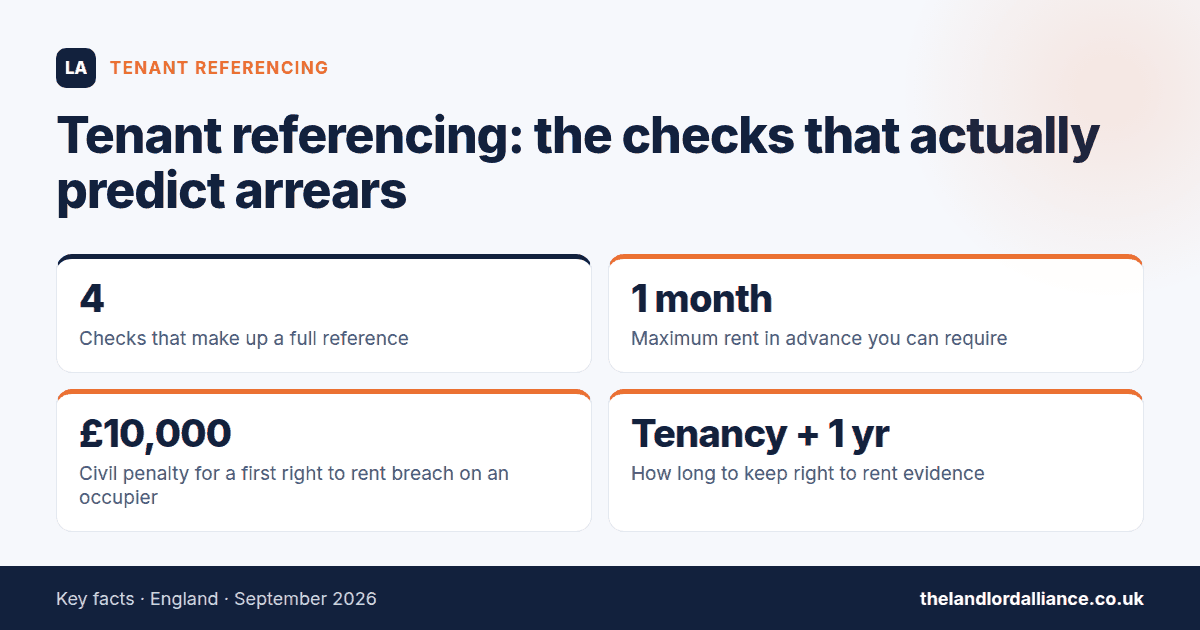
Referencing is risk assessment dressed up as administration. Four things get checked — identity and right to rent, credit history, income, and the previous landlord — and they are not equally useful. The previous landlord reference and the affordability calculation predict arrears. The credit score mostly tells you whether someone has borrowed before. Since 1 May 2026 two of the old fallbacks are gone: you cannot refuse someone for being on benefits or having children, and you cannot take more than one month’s rent in advance. That makes the guarantor the main tool left for a marginal applicant.
What a full reference actually covers
| Check | What it proves | How much it predicts arrears |
|---|---|---|
| Identity and right to rent | That the person is who they say they are and may legally rent in England | None — but skipping it is the only one of the four that can cost you £10,000 |
| Credit check | CCJs, bankruptcies, IVAs, and a borrowing history | Moderate. A CCJ or bankruptcy is a real signal. A thin file on a 23-year-old is not. |
| Income and employment | That the rent is affordable against verified income | High — this is the single most useful number you will get |
| Previous landlord | Whether they paid on time and left the place in order | Highest, and the one most often skipped because it takes a phone call |
The affordability calculation
The industry convention is that gross annual income should be at least 30 times the monthly rent — equivalent to rent being about a third of gross income. On a £1,200 a month property that means £36,000 a year.
It is a blunt instrument. It ignores existing debt, childcare, commuting and the fact that a £36,000 salary in London and in Hull are not the same thing. A better sanity check is to look at rent as a share of net monthly income: under 35% is comfortable, 35–45% is workable for a single person with no debt, and over 45% will fail the first time anything goes wrong.
Benefit income counts. Universal Credit, housing element, disability benefits and pensions are income. Since 1 May 2026 it has been unlawful in England to refuse a tenant, or apply different terms, because they receive benefits. Assess affordability on the total household income — that is a legitimate and lawful question. Refusing on the source of it is not.
What you may no longer do
| Practice | Position since 1 May 2026 |
|---|---|
| “No DSS”, or asking for a guarantor only from benefit claimants | Unlawful. This includes advertising, and applying stricter terms rather than an outright refusal. |
| Refusing tenants with children | Unlawful. |
| Asking for six or twelve months’ rent up front | Not permitted. One month’s rent in advance is the maximum. |
| Inviting or accepting offers above the advertised rent | Rental bidding is banned. You must advertise a price and cannot accept more. |
| Charging a referencing or admin fee to the tenant | Prohibited since the Tenant Fees Act 2019. You pay for referencing. |
| Checking only applicants who “look foreign” | Unlawful discrimination. Right to rent checks must be done on every adult occupier. |
Guarantors, done properly
A guarantor agreement is a contract and it needs to be treated like one.
- Reference the guarantor, not just the tenant. Income, credit and homeownership. A guarantor who cannot cover their own outgoings plus your rent is decoration.
- Make the liability explicit. State whether it covers rent only or rent plus damage, and whether it continues after the tenancy becomes periodic — which, since May 2026, is from day one.
- Get it signed before the tenancy starts. A guarantee signed afterwards may fail for want of consideration.
- Joint tenants need clarity. Say whether each guarantor covers their own tenant’s share or the whole rent. Ambiguity here is why guarantees fail in court.
- UK-based, ideally a homeowner. Enforcing against someone overseas is theoretical comfort.
Data protection
Referencing generates a lot of personal data about people you may never house. Collect only what you need to make the decision, tell applicants what you are doing with it, and delete unsuccessful applicants’ data once the decision is made rather than keeping a folder indefinitely. The exception is right to rent evidence for tenants you accept, which must be kept for the length of the tenancy and one year after.
Where referencing ends
A good reference reduces risk; it does not remove it. Circumstances change, and the possession routes available to you when they do are narrower than they were — there is no section 21, and Ground 8 now needs three months of arrears and four weeks’ notice. That makes the front end matter more than it used to, and it makes early intervention on arrears matter even more.
Read next
Who pays for tenant referencing?
The landlord or agent. Charging the tenant for referencing has been a prohibited payment since the Tenant Fees Act 2019, and a charge dressed up as an “admin fee” is caught too.
Can I refuse someone with a low credit score?
Yes — there is no protected characteristic in a credit score. But be careful the policy is applied to everyone equally, and remember a thin file is not the same as a bad one.
Do I need consent to run a credit check?
Yes. You need the applicant’s explicit consent, and they are entitled to know which agency is being used and to see what came back.
Can I ask for a guarantor?
Yes, provided you apply the requirement consistently. Asking only benefit claimants or only families for a guarantor is discrimination, even if you would have accepted the same person with one.
What if the previous landlord will not respond?
Common, and not by itself a red flag. Ask the applicant for bank statements showing rent leaving the account on time, which is often better evidence than a reference letter anyway.
Do I have to reference every adult?
You must carry out a right to rent check on every occupier aged 18 or over, whether or not they are named on the agreement. Full referencing is a commercial decision, but anyone you would pursue for the rent should be referenced.
Sources. Home Office code of practice for landlords: the right to rent scheme; Immigration Act 2014; Tenant Fees Act 2019; Renters’ Rights Act 2025 (c. 26); Information Commissioner’s Office guidance on data minimisation. Checked 7 September 2026.
Related: All landlord guides · Free calculators · The Renters’ Rights Act