The short version
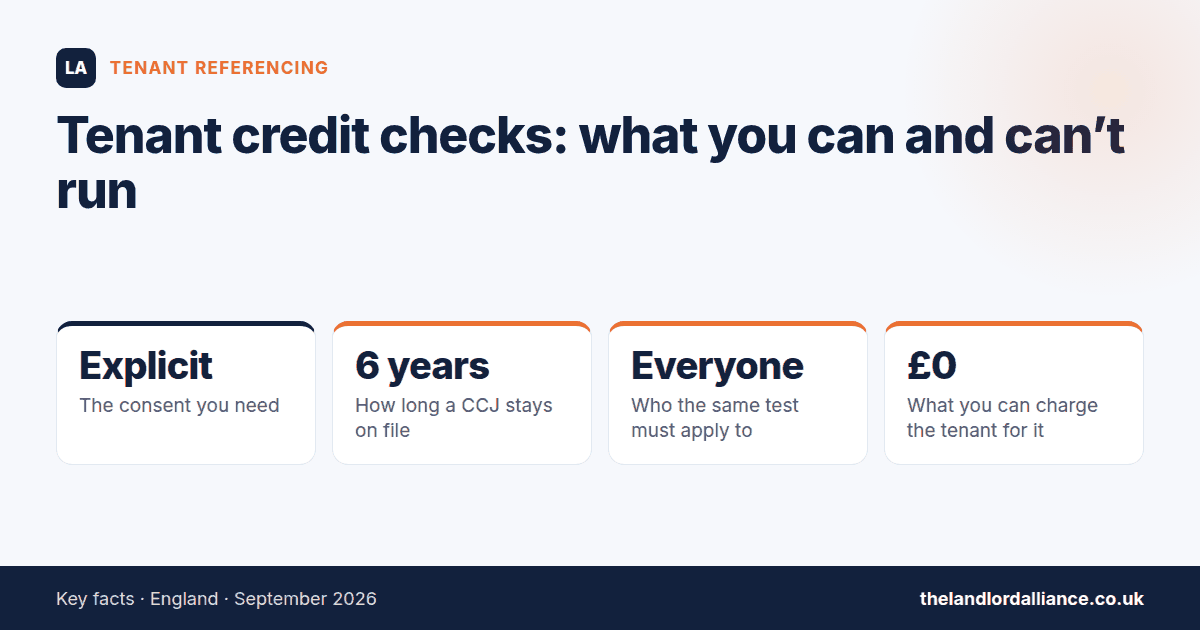
You can run a credit check on a prospective tenant, but only with their explicit consent, and you must tell them who is doing it and why. What it usefully shows is county court judgments, bankruptcies and insolvency arrangements — hard facts that predict something. What it shows less usefully is a score, which mostly measures borrowing history and penalises people who have never needed credit. A 23-year-old with no debt and a thin file is not a risk; a CCJ from last year is. And whatever you find, the check must be run on the same terms for everyone, because applying it selectively is discrimination.
What the check actually shows
| What comes back | How much it tells you |
|---|---|
| County court judgments | A lot. An unsatisfied CCJ for a debt is the single most useful item on the report. Stays for six years. |
| Bankruptcy, IVA, debt relief order | A lot. Relevant, and worth discussing rather than refusing on reflexively. |
| Electoral roll and address history | Useful for confirming identity and picking up gaps |
| Existing credit commitments | Useful for affordability — large monthly commitments reduce what is available for rent |
| Payment history on those accounts | Moderately useful. A pattern of missed payments is a signal. |
| The score itself | Less than people think. It measures credit behaviour, not rent behaviour, and it punishes thin files. |
| Previous rent payment history | Not included. Rent is not routinely reported to credit agencies, which is the fundamental limitation. |
Consent and data protection
A credit check is processing personal data, and a hard search leaves a footprint on the applicant’s file. Three things you must do:
- Get explicit consent, in writing, before you run it. A tick box buried in an application form is weak; a clear, separate statement is better.
- Tell them who will run it — the agency or referencing provider — and what you will use it for.
- Collect only what you need, and delete unsuccessful applicants’ data once the decision is made. Keeping a folder of rejected applicants’ credit reports indefinitely is a data protection problem with no upside.
Applicants are entitled to know what came back, and to see their own file and correct errors. Errors are common enough that a flat refusal without telling someone why is both unfair and, in practice, a way of losing good tenants to a mistake.
You pay for it. Charging a tenant for referencing or credit checking has been a prohibited payment since the Tenant Fees Act 2019, and an “admin fee” covering the same thing is caught. The cost of assessing risk is a cost of letting.
Using the result lawfully
Since 1 May 2026 it has been unlawful in England to refuse an applicant because they receive benefits or have children, or to apply different terms to them. That has a direct effect on how you use a credit check:
- Run the same check on every applicant. Not just the ones you have doubts about.
- Apply the same threshold to every applicant. Write it down before you advertise.
- Do not require a guarantor only from some groups. Requiring one from everyone who fails the same affordability test is lawful; requiring one from benefit claimants is not.
- Assess affordability on all household income, including benefits. See the ban on benefit discrimination.
- Record the reason for every decline. A decision you cannot explain later looks like the decision the law prohibits.
What to do with an imperfect file
| What you find | Sensible response |
|---|---|
| Thin file, no adverse data | Usually fine. Common for young people, recent arrivals and those who avoid credit. Lean on income and landlord references instead. |
| Old satisfied CCJ | Ask about it. A judgment from four years ago, paid, with clean references since, is a story rather than a risk. |
| Recent unsatisfied CCJ | A genuine concern. Consider a guarantor, and be consistent about when you require one. |
| Current bankruptcy or IVA | Discuss it. An IVA with regular payments and stable income can be a better prospect than an unmanaged mess. |
| Address history gaps | Ask. There is usually an ordinary explanation — living abroad, living with family, a period in hospital. |
| Identity mismatch | Resolve before proceeding. This is the one to take seriously. |
Read next
Can I run a credit check without asking?
No. You need the applicant’s explicit consent, and they are entitled to know who is running it and why.
Can I charge the tenant for it?
No. It has been a prohibited payment since the Tenant Fees Act 2019, including where it is dressed up as an admin fee.
Is a low credit score a good reason to refuse?
It can be, if you apply the same threshold to everyone. But a score is a poor predictor of rent payment and punishes people who have simply never borrowed.
Does the report show missed rent payments?
Usually not. Rent is not routinely reported to credit reference agencies, which is why a previous landlord reference is worth more.
How long do I keep the report?
For successful applicants, as long as you need it and no longer. For unsuccessful ones, delete it once the decision is made.
Can I ask a benefit claimant for a guarantor?
Only if you require one from everyone who fails the same affordability threshold. Applying it selectively is unlawful discrimination.
Sources. UK GDPR and Data Protection Act 2018 on consent and data minimisation; Tenant Fees Act 2019 on prohibited payments; Renters’ Rights Act 2025 (c. 26) on rental discrimination, commenced 1 May 2026; Information Commissioner’s Office guidance for landlords. Checked 8 September 2026.
Related: Tenant referencing · All guides · The Renters’ Rights Act