Information, not tax advice. We are landlords, not accountants. The mechanics below are checked against HMRC guidance, but incorporation and disposal decisions need an accountant who can see your whole position.
The short version
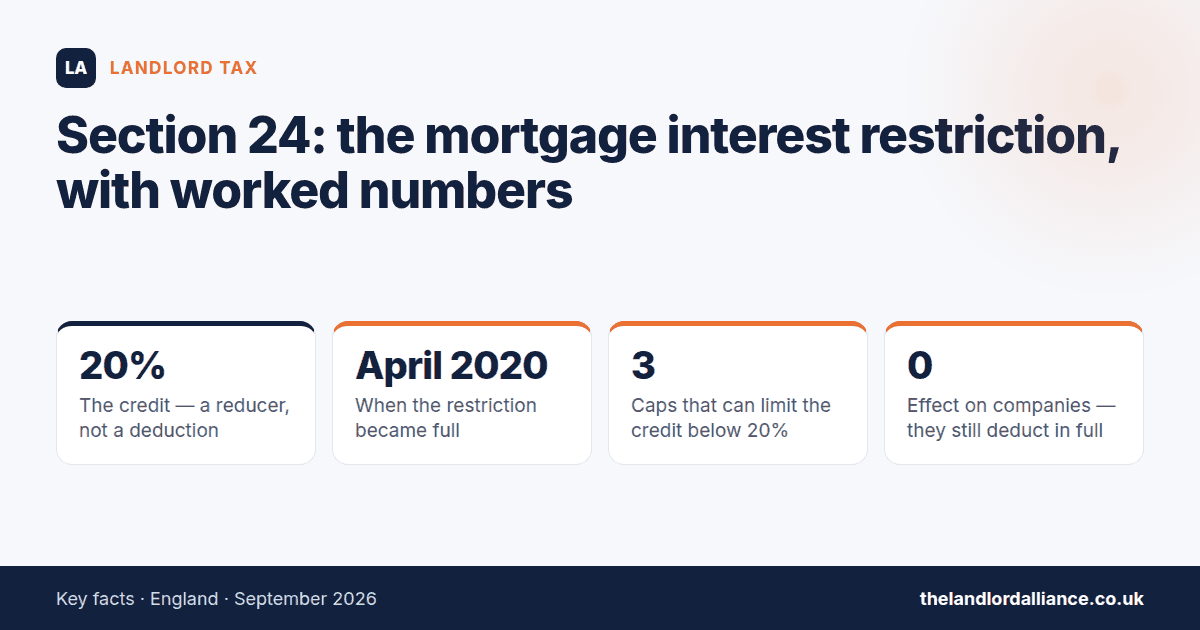
Section 24 stopped mortgage interest being an expense. You now pay tax on rent minus running costs — with the interest added back — and then receive a tax reducer worth 20% of the interest. For a basic-rate taxpayer that is roughly neutral. For a higher-rate taxpayer it is a straight cost, and it has a second effect that hurts more than the first: because your taxable profit is now larger than your real profit, it can push you into a higher band, taper away your personal allowance or trigger the high income child benefit charge, without a penny more actually reaching you.
How it works
Before April 2017, mortgage interest came off rental income like any other cost. The restriction was phased in over four years and has applied in full since April 2020. The calculation now runs in two stages.
- Work out the taxable profit as rent minus allowable running costs. Finance costs — mortgage interest, and the interest element of most loans taken out for the property business — are not deducted.
- Calculate the tax on that profit at your marginal rate, then subtract a tax reducer of 20% of the finance costs.
The distinction between a deduction and a reducer is the whole of Section 24. A deduction comes off before the rate is applied, so it is worth your marginal rate. A reducer comes off the tax bill afterwards, so it is worth 20% whatever your rate.
What it costs, by band
Take £18,000 of rent, £3,000 of running costs and £6,000 of mortgage interest.
| Step | Basic rate | Higher rate | Additional rate |
|---|---|---|---|
| Rent | £18,000 | £18,000 | £18,000 |
| Less running costs | −£3,000 | −£3,000 | −£3,000 |
| Taxable profit (interest added back) | £15,000 | £15,000 | £15,000 |
| Tax at your rate | £3,000 | £6,000 | £6,750 |
| Less 20% credit on £6,000 | −£1,200 | −£1,200 | −£1,200 |
| Tax due | £1,800 | £4,800 | £5,550 |
| Tax under the old rules | £1,800 | £3,600 | £4,050 |
| Cost of Section 24 | £0 | £1,200 | £1,500 |
From April 2027 the gap widens. Property income gets its own rates — 22%, 42% and 47%. If the credit stays at 20%, the higher-rate cost on the example above rises from £1,200 to £1,500. Whether the credit tracks the new basic rate to 22% is not settled, and anyone telling you confidently either way should be asked for their source.
The three caps on the credit
The reducer is 20% of the lowest of three figures, which is why some landlords get less relief than they expect:
- The finance costs for the year, plus anything carried forward.
- The property business profits for the year, after losses brought forward.
- Your adjusted total income above the personal allowance — broadly, income that is actually being taxed.
So a heavily geared portfolio making a small profit gets relief limited by the second cap, and a landlord with little other income gets limited by the third. Unused finance costs are carried forward indefinitely and relieved in a later year when there is capacity, which softens the blow but delays it.
The second-order effect that costs more
This is the part people miss. Because your declared profit is inflated by the interest you cannot deduct, it lifts your total income for every other test in the tax system.
| Threshold | What happens |
|---|---|
| The higher-rate band | Rental profit that would once have been small enough to stay in the basic band now crosses into 40%, taking your other income with it. |
| The personal allowance taper | Above £100,000, the allowance drops by £1 for every £2 of income. Inflated rental profit accelerates this, producing an effective marginal rate far above the headline. |
| High income child benefit charge | Triggered by adjusted net income, which the restriction inflates. Families lose child benefit on profit they never received. |
| Student loan repayments | Assessed on total income, so they rise with the inflated figure too. |
What actually reduces the impact
- Reduce the debt. Interest is the input to the whole calculation. Lower gearing shrinks both the tax cost and the risk.
- A limited company. Companies deduct interest in full and sit outside the April 2027 property income rates. For a higher-rate taxpayer buying from here it is often decisive — but moving existing property in is a disposal, with capital gains tax and stamp duty. See when it actually pays.
- Transfer to a lower-earning spouse. Beneficial ownership determines who is taxed. Married couples are taxed 50/50 by default; unequal shares need tenants in common and a Form 17. This is a real planning tool, and it needs doing properly.
- Claim everything you are entitled to. The restriction makes every legitimate deduction worth more, because it is now the only thing reducing the profit figure. See allowable expenses.
What does not work is switching to interest-only, or remortgaging to release equity and calling the interest something else. The restriction applies to the interest, not to the repayment structure, and loans taken out against a rental property are only relievable to the extent the money was used in the property business.
Read next
Does Section 24 affect basic-rate taxpayers?
Usually not directly — the 20% credit matches what the deduction was worth. But it can push a basic-rate taxpayer into the higher band, at which point it does.
Can I still deduct mortgage fees and arrangement costs?
No. Incidental costs of obtaining finance are treated the same as the interest and go through the 20% credit.
Does it apply to furnished holiday lets?
It does now. The furnished holiday lettings regime, which allowed full interest deduction, was abolished from April 2025.
Does it apply to commercial property?
No. The restriction applies to residential property businesses. Commercial letting still deducts interest in full.
What if my rental business makes a loss?
The credit is capped at the property profits, so a loss-making year gets no relief. The unused finance costs carry forward indefinitely.
Is it worth incorporating just for this?
Sometimes, but rarely on its own. Model the capital gains tax and stamp duty on the transfer first — on an established portfolio it frequently exceeds a decade of Section 24 savings.
Sources. Income Tax (Trading and Other Income) Act 2005, sections 272A–274A as inserted by Finance (No. 2) Act 2015; HMRC Property Income Manual on finance cost relief; House of Commons Library briefing CBP-10450 on the Budget 2025 property income rates. Checked 8 September 2026.
Related: Landlord tax · All guides · Free calculators