The short version
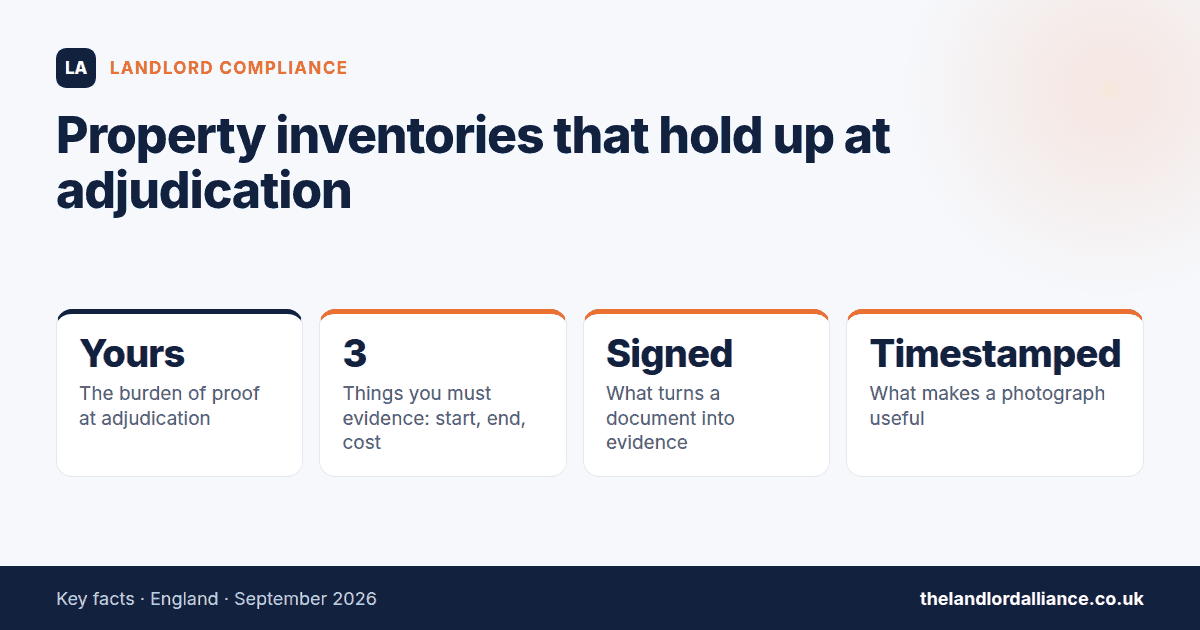
An inventory is not paperwork; it is the evidence you will rely on months or years later when you want to keep part of a deposit. Adjudicators start from the position that the deposit is the tenant’s money and the burden of proving a deduction is entirely yours. What loses claims is almost never dishonesty — it is a check-in record too vague to prove the condition at the start, no dated check-out to compare it with, and no evidence of what the remedy actually cost. Get those three things right and reasonable deductions are usually agreed. Get them wrong and even genuine damage is unrecoverable.
What the inventory has to do
It has to prove the condition of the property, and of everything in it, on the day the tenant took possession — in enough detail that the same person could look at it at the end and say what changed. “Kitchen: good condition” does not do that. “Kitchen: worktop free of burns and chips; one 40mm scratch left of the sink, photographed” does.
| Include | Detail that makes it evidence |
|---|---|
| Every room, and every surface in it | Walls, ceiling, floor covering, doors, windows, skirting — each described separately, not as one line |
| Existing damage and wear | Described precisely and photographed. Recording existing damage protects you as much as the tenant. |
| Fixtures, fittings and appliances | Make, model, condition, and confirmation that each one works |
| Furniture, if supplied | Item by item, with fire safety labels photographed |
| Meter readings | Gas, electricity, water, with photographs of the displays |
| Keys | How many of each, issued to whom |
| Alarms | Confirmation that each smoke and CO alarm was tested on the day — a legal duty as well as evidence |
| Garden and exterior | Condition of lawn, borders, fencing, sheds, guttering |
| Cleanliness | Described room by room, with photographs. “Professionally cleaned” is a claim; photographs are proof. |
The three mistakes that lose money
- No signature. An inventory the tenant never agreed to is one party’s account. Have them sign it at check-in, or send it with a clear window — commonly seven days — to comment, and keep proof you sent it. Unchallenged after a fair opportunity is far stronger than never sent.
- No check-out. The comparison is the claim. Without a dated check-out record in the same format, there is nothing to compare the check-in to, and the deduction fails however obvious the damage looks to you.
- No evidence of cost. “The carpet is ruined, I want £800” is not a claim. Quotes or invoices are, and adjudicators expect a like-for-like remedy rather than an upgrade.
Betterment is the trap. You are entitled to be put back in the position you were in, not a better one. Where a five-year-old carpet with a ten-year life is damaged beyond repair, an adjudicator will typically award a proportion of the replacement cost reflecting the life already used, not the full price of a new carpet. Claim on that basis from the start and you will be taken more seriously on everything else.
Fair wear and tear
You cannot charge for the reasonable use of the property over the length of the tenancy by the number of people living there. Carpets flatten, paint scuffs, seals discolour. The test is proportionate use, not perfection.
| Usually fair wear and tear | Usually chargeable |
|---|---|
| Traffic-worn carpet in a hallway after three years | A cigarette burn or a large stain in the same carpet |
| Scuff marks on painted walls | Holes from unagreed shelving, or a repaint in a different colour |
| Faded curtains or blinds | Torn or missing curtains |
| Worn seals around a bath | A cracked bath panel or basin |
| Garden looking tired at the end of winter | A garden left knee-deep after two summers, where the agreement required maintenance |
| Limescale in a hard water area | Blocked waste from misuse |
Doing it yourself, or paying for it
A professional inventory clerk costs somewhere in the low hundreds and produces an independent, formatted, timestamped report. That independence carries weight, and on a higher-value property or a first tenancy it is usually money well spent.
A self-made inventory is perfectly acceptable if it is thorough. What makes it work: a consistent room-by-room structure, a photograph of every item and defect you describe, the date visible, the tenant’s signature, and the identical format used at check-out. What makes it fail: written months after the tenant moved in, no photographs, no signature, and a different format at the end.
Mid-tenancy inspections
Inspect periodically — commonly every six months — with proper written notice, normally at least 24 hours, at a reasonable time. Record what you find in the same format, with photographs. That interim record does two things: it gives you a dated position between check-in and check-out, and it demonstrates you were managing the property, which matters if there is ever an argument about disrepair or damp.
Read next
Is an inventory a legal requirement?
No. But without one you will almost certainly fail to justify a deposit deduction, because the burden of proof at adjudication is on you.
Does the tenant have to sign it?
Not legally, but an unsigned inventory is weaker. Send it with a clear period to comment and keep proof of sending — an unchallenged inventory carries real weight.
Can I charge for cleaning?
Only if the property is less clean than it was at check-in, evidenced both ways. You cannot require professional cleaning as a blanket condition, and a clause purporting to do so is a prohibited payment.
How long should I keep it?
At least until the deposit is settled and the limitation period for a claim has passed — six years is a safe rule.
Do photographs need to be dated?
Yes in practice. An undated photograph proves a condition existed at some point, which is not the question being asked.
What if the tenant disputes the inventory at check-in?
Good — that is the system working. Amend it to reflect what you agree, note what you do not, and have both parties sign the amended version.
Sources. Housing Act 2004 Part 6 on deposit protection; scheme adjudication guidance from the three government-approved deposit protection schemes; Tenant Fees Act 2019 on prohibited payments. Checked 8 September 2026.
Related: Tenancy deposits · Compliance checklist · All guides