The short version
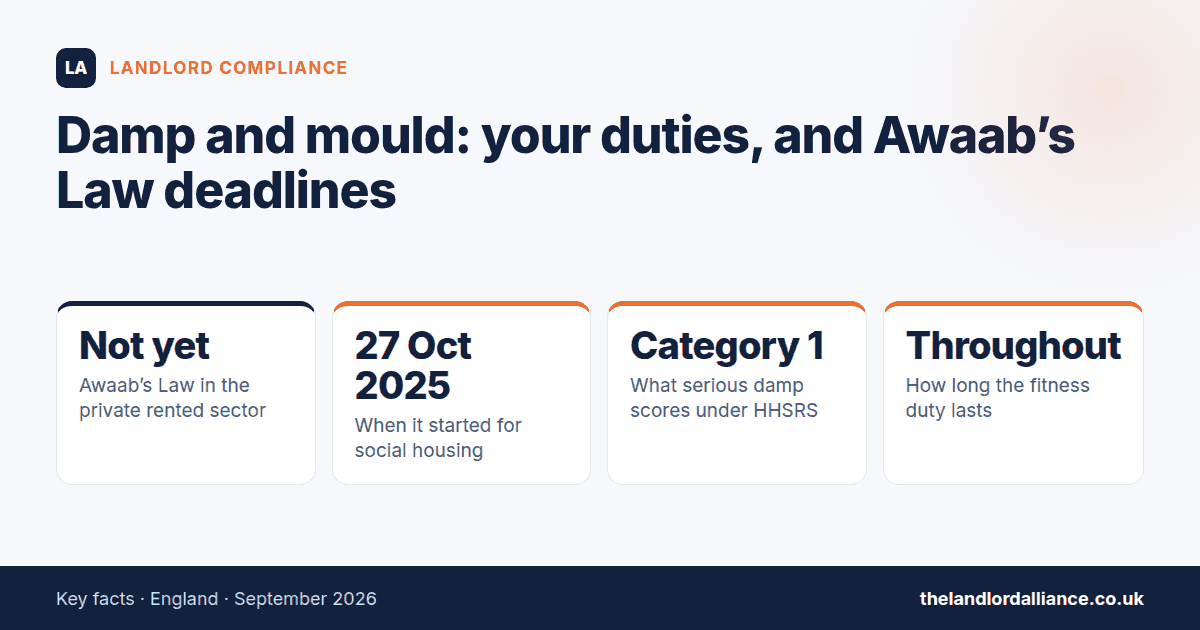
Two obligations already bind private landlords and neither is new. Section 11 of the Landlord and Tenant Act 1985 makes you responsible for the structure and exterior, and the Homes (Fitness for Human Habitation) Act 2018 requires the property to be fit to live in at the start of the tenancy and throughout it — enforceable by the tenant directly in court, without needing the council. Awaab’s Law does not yet apply to private landlords. It commenced for social housing on 27 October 2025, and the Renters’ Rights Act contains the power to extend it, but that has not happened and is not expected before 2027. Anyone telling you the 24-hour and 5-day deadlines already bind you is wrong — but they describe where this is going.
What already applies to you
| Obligation | What it requires | Who enforces it |
|---|---|---|
| Section 11, Landlord and Tenant Act 1985 | Keep the structure and exterior in repair, and the installations for water, gas, electricity, sanitation and heating in working order | The tenant, by claim for disrepair |
| Homes (Fitness for Human Habitation) Act 2018 | The property must be fit for human habitation at the start of the tenancy and remain so. Damp and mould is expressly a factor. | The tenant, directly. No council involvement needed. |
| Housing Health and Safety Rating System | Councils assess hazards, including damp and mould growth. A Category 1 hazard triggers a duty to act. | The local authority, by improvement notice or prohibition order |
| Awaab’s Law | Fixed investigation and repair deadlines | Social landlords only, for now |
Where Awaab’s Law has actually got to
Awaab’s Law was introduced after the death of Awaab Ishak in social housing. The first phase commenced on 27 October 2025 and applies to social landlords. It requires:
- Emergency hazards — investigated and made safe within 24 hours.
- Significant damp and mould — investigated within 10 working days, and safety work completed within 5 working days of the hazard being identified.
- Where those deadlines cannot be met, suitable alternative accommodation at the landlord’s cost.
This does not bind private landlords today. The Renters’ Rights Act contains the power to extend Awaab’s Law to the private rented sector, but the regulations have not been made and commencement is not expected before 2027 at the earliest. We will update this page when that changes. In the meantime, be sceptical of anyone selling you compliance with a law that does not yet apply to you — and equally, do not treat “it does not apply yet” as a reason to leave mould in a child’s bedroom.
Condensation is not a defence
The instinct when mould appears is to say the tenant is drying washing indoors and not opening windows. Sometimes that is a contributing factor. It is very rarely a complete answer, and it is a weak position in court.
| Type | Typical signs | Usually whose problem |
|---|---|---|
| Condensation | Black spot mould on cold surfaces, window reveals, behind furniture on external walls, worse in winter | Shared — but if ventilation, heating or insulation is inadequate, the deficiency is the property’s |
| Penetrating damp | Localised patches, worse after rain, often traceable to a defect | Landlord — failed pointing, gutters, roof, render, window seals |
| Rising damp | Tide mark to about a metre, salts, decayed skirtings | Landlord — failed or bridged damp-proof course |
| Plumbing leak | Sudden, localised, sometimes above or behind | Landlord |
Practically: if there is no working extractor fan in the bathroom or kitchen, if trickle vents are missing or painted shut, if the heating is inadequate or so expensive the tenant cannot run it, or if there is single glazing and uninsulated solid walls, then the property’s deficiencies are doing the work. Fixing ventilation is usually cheaper than defending a claim.
What to do when it is reported
- Respond in writing the same day, and record it. Delay is what converts a repair into a claim, and your response time is the first thing anyone will look at.
- Inspect within days, not weeks. Photograph everything, including moisture readings if you have a meter.
- Diagnose the cause properly. A damp specialist who sells damp-proof courses will find you need a damp-proof course. An independent surveyor is worth the fee on anything persistent.
- Treat the cause, not the surface. Painting over mould and leaving a blocked gutter is a repair that will fail, on the record, in front of a judge.
- Deal with ventilation. Extractor fans that actually run, humidistat-controlled where practical, and clear trickle vents. This is the single highest-value intervention in most cases.
- Advise the tenant, without blaming them. Written guidance on ventilation and heating is sensible and reasonable. Written accusation is evidence against you.
- Keep the paper trail. Every report, every visit, every invoice, every response. It is your entire defence.
What it costs to get wrong
A fitness for habitation claim can produce an order compelling the works, damages for the period the property was unfit — often calculated as a percentage of the rent over months or years — and the tenant’s legal costs. A council improvement notice under HHSRS can compel works to a deadline and carries a financial penalty for non-compliance, and the council can do the work itself and bill you.
There is also a possession dimension. Serving notice shortly after a tenant complains about disrepair invites a retaliatory eviction argument, and with section 21 gone you need a ground that will withstand scrutiny anyway. See retaliatory eviction.
Read next
Does Awaab’s Law apply to private landlords?
Not yet. It commenced for social housing on 27 October 2025. The Renters’ Rights Act allows it to be extended to the private sector, but that has not happened and is not expected before 2027.
Is mould always the landlord’s responsibility?
Not automatically, but the burden is effectively on the property. If mould appears under normal occupation, the question becomes whether ventilation, heating and insulation are adequate — and if they are not, it is your repair.
Can I evict a tenant who complains about damp?
You would be inviting a retaliatory eviction argument, and since section 21 was abolished you need a valid ground in any event. Fix the damp; it is cheaper, and it is the point.
How quickly must I respond?
No statutory deadline yet binds private landlords, but “a reasonable time” is judged after the event. Same-day acknowledgement and inspection within a few days is a defensible standard, and it is roughly where regulation is heading.
What if the tenant will not ventilate the property?
Provide working extractor fans and clear trickle vents, give written guidance, and record that you have. If the property still grows mould when used normally, the deficiency is the building’s, not the tenant’s.
Does my insurance cover it?
Almost never. Damp and mould are usually excluded as gradual deterioration or lack of maintenance. A sudden escape of water is different.
Sources. Landlord and Tenant Act 1985, section 11; Homes (Fitness for Human Habitation) Act 2018; Housing Act 2004 Part 1 (HHSRS); the Awaab’s Law provisions commencing 27 October 2025 for social landlords; Renters’ Rights Act 2025 (c. 26); Shelter England professional guidance on Awaab’s Law. Checked 8 September 2026.
Related: Compliance checklist · All guides · The Renters’ Rights Act