The short version
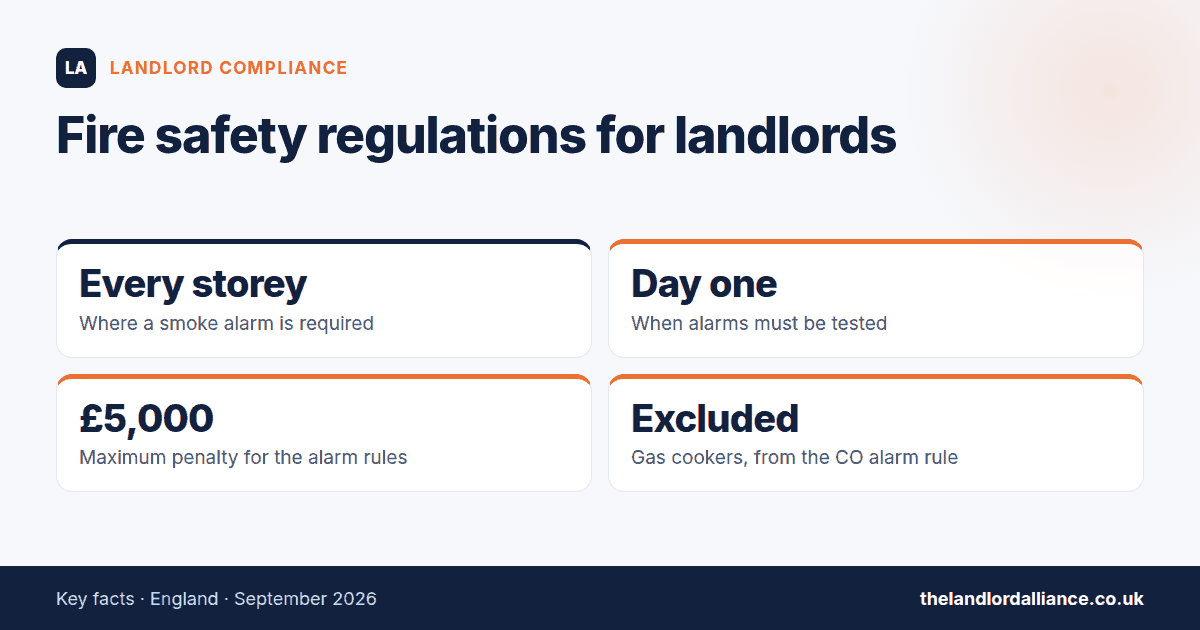
For an ordinary single let, fire safety comes down to four things: a smoke alarm on every storey with living accommodation, a carbon monoxide alarm in every room with a fixed combustion appliance other than a gas cooker, all of them tested on the first day of the tenancy, and any furniture you supply meeting the fire safety regulations. For an HMO, that is the starting point rather than the standard — you will also need a fire risk assessment, fire doors, a linked detection system and protected escape routes, with the specification set by your licence conditions.
Alarms: the minimum standard
| Requirement | Detail |
|---|---|
| Smoke alarms | At least one on every storey containing a room used as living accommodation. A hallway or landing ceiling is the usual position. |
| Carbon monoxide alarms | In every room used as living accommodation containing a fixed combustion appliance — a boiler, a gas fire, a wood burner. Gas cookers are excluded. |
| Testing | Every prescribed alarm must be tested and working on the day the tenancy starts. Installing is not enough. |
| Repairs | Repair or replace any alarm reported as faulty. Tenants can change batteries; you remain responsible for a unit that still does not work. |
| Penalty | Up to £5,000 for failing to comply with a remedial notice. |
Evidence the day-one test. The duty is to check the alarms work on the first day of the tenancy, and the only practical way to prove you did is to have the tenant sign the inventory or a check-in sheet confirming it. Take a photograph of the alarms with the date. Without that, the obligation is unprovable and effectively unmet.
Furniture you supply
Upholstered furniture and furnishings you provide must meet the Furniture and Furnishings (Fire) (Safety) Regulations 1988. In practice that means checking for the permanent fire safety label on sofas, armchairs, mattresses, headboards, cushions and padded seating.
The rules do not apply to items the tenant brings, or to furniture made before 1950. They do apply to second-hand items you supply, which is where landlords furnishing on a budget get caught — a marketplace sofa with no label should not go into a let property.
Escape routes and general fire safety
Even in a single let, keep the escape route usable and the property free of obvious fire risk:
- A clear route to a final exit, not obstructed by storage or a locked door needing a key that is kept elsewhere.
- Windows that open where they form part of an escape strategy, particularly in loft conversions.
- An electrical installation in good order — the EICR is the evidence for this, and C1 and C2 items must be fixed within 28 days.
- Gas appliances serviced and certified annually. See gas safety certificates.
- No obviously dangerous heating — portable gas heaters and unguarded open fires in particular.
HMOs: the higher standard
HMOs carry substantially more, and the detail comes from your licence conditions and the council’s amenity standards rather than from a single national rulebook. Expect:
| Item | What is typically required |
|---|---|
| Fire risk assessment | A written assessment, reviewed regularly and kept available for the council |
| Detection system | An interlinked system to a specified grade, usually mains-powered with battery backup, covering escape routes and often individual rooms |
| Fire doors | Typically 30-minute doors with intumescent strips, cold smoke seals and self-closers on rooms opening onto the escape route |
| Emergency lighting | On escape routes in larger or multi-storey HMOs |
| Fire blanket and extinguishers | Commonly required in shared kitchens |
| Signage | Fire action notices and escape route signs in larger properties |
Note the interaction with the wider regime: many HMO licences require annual electrical inspections rather than the five-yearly cycle that applies elsewhere, and non-compliance with licence conditions is enforceable in its own right. See HMO licensing.
The Building Safety Act and blocks of flats
If you own a leasehold flat in a block, the responsibility for the building’s fire safety sits with the freeholder or management company, not with you. What you should do is ask for evidence — the fire risk assessment for the common parts, and the remediation position if the block has cladding or other external wall issues. It affects your ability to sell and to remortgage, and it is far better discovered now than at the point of a sale.
Read next
How many smoke alarms do I need?
At least one on every storey that has a room used as living accommodation. A two-storey house needs a minimum of two.
Do I need a carbon monoxide alarm for a gas cooker?
No. The requirement covers rooms with a fixed combustion appliance, and gas cookers are specifically excluded. A gas boiler or gas fire in a living space is caught.
Do the alarms have to be interlinked?
Not for an ordinary single let in England. HMO licence conditions usually do require an interlinked system, and Scotland requires interlinked alarms generally.
Does furniture I bought second hand need to comply?
Yes, if you are supplying it. Look for the permanent fire safety label; without one, do not put it in the property.
Do I need a fire risk assessment for a single let?
Not as a legal requirement for a self-contained single dwelling, though it is sensible. HMOs and buildings with common parts do need one.
Who is responsible in a block of flats?
The freeholder or management company handles the common parts and the building. You remain responsible for alarms and safety inside your own flat.
Sources. Smoke and Carbon Monoxide Alarm (England) Regulations 2015 as amended by the 2022 Regulations, and the GOV.UK guidance booklet for landlords; Furniture and Furnishings (Fire) (Safety) Regulations 1988; Regulatory Reform (Fire Safety) Order 2005; Housing Act 2004 Part 1 (HHSRS) and Part 2 (HMO licence conditions); Building Safety Act 2022. Checked 8 September 2026.
Related: Compliance checklist · All guides · HMOs