The short version
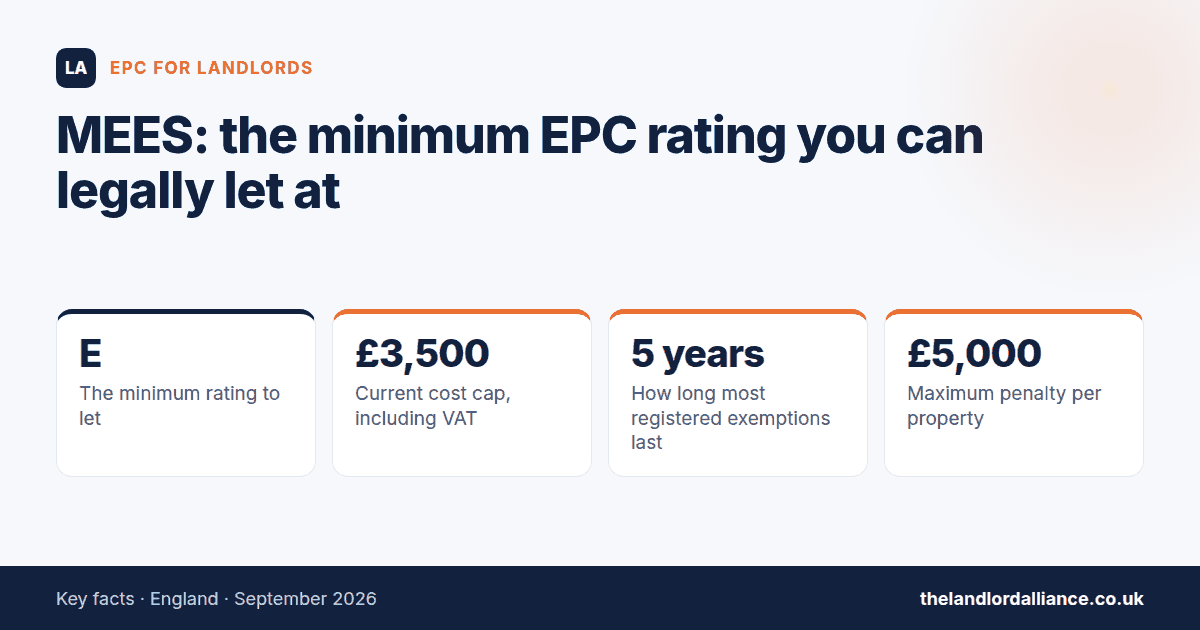
The Minimum Energy Efficiency Standard makes it unlawful to let — or to continue letting — a domestic property rated F or G. The minimum is E, and it has applied to all tenancies, including ones that were already running, since April 2020. If your property cannot reach E within the cost cap, an exemption may apply, but it only protects you once it is registered on the PRS Exemptions Register. An unregistered exemption is not an exemption, and that is the most common way landlords fall foul of this.
What MEES requires
Since 1 April 2018 you have not been able to grant a new tenancy of a property rated F or G. Since 1 April 2020 you have not been able to continue letting one either — the standard bites on existing tenancies, not just new ones.
It applies to domestic private rented property that legally requires an EPC. That excludes some tenancies — lettings of six months or less with no security of tenure, and lettings of 99 years or more — and a property genuinely exempt from needing an EPC at all, such as certain listed buildings where the required measures would unacceptably alter character, sits outside the regime.
Listed buildings are not automatically exempt. This is widely misunderstood. A listed building needs an EPC unless the improvement measures would unacceptably alter its character or appearance — and that judgement has to be made, evidenced, and where relevant supported by a refusal of consent. “It is listed” is not, on its own, an answer to an enforcement officer.
The cost cap
You are not required to spend without limit. The current cap is £3,500 including VAT per property. If you have spent that much on relevant energy efficiency improvements and the property still does not reach E, you can register an “all improvements made” exemption.
Note that this cap sits alongside the separate and larger £10,000 cap confirmed for the EPC C standard arriving in October 2030, under which qualifying spending counts from 1 October 2025. Two caps, two standards, two dates — keep your invoices for both.
The exemptions
| Exemption | When it applies | Length |
|---|---|---|
| All improvements made | You have spent to the cap, or all relevant measures are installed, and the property is still below E | 5 years |
| High cost | No relevant improvement can be made within the cap | 5 years |
| Wall insulation | Cavity, external or internal wall insulation would damage the property, evidenced by a suitable expert report | 5 years |
| Third-party consent | A freeholder, lender, planning authority or tenant has refused consent, or granted it on unreasonable conditions | 5 years, or until the tenant leaves |
| Property devaluation | An independent RICS surveyor confirms the measures would reduce market value by more than 5% | 5 years |
| New landlord | You have only recently become the landlord — for example on inheritance or purchase with a sitting tenant | 6 months, once |
The register is the whole point
An exemption has no legal effect until it is registered on the PRS Exemptions Register. Registration requires the property address, the exemption type, and the supporting evidence — the EPC, the quotes, the surveyor’s report, the refusal of consent.
Registrations are public. That is deliberate, and it means an enforcement officer can see at a glance whether you have one. It also means a landlord relying on an unregistered exemption is visible as a landlord with no exemption at all.
Enforcement and penalties
| Breach | Penalty |
|---|---|
| Letting in breach for less than three months | Up to £2,000, plus publication penalty |
| Letting in breach for three months or more | Up to £4,000, plus publication penalty |
| Registering false or misleading information | Up to £1,000, plus publication penalty |
| Maximum per property | £5,000 |
Local authorities enforce, and they can require you to produce the EPC, the tenancy agreement and your evidence. A compliance notice can be issued up to twelve months after a suspected breach.
What to do
- Check every property’s rating and EPC expiry. Ratings are searchable on the national EPC register by postcode.
- If anything is F or G, get quotes for the recommended measures immediately. Most F and G properties reach E with loft insulation and a decent boiler.
- If the work cannot get you to E within the cap, gather the evidence and register the exemption. Do not rely on it unregistered.
- Diarise exemption expiry. Most last five years, and they do not renew themselves.
- Keep invoices from 1 October 2025 for the separate 2030 cap.
Read next
What does MEES stand for?
Minimum Energy Efficiency Standard. It is the regime requiring a minimum EPC rating to let a property.
Can I let a property rated F?
No, unless you have a registered exemption. It applies to existing tenancies as well as new ones.
How much do I have to spend?
Up to £3,500 including VAT under the current standard. If the property still cannot reach E, register an exemption.
Are listed buildings exempt?
Not automatically. A listed building needs an EPC unless the required measures would unacceptably alter its character — and that has to be evidenced.
Do exemptions last forever?
No. Most last five years, and the new landlord exemption lasts six months. They must be re-assessed and re-registered.
Who enforces it?
The local authority, with penalties up to £5,000 per property and publication of the breach on the register.
Sources. Energy Efficiency (Private Rented Property) (England and Wales) Regulations 2015, as amended; GOV.UK guidance on the domestic private rented property minimum standard and the PRS Exemptions Register. Checked 8 September 2026.
Related: EPC rules · Compliance checklist · All guides