The short version
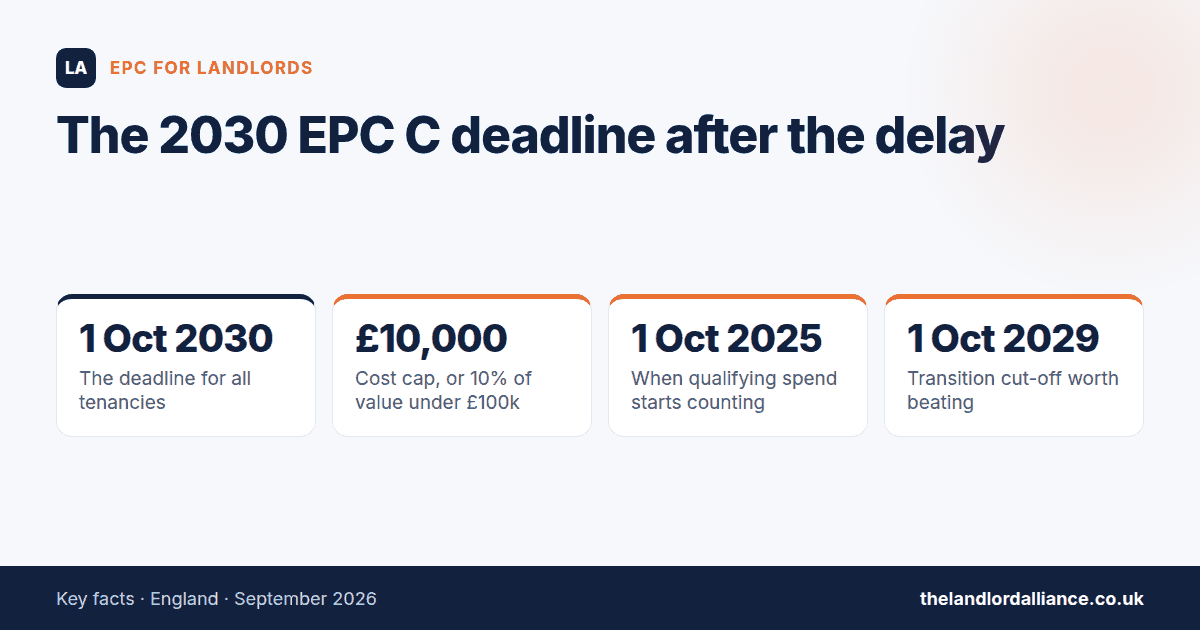
This policy has been announced, scrapped and reinstated, which is why landlords are sceptical of it. The current position is that it is confirmed: in January 2026 the government set a requirement for private rented homes in England and Wales to reach EPC C by 1 October 2030, with a £10,000 cost cap. Two details are worth acting on now rather than in 2029. Qualifying spending counts only from 1 October 2025, so work done before that date is not credited towards the cap. And a property reaching C before 1 October 2029 under the current methodology is treated as compliant until that certificate expires — potentially well into the 2030s.
Why landlords stopped believing it
An EPC C requirement was first proposed for new tenancies in 2025 and all tenancies in 2028. In September 2023 it was scrapped outright. A fresh consultation followed in February 2025, proposing 2028 for new tenancies and 2030 for all. The confirmed policy, announced in January 2026 alongside the Warm Homes Plan, consolidated that into a single deadline of 1 October 2030 with a £10,000 cap.
That history is a fair reason for caution, and a poor reason for inaction. The direction of travel has been consistent through three governments even when the dates moved, and the cost of leaving a solid-wall terrace until 2029 is that you will be competing for the same insulation contractors as everyone else who waited.
The transition rule worth using
Reach C before 1 October 2029 and you buy time. A property that achieves EPC C before that date under the current assessment methodology is treated as compliant for the life of that certificate — up to ten years from issue. Get a C-rated EPC issued in, say, mid-2029 and you are effectively compliant into 2039, whatever the reformed methodology would have said about the same building.
This matters because the EPC system itself is being reformed. The government has confirmed that new certificates will report four headline metrics — fabric performance, heating system performance, smart readiness and estimated energy cost — rather than a single score. A property that scrapes a C today may not score the same way under the new methodology, so an existing valid C is a genuinely valuable asset.
What it will take, by property type
| Property | Typical starting point | Realistic route to C |
|---|---|---|
| Post-2000 house or flat | C or better already | Usually nothing |
| 1930s–1980s cavity-wall semi | D | Cavity wall and loft insulation, modern boiler and controls. Often achievable for a few thousand pounds. |
| Victorian solid-wall terrace | D or E | The hard case. Fabric measures are expensive and disruptive; solar PV and low-carbon heating often do more per pound than wall insulation. |
| Purpose-built flat, electric heating | D or E | Constrained — you cannot alter the building fabric alone. Heating and controls upgrades, plus whatever the freeholder will permit. |
| Listed building or conservation area | E or below | Consent restrictions are real and are recognised in the exemptions framework |
| Park home or unusual construction | Varies | Assess individually; several exemptions may apply |
The cost cap in practice
You are not expected to spend unlimited amounts. The cap is £10,000 per property, reduced to 10% of the property’s value where that is under £100,000 — so a property worth £80,000 has an £8,000 cap. Once you have spent to the cap on qualifying improvements and the property still falls short, you can register an exemption.
Three practical consequences:
- Keep every invoice from 1 October 2025. Spending before that date does not count, and you will need documentary evidence to register an exemption later.
- Grants reduce what you pay, not what counts. Check the rules carefully before assuming grant-funded work counts towards your cap — see EPC grants.
- The cap is per property, not per portfolio. A ten-property portfolio with three hard cases faces the cap three times.
What this does to the numbers
For most landlords, a few thousand pounds spread over four years. For the owner of a solid-wall terrace, potentially £10,000 against a property producing perhaps £4,000 of net rent a year — which for a higher-rate taxpayer with a mortgage is the best part of a decade of net income. That is the calculation that will push some properties onto the market before 2030, and it belongs in your thinking now rather than in 2029.
The counter-argument, which is also real: energy efficiency work is not solely a compliance cost. It reduces void times, improves tenant retention, and directly reduces the damp and mould risk that is itself becoming a regulated hazard. Insulating a cold, mouldy flat solves two problems.
Read next
Is EPC C by 2030 confirmed?
Yes. It was confirmed as government policy in January 2026, with a deadline of 1 October 2030 and a £10,000 cost cap. The detailed regulations are still to be laid.
Was it not scrapped?
An earlier version was scrapped in September 2023. It was reconsulted on in February 2025 and confirmed in January 2026 on the current terms.
Do new and existing tenancies have different dates?
No. The confirmed position is a single deadline of 1 October 2030 for all tenancies, replacing the earlier proposal of 2028 for new lettings.
What if I reach C before 2029?
A property reaching C before 1 October 2029 under the current methodology is treated as compliant until that certificate expires — up to ten years. This is worth planning around.
What happens if I cannot reach C?
Spend up to the cap on qualifying improvements, then register an exemption on the PRS Exemptions Register with your evidence. An unregistered exemption does not protect you.
Will the EPC calculation itself change?
Yes. Reformed certificates will report four headline metrics instead of a single score, which is another reason a valid C achieved under the current system is worth having.
Sources. Energy Efficiency (Private Rented Property) (England and Wales) Regulations 2015; the February 2025 consultation on improving the energy performance of privately rented homes; the government’s confirmed response announced January 2026 alongside the Warm Homes Plan. Detailed regulations pending. Checked 8 September 2026.
Related: EPC rules · Compliance checklist · All guides